Home / Lumber papers and certificates / NHLA Inspection Reports for Hardwood Lumber: What a Graded-Lot Report Should Show
NHLA Inspection Reports for Hardwood Lumber: What a Graded-Lot Report Should Show
Reference page · Last reviewed 1 March 2027
An inspection report on hardwood lumber is only as useful as the fields on it. NHLA National Inspectors grade lots to the NHLA rules, and NHLA runs programs that put its name on a shipment or a mill. The public pages do not show a single certificate form, so a buyer should decide which fields it needs and ask the inspector for them in writing. This page lists the fields, the NHLA programs that exist and the red flags.
| Document or program | What it is | What it can tell a buyer |
|---|---|---|
| Inspection by an NHLA National Inspector | On-site grading and quality control by an NHLA employee, ordered per day | Grade of the sampled lot against the NHLA rules |
| Strap and Seal financial guarantee | Serial-numbered strap and seal with documented inspection, domestic shipments only | The shipment was inspected and the guarantee covers a value difference |
| Facility Grade (FG) certification | Voluntary third-party check of a company’s grading | The company’s grading is checked against the rules over time |
| Kiln Drying (KD) certification | Check of a company’s drying process and records | The drying process is documented and audited |
| Mill or third-party grade report | Report from a mill grader or an independent inspector | Only as reliable as the inspector and the fields shown |
NHLA programs and fees change. This page is general information as of October 2026. Confirm with NHLA.
Who does the grading
NHLA employs National Inspectors who grade lumber and run quality control checks on site. NHLA says the Chief Inspector oversees the rules so that the inspectors apply them consistently, and that its inspectors work with member companies in North America. The Inspector Training School teaches grading and is part of the National Hardwood Academy. A mill can also train its own graders there.
NHLA quotes inspection as a flat fee per day. Extra charges can apply for expedited service or for travel outside the inspector’s area. Agree in writing who pays and who may be present. Our guide to pre-shipment lumber grading covers how to set up a check before loading.
The NHLA programs
Strap and Seal. Bundles are strapped and sealed with serial numbers, which shows an official NHLA inspector inspected them and that the inspection is documented. NHLA states that it reimburses the buyer for the difference in value if a financially guaranteed shipment has a quality problem. The program is for domestic shipments only, so it does not help an export order.
Facility Grade certification. A voluntary program for NHLA members. Participants let a third party verify their grading, and certified companies may use the NHLA Certified designation. A company with this status is not a guarantee for a specific lot, but it shows that grading is checked.
Kiln Drying certification. NHLA describes it as a check of a company’s drying process and its documentation against industry standards, offered as a lower-cost alternative to an APHIS phytosanitary certificate for similar goals. If you import, ask your broker whether the destination accepts it. Read phytosanitary and fumigation rules before you rely on it.
Hardwood Vendor does not issue or hold any of these certificates and does not certify mills. Ask the mill for the original document and confirm it with NHLA.
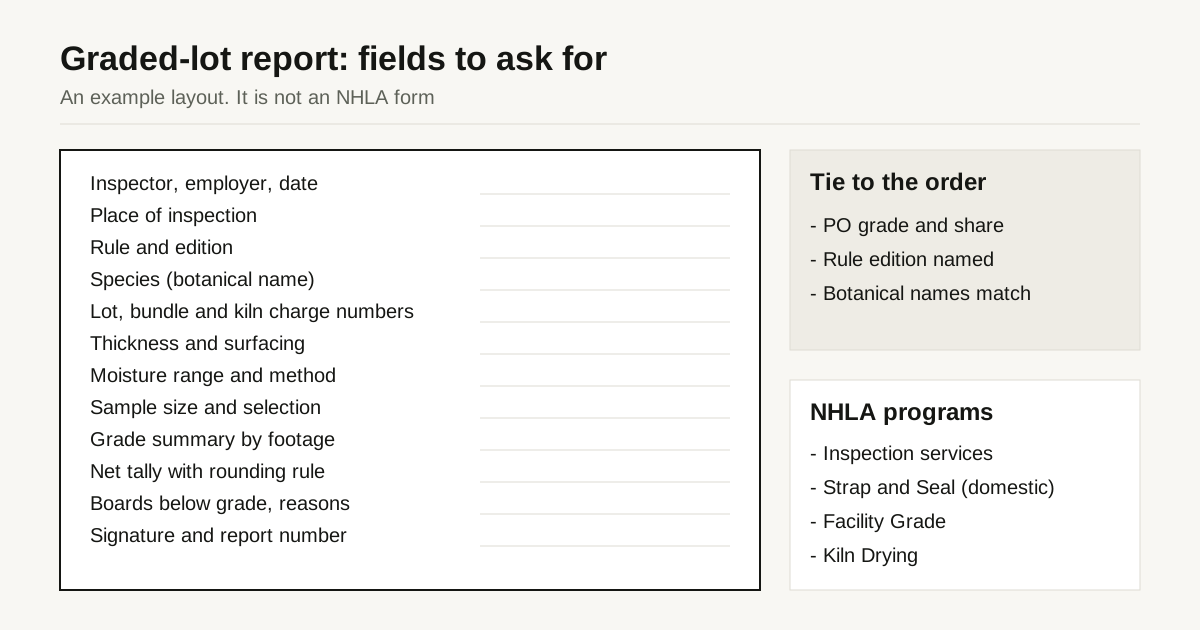
Fields a graded-lot report should show
| Field | Why it matters |
|---|---|
| Inspector name, employer and date of inspection | You know who graded and when |
| Place of inspection | At the mill, in the yard or at the port |
| Rule and edition | The grade is only defined against an edition of the NHLA rules |
| Species by botanical name | Matches the Lacey Act and CITES papers |
| Lot identification | Bundle numbers, kiln charge, shipment or order number |
| Thickness and surfacing | 4/4 rough, S2S and so on |
| Drying condition and moisture range | Kiln dried, air dried or green, with readings and method |
| Sample size | How many boards or bundles were graded and how they were chosen |
| Grade result | Grade summary by footage, such as share of FAS, Selects, No.1 Common |
| Tally | Board feet by grade, gross or net, with the rounding rule |
| Exceptions | Boards below grade, with reasons |
| Signature and report number | Lets you check it later |
Tie this to the order. If the PO says FAS 80 percent minimum with the rest Selects, the report must show the share of each, not a single overall statement. For tally layout see lumber tally sheet.
When to order an inspection
- First order from a new mill, before the container is loaded.
- A high-value species or thick stock where one grade difference matters.
- A repeat supplier whose last load had a claim.
- When the contract already names an NHLA inspector as the tie-breaker.
An inspection at origin helps most because a failed lot can be fixed before shipping. At destination it supports a claim. Read the lumber quality claim guide for how claims are usually handled.
Red flags
- A report with no rule edition.
- A grade stated with no sample size or no tally.
- A report from the seller’s own staff presented as independent.
- A Strap and Seal claim on an export shipment.
- An unsigned report, or one without a report number.
- A certificate that names the mill’s program but not the lot.
What to write on the RFQ
Name the inspector (mill grader, third party or NHLA), the timing (before loading), the rule edition and the fields you need on the report. Send your lumber RFQ and we pass it to up to 3 mills or yards that accept those terms.
RFQ line: Walnut (Juglans nigra), FAS and Selects, 5/4 rough, KD, graded to NHLA rules (edition named), third-party report before loading with sample size, grade summary by footage and net tally.
Frequently asked questions
Is there one standard NHLA inspection certificate form?
NHLA's public pages describe inspection services, a Strap and Seal program, Facility Grade certification and Kiln Drying certification. They do not publish a fixed certificate form that a buyer can ask for by name. Ask the inspector or NHLA what document goes with your inspection and list the fields you need.
Who can inspect a lumber shipment?
A buyer can ask the mill's own trained grader, a third-party inspector or an NHLA National Inspector. NHLA lists a flat fee of $920 per day for members and $1,380 per day for non-members in the US and Canada, with travel costs possible. The page carries no date, so confirm current fees.
What does the NHLA Strap and Seal cover?
NHLA describes serial-numbered straps and seals that show an official NHLA inspector inspected a shipment, with the inspection documented. If a financially guaranteed shipment has a quality problem, NHLA reimburses the buyer the difference in value. The program is for domestic shipments only.
Does an inspection report replace a phytosanitary certificate?
No. The two answer different questions. A grade report says what the lumber is. A phytosanitary certificate says the shipment meets plant health requirements. NHLA's Kiln Drying certification is described as a lower-cost alternative to an APHIS phytosanitary certificate for similar goals, so confirm whether your destination accepts it.
Sources
- NHLA: inspection services (on-site inspection, flat daily fee, expedited and travel charges)
- NHLA: National Inspectors and Inspector Training School
- NHLA: certification programs (Strap and Seal, Facility Grade, Kiln Drying)
- NHLA: grading rules (rules overseen and reviewed every four years)
Standards and rules are cited as references, not as claims about Hardwood Vendor or any mill. Editions and status change: confirm with the issuing body, your customs broker or the regulator.
Know what you need? Send the spec.
Tell us the species, grade, thickness and board feet. We pass it to up to 3 mills or yards that carry it and reply within 24 business hours.
Send my lumber RFQMore in lumber papers and certificates
- Lacey Act Declaration (PPQ 505) for Hardwood Lumber, Field by Field
- FSC Certified Hardwood Lumber: Certificate Codes, Claims and Scope
- Testing Lumber Moisture: Oven-Dry, Resistance and Capacitance Methods
- Kiln Drying Quality: Moisture Spread, Gradient and Case Hardening Checks
- Hardwood Lumber Import Documents: The Set an Importer Should Receive
- CITES Permits for Timber: Export, Import and Re-export Steps