Home / Lumber papers and certificates / FSC Certified Hardwood Lumber: Certificate Codes, Claims and Scope
FSC Certified Hardwood Lumber: Certificate Codes, Claims and Scope
Reference page · Last reviewed 25 February 2027
FSC certified hardwood lumber has to pass three checks, and a certificate alone passes only the first. The mill’s certificate must be valid, the lumber must fall inside its product scope, and the invoice must carry the right claim with the seller’s certificate code. Then, separately, you decide what the claim does and does not prove for your own legal duties.
| Check | What to look at | Where |
|---|---|---|
| 1. Certificate | Holder name, certificate code, status, validity dates | FSC certificate database (info.fsc.org) |
| 2. Scope | Product groups the holder may sell with a claim, and any site or species notes | The certificate and its product schedule |
| 3. Invoice claim | The exact claim wording and the seller’s code on invoice and shipping documents | Commercial invoice, packing list, bill of lading |
| 4. Legal papers | Lacey Act, EUDR and CITES data are separate | See the linked pages below |
FSC standards and wording change. This page is general information as of October 2026. Confirm the current standard and claims with the certification body.
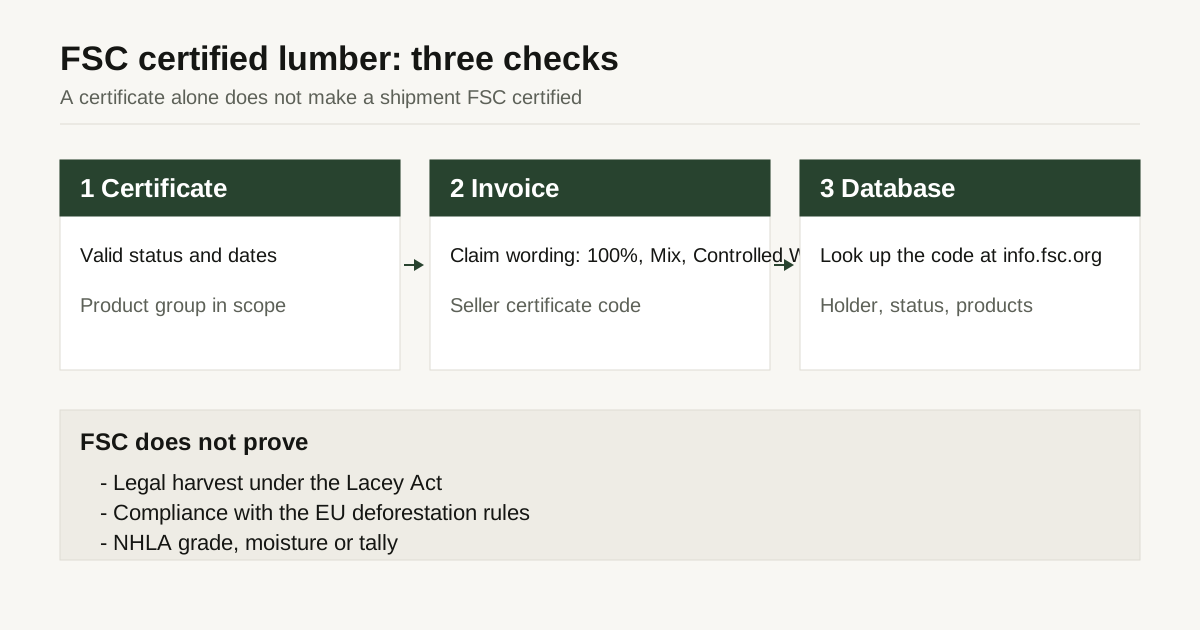
The certificate: what it says and what it does not
A chain of custody certificate names the company, lists the sites it covers and gives the product groups it is certified to sell, such as sawn timber. It also carries a registration code and a license code in the form FSC-C followed by digits. The code on the invoice is the one you look up.
A certificate sample carries a notice that the products supplied are covered only when the required FSC claim is clearly stated on invoices and shipping documents. That is the central point for a buyer. A mill can hold a valid certificate and still sell you uncertified lumber on an invoice with no claim. In that case the lumber is not FSC lumber.
The chain of custody standard that sets these rules is FSC-STD-40-004. Version 3-1 took effect on 1 September 2021 with a transition that ended on 31 December 2022. Ask the certification body or check the FSC document center for the version now in force.
The claim on the invoice
| Claim | What it means | Notes for lumber buyers |
|---|---|---|
| FSC 100% | All wood comes from FSC certified forests | No mixing with other inputs |
| FSC Mix (percentage or credit) | Certified material mixed with reclaimed material and, up to a limit, Controlled Wood | A percentage claim states the share. A credit claim is accounted over time |
| FSC Recycled | Reclaimed material only | Unusual for sawn virgin hardwood |
| FSC Controlled Wood | Not FSC certified. Wood from sources assessed as low risk in FSC categories such as illegal harvesting and conversion of forest | Sold only in the forms FSC allows, and to FSC certified customers |
Two practical points. First, the invoice is what counts. If the invoice says FSC Mix 70% and you pass the lumber on, the claim you can make downstream depends on that percentage. Second, Controlled Wood claims may appear on sales documents only for raw or semi-finished products and only when the customer is FSC certified. A cabinet shop without its own certificate cannot buy Controlled Wood with a claim.
The claim wording is not interchangeable with other schemes. A product sold with an FSC claim on the sales document does not carry labels from another certification scheme, so a mill selling the same lumber as PEFC or SFI must keep the claims apart.
Checking a code
- Ask the mill for its certificate code before you order and again on every invoice.
- Enter the code in the FSC database. The record shows whether the certificate is valid and what the holder may sell.
- Match the species and product on the record to your order. Where a species list or product schedule is attached, the lumber must be in it.
- Check that the name on the invoice is the certificate holder. A trader may hold its own certificate. The mill’s certificate does not cover the trader’s sales.
- Keep the invoice, the record printout and the date you checked.
A certificate can be suspended or end. Check again for repeat orders, not just the first one.
What FSC does not prove
- Lacey Act. The Lacey Act declaration and the legality of the harvest are separate from chain of custody. See the Lacey Act declaration page.
- EU deforestation regulation. FSC says that its certification does not replace due diligence, though it can strengthen the evidence. The importer’s duties under the EUDR remain.
- CITES. A CITES-listed species still needs its permit. See CITES permits for timber.
- Grade or moisture. FSC says nothing about NHLA grade, drying or tally. A grade report does. See NHLA grades.
What a mill can say about itself
Hardwood Vendor does not hold or issue any certificate and does not certify mills. Ask the mill for its original certificate and check it in the FSC database yourself. The same goes for SFI and PEFC, which are separate schemes with their own databases and claims.
What to write on the RFQ
- The claim you need: FSC 100%, FSC Mix with a minimum percentage, or none.
- The certificate code on the quotation and on every invoice.
- A statement that the supplier will send the certificate and product schedule before the order is confirmed.
- A clause that lets you reject lumber that arrives without the claim on the invoice.
Send your lumber RFQ with the claim you need and we pass it to up to 3 mills or yards that say they can supply it.
RFQ line: White oak (Quercus alba), FAS, 8/4, KD 6-8%, FSC 100% claim and certificate code on invoice, certificate copy before order.
Frequently asked questions
Is a mill's FSC certificate enough to call the lumber FSC certified?
No. A certificate shows that the company is certified and lists the product groups in its scope. A shipment counts as FSC certified only when the invoice and shipping documents carry the right claim and the seller's certificate code.
What is the difference between FSC 100%, FSC Mix and FSC Controlled Wood?
FSC 100% comes entirely from FSC certified forests. FSC Mix combines certified material with reclaimed material or Controlled Wood. FSC Controlled Wood is not FSC certified: it is wood assessed as low risk against five listed categories, and it can be sold only in the forms and to the customers FSC allows.
How do I check a certificate?
Enter the certificate code or license code from the invoice in the FSC certificate database at info.fsc.org. The record shows the status, the validity dates and the products in scope. Check that the product, the species where listed, and the claim on the invoice match.
Does FSC certification show that the lumber is legal under the Lacey Act or the EU deforestation regulation?
No. FSC states that certification does not replace due diligence. It can be useful evidence in a due diligence file, but the importer still files the declarations and carries the legal duty.
Sources
- FSC: what do the FSC labels mean (100%, Mix, Recycled)
- FSC: Mix label and Controlled Wood
- FSC-STD-40-004 V3-0 Chain of Custody Certification (claims on invoices, percentage and credit systems)
- FSC UK: chain of custody standard V3-1 effective date postponed to 1 September 2021, transition extended
- FSC and EUDR (certification does not replace due diligence)
- FSC Global certificate database
Standards and rules are cited as references, not as claims about Hardwood Vendor or any mill. Editions and status change: confirm with the issuing body, your customs broker or the regulator.
Know what you need? Send the spec.
Tell us the species, grade, thickness and board feet. We pass it to up to 3 mills or yards that carry it and reply within 24 business hours.
Send my lumber RFQMore in lumber papers and certificates
- Lacey Act Declaration (PPQ 505) for Hardwood Lumber, Field by Field
- Testing Lumber Moisture: Oven-Dry, Resistance and Capacitance Methods
- NHLA Inspection Reports for Hardwood Lumber: What a Graded-Lot Report Should Show
- Kiln Drying Quality: Moisture Spread, Gradient and Case Hardening Checks
- Hardwood Lumber Import Documents: The Set an Importer Should Receive
- CITES Permits for Timber: Export, Import and Re-export Steps