Home / Lumber papers and certificates
Hardwood Lumber Papers, Certificates and Test Reports by Buyer Type
Reference hub · Last reviewed 20 October 2026
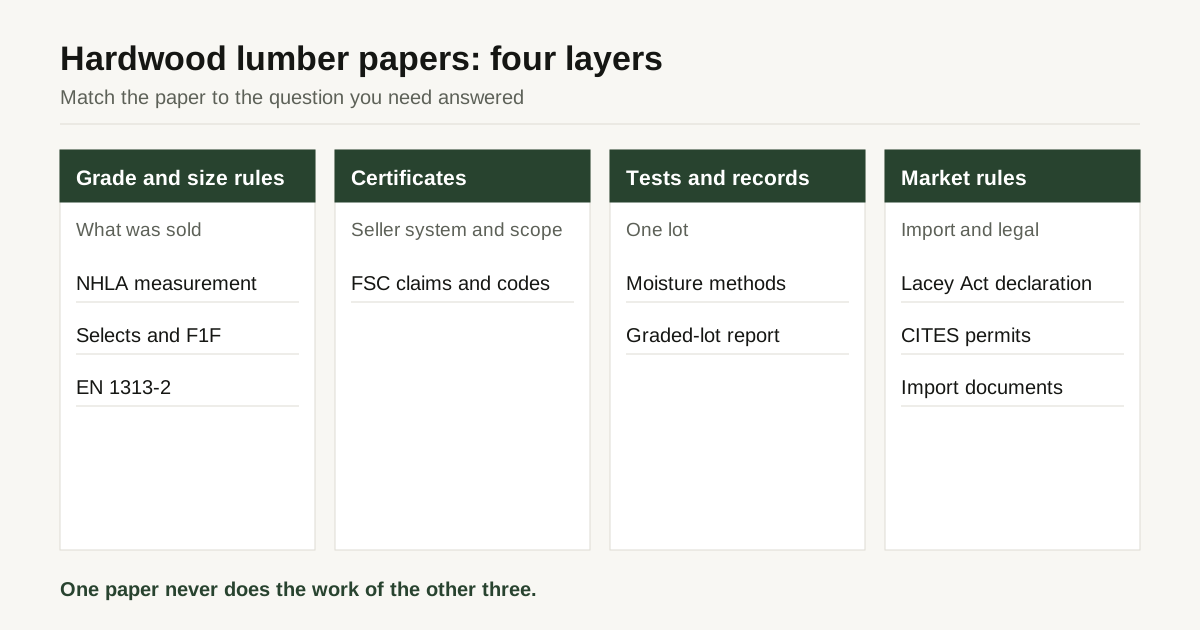
A hardwood lumber order is backed by four kinds of paper: a grade rule that defines what was sold, a certificate that says something about the seller’s system, a test or inspection record for one lot, and the import papers for the market. Which ones matter depends on who is buying and where the lumber goes. This page maps each buyer type to the standards, certificates, records and market rules that usually apply, and links to the detail pages.
| Paper | Issued by | About | Cannot tell you |
|---|---|---|---|
| Grade rule and grade report | A rule body (NHLA) and the grader or inspector | One lot against a named rule and edition | Legal origin, drying quality unless measured |
| Certificate (FSC, SFI, ISO 9001) | A certification body | The seller’s system and product scope | The grade or moisture of the lot you are buying |
| Test and inspection record | Mill, laboratory or inspector | Moisture, tally and condition of the lot | The same for the rest of the shipment unless sampled well |
| Import and legal papers | Authorities and the importer | Species, origin, permits | Quality |
Buyer type by paper matrix
Standards are named as families. A “check” mark means the number or edition should be confirmed with the issuing body before use. Hardwood Vendor does not hold or issue any of these papers.
| Buyer type | A. Grade and size rules | B. Certificates | C. Tests and records | D. Market rules |
|---|---|---|---|---|
| Cabinet and millwork shops | NHLA FAS, Selects and F1F, No.1 Common, NHLA measurement rules, surfacing codes (S2S) | FSC, SFI or PEFC chain of custody only when the end customer asks | Kiln-dried moisture (ASTM D4442, EN 13183), kiln drying checks, graded-lot report, tally | Lacey Act declaration, CITES if the species is listed |
| Furniture plants | Grade by part, Selects and F1F, dimension stock specifications | FSC Mix or Controlled Wood claim on the invoice | Moisture spread across a kiln charge (EN 14298, check), photos, tally | Lacey Act, EUDR for EU-bound goods |
| Flooring stock mills | NWFA and NOFMA grade names, EN 14342 for CE marking (check scope) | FSC or SFI if the customer requires | Moisture, bundle tally | Lacey Act, solid wood versus formaldehyde rules |
| EU and UK importers | EN 975-1 appearance grades, EN 1313-2 size deviations, EN 13556 timber names | FSC or PEFC claims (not proof for EUDR) | Phytosanitary certificate, origin certificate, kiln record | EUDR, CITES import permit for Annex B species, plant health rules |
| Sawmills and yards (suppliers) | NHLA inspector training and grade control | SFI chain of custody steps, FSC, ISO 9001 | Quality control plan, plant health papers, kiln charts | Lacey supplier records, CITES permits |
Pages in this library
Grade and size rules live under lumber grades and size rules:
- NHLA measurement rules: surface measure, board feet, rounding and tally.
- Selects and F1F lumber: when one clear face is enough.
- EN 1313-2 deviations: European size rules and how they differ from NHLA quarters.
- EN 13556 timber names: trade names and four-letter codes on European quotes.
- Flooring stock grades: NWFA and NOFMA names, lengths and the EN 14342 note.
- Dimension stock specifications: cut size, face rules and yield math.
Papers, certificates and records are on this hub:
- Lacey Act declaration (PPQ 505): the four data fields for US imports.
- CITES permits for timber: export, import and re-export steps.
- FSC certified hardwood lumber: certificate codes, claims and scope.
- Moisture test methods: oven-dry, resistance and capacitance.
- NHLA inspection reports: what a graded-lot report should show.
- Import documents checklist: the set an importer should receive.
- Kiln drying quality checks: lot average, spread, gradient and case hardening.
- SFI and PEFC certified lumber: claims, labels and how they compare with FSC.
- ISO 9001 at a sawmill or yard: what a buyer can read from the certificate.
- Certificate of origin for lumber: customs origin, preference proofs and harvest country.
- Phytosanitary certificate for exporters: who issues it and what it states.
- Solid lumber and TSCA Title VI: what the US formaldehyde rule covers and what it names as excluded.
For mills and yards:
- SFI chain of custody for a sawmill: steps, records and audits.
- NHLA inspector training and in-house grading control: training routes, Facility Grade and an audit routine.
- A quality control plan for a hardwood mill: seven control points, records and a buyer summary.
- Lacey Act records a supplier gives its importer: shipment sheet, purchase records and a statement layout.
How to use the papers in an order
- Write the grade rule and edition, then the botanical name and thickness, on the RFQ.
- Choose the certificate only if your customer or market asks for it, and write the claim and code.
- Name the moisture target, the method and the sampling.
- List the import papers with a date for each.
- Check each original with the issuing body. A copy sent by the mill is a start, not a check.
When the order is ready, send your lumber RFQ and we pass it to up to 3 mills or yards that carry your species, grade and thickness and say they can supply the papers. They reply to you directly.
Detail pages
- Lacey Act Declaration (PPQ 505) for Hardwood Lumber, Field by FieldThe US Lacey Act import declaration for lumber: what the four data fields are, who files, the 2026 end of paper PPQ 505, and what to get from the mill.
- FSC Certified Hardwood Lumber: Certificate Codes, Claims and ScopeHow to buy FSC certified hardwood lumber: read the certificate code and product scope, the invoice claim (100%, Mix, Controlled Wood) and what FSC does not prove.
- Testing Lumber Moisture: Oven-Dry, Resistance and Capacitance MethodsLumber moisture content test methods compared: oven-dry reference (EN 13183-1, ASTM D4442), resistance and capacitance meters, ISO 13061-1, and what to write in a contract.
- NHLA Inspection Reports for Hardwood Lumber: What a Graded-Lot Report Should ShowNHLA inspection certificate explained: who inspects, the Strap and Seal, Facility Grade and KD programs, the fields a graded-lot report needs and red flags.
- Kiln Drying Quality: Moisture Spread, Gradient and Case Hardening ChecksChecks for kiln dried hardwood: lot average and spread against EN 14298, moisture gradient, the prong test for case hardening and the fields a KD record needs.
- Hardwood Lumber Import Documents: The Set an Importer Should ReceiveChecklist of the documents an importer should receive with a hardwood lumber shipment: invoice, tally, bill of lading, plant health, origin, Lacey and EUDR data, CITES, KD record and grade report.
- CITES Permits for Timber: Export, Import and Re-export StepsHow CITES permits work for hardwood timber: Appendix I, II and III, the export permit, the EU import permit, validity, source codes, US ports and CoP20 changes.
- SFI and PEFC Certified Hardwood Lumber: Claims, Labels and How They Compare with FSCHow SFI and PEFC chain of custody claims work on hardwood lumber invoices, how they differ from FSC, which labels say what and where to verify a certificate.
- ISO 9001 at a Hardwood Sawmill or Yard: What a Buyer Can Read From the CertificateWhat an ISO 9001 certificate tells a lumber buyer about a sawmill or yard: scope, the clauses behind grading and tally, what it cannot prove, and how to verify it.
- SFI Chain of Custody for a Hardwood Sawmill: Steps, Records and AuditsSteps for a hardwood sawmill or yard to get SFI chain of custody certified: choose a method, set up records, pass the audit and put the claim on invoices.
- NHLA Inspector Training and In-House Grading Control at a Hardwood MillHow a hardwood mill can train its graders and control grading in-house: NHLA Inspector Training School, Facility Grade, an internal audit routine and a buyer note.
- Certificate of Origin for Hardwood Lumber: Non-Preferential Certificates and Tariff Preference ProofsA certificate of origin for hardwood lumber: who issues it, how it differs from preference proofs such as EUR.1, REX and USMCA, and from the harvest country.
- Phytosanitary Certificate for Lumber Exporters: Who Issues It and What It StatesWhat a phytosanitary certificate for lumber exports states under ISPM 12: its fields, additional declaration, treatment and validity, and how a US exporter applies.
- Lacey Act Records a Lumber Supplier Gives Its ImporterThe records a hardwood mill or yard gives a US importer for the Lacey Act: per-shipment data, purchase records, a supplier statement layout and how long to keep them.
- Is Solid Hardwood Lumber Covered by the TSCA Title VI Formaldehyde Rules?Does the US TSCA Title VI formaldehyde rule cover solid hardwood lumber? Scope of 40 CFR 770, named exclusions, edge-glued blanks and what to ask your broker.
- A Quality Control Plan for a Hardwood Mill: Grade, Moisture and Loading ChecksA quality control plan template for a hardwood sawmill or yard: seven control points, what to record, written limits, a claims log and a one-page buyer summary.
Frequently asked questions
Is a certificate the same as a grade report or an import paper?
No. A certificate such as FSC is an independent body's statement about a company's system. A grade report says what one lot is against a named rule. A moisture record says how dry it was. An import paper such as the Lacey Act declaration or a CITES permit is a customs or legal document. They answer different questions and do not substitute for each other.
Which papers do I ask a hardwood mill for first?
Start with the grade rule and edition, the botanical name of every species, the moisture target and method, and the harvest country. Then add the certificate or permit your market requires, such as an FSC claim, a CITES permit or Lacey Act data.
Does Hardwood Vendor issue or hold any of these certificates?
No. Hardwood Vendor is a matching service. It does not grade lumber, issue certificates or certify mills. Ask the mill for the original document and check it with the issuing body.
Sources
- 40 CFR part 770: formaldehyde standards for composite wood products (scope in 770.1 and 770.3)
- NHLA: grading rules (four-year review cycle)
- APHIS: File a Lacey Act declaration (paper PPQ 505 ended 1 January 2026)
- FSC: what do the FSC labels mean
- 50 CFR 23.73: international trade in CITES timber
- EVS-EN 13183-1:2002 moisture content of a piece of sawn timber, oven-dry method
- BSI: BS EN 1313-2:1999 hardwood sawn timber, permitted deviations and preferred sizes
Standards and rules are cited as references, not as claims about Hardwood Vendor or any mill. Editions and status change: confirm with the issuing body, your customs broker or the regulator.
Know what you need? Send the spec.
Tell us the species, grade, thickness and board feet. We pass it to up to 3 mills or yards that carry it and reply within 24 business hours.
Send my lumber RFQ