Home / Lumber papers and certificates / A Quality Control Plan for a Hardwood Mill: Grade, Moisture and Loading Checks
A Quality Control Plan for a Hardwood Mill: Grade, Moisture and Loading Checks
Reference page · Last reviewed 24 March 2027
A quality control plan is a table, not a binder. For each point where a hardwood mill can lose quality, it says who checks, how often, against what written limit, what record is left and what happens when the check fails. A buyer who reads a mill’s plan can see how its grading, drying, tally and loading are kept honest, which a certificate alone does not show. This page gives a seven-point layout a sawmill or yard can fill in and a one-page summary it can send with a quotation.
| # | Control point | Check | Written limit (example) | Record |
|---|---|---|---|---|
| 1 | Receive | Species and source of logs or green lumber | Species named on the delivery ticket, origin on file | Receiving log |
| 2 | Sort | Thickness, width and species sort | Sort sheet matches the order | Sort sheet |
| 3 | Grade | Re-grade of a sample against the named rule | Difference between line grade and audit grade logged | Grade audit log |
| 4 | Dry | Kiln charge moisture sample, spread and stress | Target range and spread stated for the order | Kiln record |
| 5 | Tally | Piece count and measure against the tally | Tally and bundle agree | Tally check sheet |
| 6 | Load | Bundles, strapping, container condition, securing | Loading sheet signed before sealing | Loading sheet and photos |
| 7 | Claims | Each complaint logged and traced to a cause | Closed with a cause and a fix | Claims log |
The limits in the table are examples. Each mill writes its own, and the buyer’s contract overrides them. This page is general information as of October 2026. Confirm any standard edition with the standards body before you cite it.
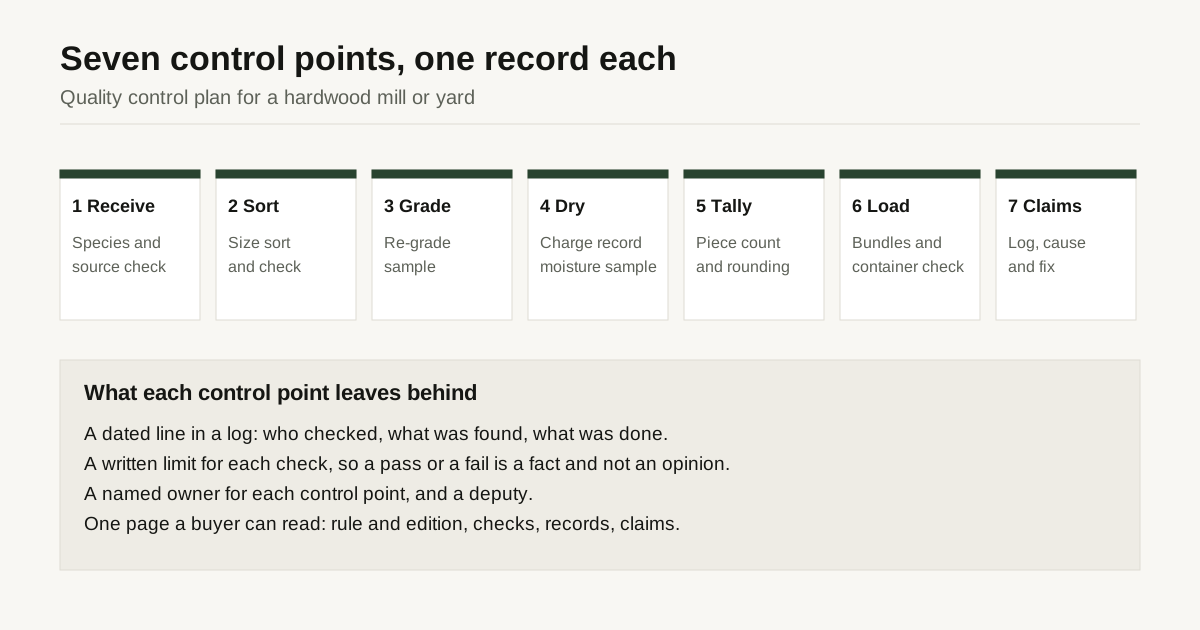
How to build the plan
- List the points where a lot can change in quality between the log yard and the container.
- For each, write the check in one sentence.
- Write a limit that someone can read as pass or fail.
- Name an owner and a deputy.
- Decide the record: a log line, a sheet or a photo.
- Write what happens on a fail: hold, re-sort, re-dry, replace.
- Test the plan on one real lot and fix what is unclear.
A mill with ten staff can run this on one page per control point. Keep each page short enough that the owner reads it before the shift.
1. Receive
What comes in decides what can go out. Log or green lumber receiving checks the species against the delivery ticket, the source against the purchase record and the condition (stain, splits, metal). The source record also feeds the origin file for a US importer: see Lacey Act records a supplier gives its importer.
Record: date, supplier, species, volume, source, who checked, any rejection.
2. Sort
A sort sheet ties what was sawn to what was ordered: species, thickness in quarters, width and length sorts. The sheet is the base for the later tally. Sorting errors are cheap to fix at the sorter and costly after drying.
Record: sort sheet with lot number and date.
3. Grade
Grading is the check buyers care about most. The plan names the rule and edition (NHLA reviews its rules on a four-year cycle, so the edition belongs in the contract), who grades and how often a second person re-grades a sample. Our page on NHLA inspector training and in-house grading control describes the audit routine in detail. For the plan itself, the point is to put in the table:
- the sample size in pieces, fixed in advance
- how a difference is recorded and what size of difference triggers action
- what happens to a lot that fails: re-grade the lot, re-sort or tell the customer
Record: grade audit log. An outside check, such as an NHLA inspection before shipment, adds a third-party view: see NHLA inspection reports.
4. Dry
Drying is where one number is not enough. The plan states the target moisture range for each order, the method (oven-dry reference per EN 13183-1 or ASTM D4442, or a calibrated meter per ASTM D4444), the sample taken from each charge and the spread allowed between pieces. Kiln drying quality checks covers average, spread, gradient and the prong test, and moisture test methods covers the methods. Meters need a check against a reference on a schedule, with the date written on the meter’s record.
Record: kiln charge number, schedule, sample readings, test sheet.
Moisture does not stop at the kiln door. The Wood Handbook explains that wood settles toward the moisture content that matches the surrounding air, so kiln-dried stock left in a damp yard or a wet container gains water. The plan should say where dried lumber is stored and how long.
5. Tally
The tally decides the invoice. The check is simple: someone other than the person who wrote the tally counts the pieces in a sample of bundles, measures them and compares the result with the sheet and the rounding rule. Our page on NHLA measurement rules explains the rounding rule, and the guide to a lumber tally sheet shows what the sheet carries.
Record: tally check sheet with bundle numbers, count, difference and signature.
6. Load
Loading is the last place to lose a lot. The plan covers the container or truck condition before loading (dry, clean, no holes, no taint), the bundle count against the packing list, protection against rain, strapping and chocks and a photo set. The IMO, ILO and UNECE CTU Code (MSC.1/Circ.1497) is the common reference for packing cargo transport units, and it warns that poor packing, blocking or lashing can injure people and damage cargo. Friction alone is not treated as enough to secure heavy cargo. Our guide to container loading, bundles and tally shows a buyer-side view.
Record: loading sheet with container number, seal number, bundle list, time and photos. Our note on lumber photos for buyers lists the set that settles most questions.
7. Claims
A claim is data. The plan keeps a log with the date, the customer, the lot, what was reported, the evidence, the finding, the cause and the fix, and it checks whether the cause points back to one of the six control points above. Compare the log with the audit records quarterly. A claim that closes with a cause and a changed procedure is worth more to a buyer than a claim that closes with a credit and nothing else. The buyer-side process is in lumber quality claim and inspecting a hardwood lumber delivery.
Record: claims log with status and closing date.
Where ISO 9001 fits
The plan is not a certificate. ISO 9001 does ask for the things a plan contains: documented control of production, monitoring and measuring resources, identification and traceability, release of products, control of nonconforming outputs, handling of complaints and corrective action. A mill that runs this plan has most of the paper an auditor asks for. ISO 9001:2026 was published on 16 September 2026, with a transition period reported to run to 30 September 2029. See ISO 9001 at a sawmill or yard for what the certificate shows a buyer and what it does not.
A one-page buyer summary
A buyer summary comes from the plan and does not replace it. Include:
| Section | Content |
|---|---|
| Grade | Rule and edition, who grades, how often a second person re-grades |
| Moisture | Target range, method, sample per charge, meter check |
| Tally | Unit, rounding rule, who checks |
| Loading | Container check, securing, photos, seal number |
| Failed lot | What the mill does and what it tells the customer |
| Claims | How to report, how long to reply, who answers |
Do not add an accuracy figure unless the mill measured it, and say how. A number without a method is worse than none.
What a mill can say about itself
Hardwood Vendor does not audit mills, run quality systems or hold any certificate. It matches buyer requests with mills and yards that say they can meet them. A mill that says it has a quality control plan should show the plan page for one control point, with names removed.
What to write on the RFQ
- The grade rule and edition, and whether an independent check is required before shipment.
- The moisture range, the method and the sample per kiln charge.
- The tally unit and rounding rule, and a tally check before loading.
- Photos of bundles and the container before sealing.
- A claims window and a named contact for claims.
Mills and yards with a plan can register as a supplier. Buyers can send a lumber RFQ with these checks written in, and we pass it to up to 3 mills or yards that say they can meet them.
RFQ line: Hard maple (Acer saccharum), No.1 Common, 4/4, KD 6-8% by oven-dry reference on a sample from each charge, NHLA rules edition named, tally checked before loading, container photos before sealing.
Frequently asked questions
What is a quality control plan for a sawmill?
A short document that lists each point where the mill checks its own work, who checks it, how often, what the written limit is, what record it leaves and what happens when a check fails. For a hardwood mill the points usually run from receiving to the claims log.
Does a quality control plan need ISO 9001?
No. A mill can run a plan without any certificate. ISO 9001 asks for documented control of production, monitoring and measuring resources, nonconforming outputs and corrective action, which a good plan already contains. ISO 9001:2026 was published on 16 September 2026, with a transition period reported to 30 September 2029.
How many samples should a mill check?
The mill decides and writes it down, because no single number fits every species, thickness and customer. Name the sample size in pieces for each check, apply it the same way every time and let a buyer's contract override it. For moisture, ASTM D4442 and EN 13183 describe the methods, and the sampling is agreed in the contract.
What should a buyer summary of the plan contain?
One page: the grade rule and edition, who grades, the checks done before shipment, the moisture method, how the load is secured, what the mill does with a failed lot and how a claim is handled. No accuracy figure unless the mill measured it.
Sources
- NHLA: grading rules (four-year review cycle; rulebook edition named in the contract)
- NHLA: certification programs (Facility Grade, Strap and Seal, Kiln Drying)
- ASTM D4442: direct moisture content measurement of wood and wood-based materials (D4442-20, reapproved 2025)
- ASTM D4444: laboratory standardization and calibration of hand-held moisture meters (D4444-25)
- EVS-EN 13183-1:2002 moisture content of a piece of sawn timber, oven-dry method
- EVS: EN 14298:2017 sawn timber, assessment of drying quality
- USDA Forest Service: Wood Handbook chapter 4, moisture relations and physical properties of wood (equilibrium moisture content)
- IMO MSC.1/Circ.1497: IMO/ILO/UNECE Code of Practice for Packing of Cargo Transport Units (CTU Code), 16 December 2014
- LRQA: ISO 9001:2026 is live, the transition period has begun (16 September 2026, transition to 30 September 2029)
Standards and rules are cited as references, not as claims about Hardwood Vendor or any mill. Editions and status change: confirm with the issuing body, your customs broker or the regulator.
Know what you need? Send the spec.
Tell us the species, grade, thickness and board feet. We pass it to up to 3 mills or yards that carry it and reply within 24 business hours.
Send my lumber RFQMore in lumber papers and certificates
- Lacey Act Declaration (PPQ 505) for Hardwood Lumber, Field by Field
- FSC Certified Hardwood Lumber: Certificate Codes, Claims and Scope
- Testing Lumber Moisture: Oven-Dry, Resistance and Capacitance Methods
- NHLA Inspection Reports for Hardwood Lumber: What a Graded-Lot Report Should Show
- Kiln Drying Quality: Moisture Spread, Gradient and Case Hardening Checks
- Hardwood Lumber Import Documents: The Set an Importer Should Receive