Home / Lumber papers and certificates / ISO 9001 at a Hardwood Sawmill or Yard: What a Buyer Can Read From the Certificate
ISO 9001 at a Hardwood Sawmill or Yard: What a Buyer Can Read From the Certificate
Reference page · Last reviewed 13 March 2027
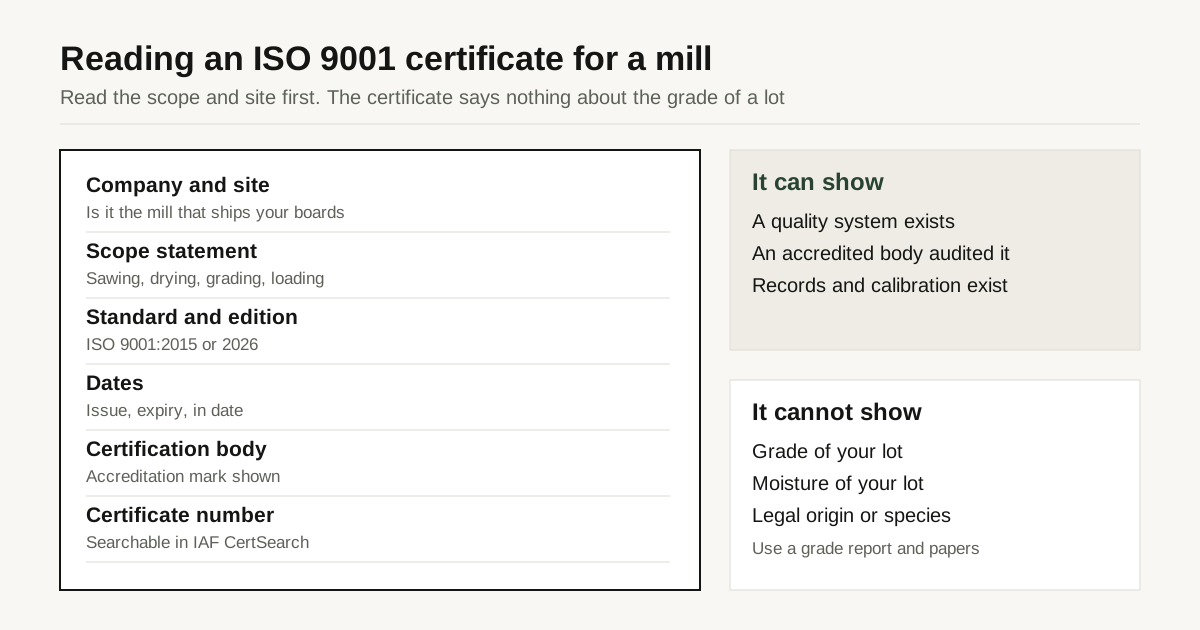
An ISO 9001 certificate says that an independent body audited a company’s quality management system against ISO 9001 and found it conforming within a stated scope. It does not say the lumber is good. For a hardwood buyer, the useful questions are: does the scope cover the site and the activities that make my lumber, is the certificate current and issued by an accredited body, and which parts of the system touch grading, drying and tally.
| Read on the certificate | What to look for | Red flag |
|---|---|---|
| Company and site | The address of the sawmill or yard that ships your boards | Head office only, or a different site |
| Scope statement | Sawing, drying, grading, sorting, loading of hardwood lumber, or the product you buy | Design, trading only, or an unrelated product |
| Standard and edition | ISO 9001:2015 or ISO 9001:2026 | No edition, or an old standard |
| Issue and expiry dates | Current, inside the dates | Expired, or issue date far in the past without recertification |
| Certification body and accreditation mark | A named body with an accreditation body mark | No accreditation mark, or an unknown body |
| Certificate number | A number that can be searched | No number, or a number that does not match the record |
This page is general information as of October 2026. The certification body is the authority on the dates and rules that apply to your supplier.
Where ISO 9001:2026 stands
ISO 9001:2026 was published on 16 September 2026. LRQA reports a transition period that ends on 30 September 2029, after which ISO 9001:2015 certificates expire or are withdrawn, and says the current certificate stays valid during the transition. Its summary of the changes mentions stronger requirements for quality culture, separate treatment of risks and opportunities, stronger change management and a short set of terms and definitions. NSF published a similar summary on the publication date.
For a buyer this means two things in the next three years. A supplier may show either an ISO 9001:2015 or an ISO 9001:2026 certificate, and both can be valid. And clause numbers used below refer to the 2015 edition. The 2026 edition may number clauses differently, so use the clause names when you ask a question.
The clauses behind grading, drying and tally
ISO 9001 does not mention lumber. A mill applies its requirements to its own processes. The table maps the parts of the 2015 edition to the places where a buyer cares most.
| Topic in ISO 9001:2015 | Clause | What it means at a sawmill or yard | What to ask |
|---|---|---|---|
| Monitoring and measuring resources | 7.1.5 | Moisture meters, scales and measuring tools checked against a reference | When was each meter last checked, against what, with what record |
| Competence | 7.2 | Graders, kiln operators and loaders trained for the work | Who grades, what training, what refresher |
| Externally provided products | 8.4 | Control of log, green lumber and kiln-dried lumber suppliers | How the mill checks species and origin of what it buys |
| Production control | 8.5.1 | Written methods for sawing, drying, grading and loading | Is there a written grade check at the end of the line |
| Identification and traceability | 8.5.2 | Bundle numbers, kiln charge numbers, lot labels | Can the mill trace a bundle back to its kiln charge |
| Release of products | 8.6 | A check before shipment | What is checked before a container is sealed |
| Nonconforming outputs | 8.7 | Handling of boards below grade or above moisture | Where do rejected boards go and who decides |
| Customer satisfaction | 9.1.2 | Tracking complaints and claims | Is there a claims log |
| Corrective action | 10.2 | Fixing causes after a claim | Can the mill show one closed claim with the cause |
The questions in the last column are not ISO requirements. They are ways to turn a certificate into evidence about the part of the system you care about. Our page on a lumber quality claim shows how claims move between buyer and mill.
What ISO 9001 does not prove
- Grade accuracy. The standard does not contain NHLA rules or any grading rule. A graded-lot report from an NHLA inspector does. See NHLA inspection reports and our guide to pre-shipment lumber grading.
- Moisture of the lot you buy. The certificate does not measure your boards. Moisture is a test on the lot. See lumber moisture test methods.
- Legal origin and species. ISO 9001 is not a chain of custody or a legality scheme. See FSC certified hardwood lumber and the Lacey Act declaration page.
- Product quality in general. A certified mill can run a weak process inside a conforming system. The certificate shows that the system exists and is audited, not how well it performs.
How to verify the certificate
- Ask the supplier for the certificate number, the certification body and the scope.
- Search the number in IAF CertSearch. It covers certificates issued by certification bodies accredited by members of the IAF multilateral arrangement. A certificate page shows the standard, scope, status, certification body and accreditation body. You need the company name or the certificate number to search.
- If there is no record, do not conclude it is false. Posting to CertSearch is voluntary for certification bodies. Ask the certification body or the accreditation body of the certification body directly.
- Match the company name, site and scope to the supplier that quotes you.
- Keep the date of your check and repeat it on later orders.
As of 1 January 2026, accreditation bodies’ international forums were reorganized under Global Accreditation Cooperation, and the CertSearch name or address may change. Follow the link on the ISO verification page if the old address stops working.
What a mill can say about itself
Hardwood Vendor does not hold or issue any ISO certificate and does not certify mills. A mill that shows an ISO 9001 certificate should give you the original and the certification body’s contact. Check it yourself with the issuing body.
What a supplier can do with this page
A mill that wants a certificate to work for it with buyers can prepare a one-page note: scope statement, site, standard edition, certification body, certificate number and the three or four process records a buyer is likely to ask for (meter checks, kiln charge records, graded-lot report format, claims log). A buyer who can open that note in five minutes will often ask fewer follow-up questions.
What to write on the RFQ
- Whether ISO 9001 is required, or only asked for as an option.
- The edition accepted: ISO 9001:2015 until the transition ends, or ISO 9001:2026.
- Certificate number, certification body and scope, sent with the quotation.
- The site that ships the lumber, matched to the scope.
- The records you want on request: meter check, kiln charge, grade report.
Send your lumber RFQ with the certificate you need and we pass it to up to 3 mills or yards that say they can supply it. They reply to you directly.
RFQ line: Hard maple (Acer saccharum), Selects and Better, 5/4 rough, KD 6-8%, supplier ISO 9001 certificate covering the shipping site, certificate number and certification body before order, NHLA graded-lot report on shipment.
Frequently asked questions
Does an ISO 9001 certificate mean the sawmill grades lumber correctly?
No. ISO 9001 certifies that a quality management system meets the standard. It does not set grading rules or test grading accuracy. A mill can be certified and still ship lumber below the NHLA grade you bought. Use a graded-lot report or a pre-shipment inspection for that.
What is the status of ISO 9001:2026?
ISO 9001:2026 was published on 16 September 2026. Certification bodies report a transition period for ISO 9001:2015 certificates that runs to 30 September 2029. Existing certificates stay valid during the transition. Ask the certification body for the dates that apply to your supplier.
What should the scope statement say for a hardwood mill?
It should name the site where the lumber is made or handled and the activities you are buying, such as sawing, kiln drying, grading and shipping of hardwood lumber. A scope that covers only an office, only trading or other products tells you little about the mill that ships your boards.
How do I check an ISO 9001 certificate?
Ask for the certificate number and the certification body, then check the record in IAF CertSearch or with the accreditation body of the certification body. A missing record does not prove a certificate is false, because posting is voluntary for certification bodies. In that case ask the certification body directly.
Sources
- LRQA: ISO 9001:2026 is live, the transition period has begun (16 September 2026, transition to 30 September 2029)
- NSF: ISO 9001:2026 published on September 16, 2026
- IAF CertSearch: FAQ for verifiers
- ISO: how to verify an accredited certification
- NHLA: grading rules and four-year review
Standards and rules are cited as references, not as claims about Hardwood Vendor or any mill. Editions and status change: confirm with the issuing body, your customs broker or the regulator.
Know what you need? Send the spec.
Tell us the species, grade, thickness and board feet. We pass it to up to 3 mills or yards that carry it and reply within 24 business hours.
Send my lumber RFQMore in lumber papers and certificates
- Lacey Act Declaration (PPQ 505) for Hardwood Lumber, Field by Field
- FSC Certified Hardwood Lumber: Certificate Codes, Claims and Scope
- Testing Lumber Moisture: Oven-Dry, Resistance and Capacitance Methods
- NHLA Inspection Reports for Hardwood Lumber: What a Graded-Lot Report Should Show
- Kiln Drying Quality: Moisture Spread, Gradient and Case Hardening Checks
- Hardwood Lumber Import Documents: The Set an Importer Should Receive