Home / Lumber papers and certificates / NHLA Inspector Training and In-House Grading Control at a Hardwood Mill
NHLA Inspector Training and In-House Grading Control at a Hardwood Mill
Reference page · Last reviewed 15 March 2027
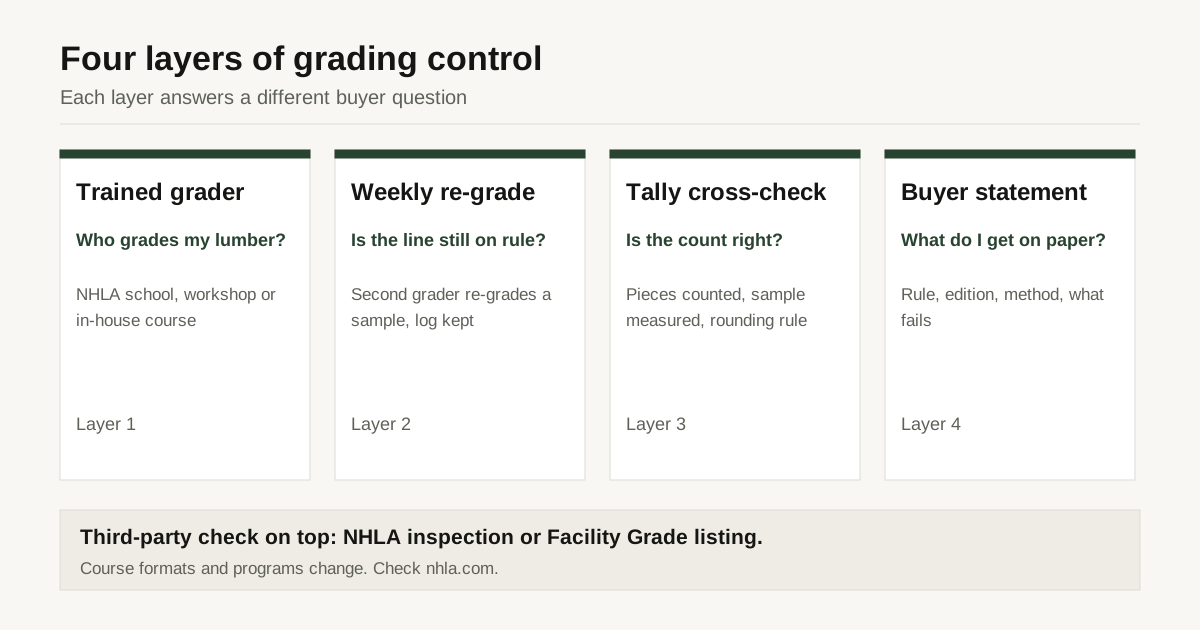
A mill ships boards that its own graders sorted, and the buyer pays for the grade. If the mill trains its graders well, checks their work on a routine and tells the buyer how it does that, fewer lots end up in a claim. This page covers the training routes NHLA offers, the programs that add a third-party check and a simple in-house routine a mill can run. The in-house routine is a suggestion, not an NHLA procedure.
| Layer | What it is | Who runs it | What the buyer can ask to see |
|---|---|---|---|
| Training | A grader learns the NHLA rules | NHLA Inspector Training School, a short workshop or in-house training | Who grades and how they were trained |
| Internal audit | The mill re-grades a sample of its own output | The mill, with a second grader or a trained supervisor | The audit log and what changed |
| Third-party check | An independent inspector grades the lot or the facility | NHLA inspection, Facility Grade or an independent inspector | The graded-lot report or the Facility Grade listing |
| Buyer statement | A short note of rule, edition and method | The mill | The note, with the quote |
This page is general information as of October 2026. NHLA course formats, calendars and programs change. Check them at nhla.com.
Training options at NHLA
NHLA says its Inspector Training School gives immersive, full-time training in hardwood lumber grading, held on campus at the National Hardwood Academy in Memphis, Tennessee. NHLA also offers:
- A hybrid inspector training option that combines on-campus sessions with a self-paced online module.
- Short workshops that NHLA lists as one to three days.
- In-house training, where NHLA inspectors come to the mill for tailored training.
The length of the flagship course has changed. A trade report said NHLA moved from a 12-week program to an 8-week course starting in January 2021 as a permanent change. Check the current schedule, tuition and admission rules on the NHLA site. This page does not list a price.
A mill choosing among these routes can think about two groups. Staff who will become inspectors or lead graders suit the school or the hybrid option. Graders and sawyers who need the rules for their own work, and a supervisor who needs to check them, suit a workshop or in-house training.
Programs that add a third-party check
NHLA runs three certification programs. Their descriptions on the NHLA site are brief, so use them as questions to put to NHLA and not as a full list of rules.
| Program | What NHLA says | What it gives a buyer |
|---|---|---|
| Facility Grade | A voluntary quality assurance program for NHLA members who manufacture, sell or purchase hardwood lumber, with independent third-party verification of lumber grading | A listing of certified companies on the NHLA member portal |
| Strap and Seal | A financial guarantee that a shipment meets or exceeds the purchase contract, with packages strapped and sealed with serial numbers. Domestic shipments only | A guarantee on a domestic shipment |
| Kiln Drying | Validates the drying process and documentation against industry standards. NHLA says it can reach the same goals as the APHIS phytosanitary certificate for exporters | A record of a validated drying process |
For eligibility, requirements and tolerances, NHLA directs readers to its Chief Inspector. Do not assume that a destination country accepts a Kiln Drying certification in place of a phytosanitary certificate. Check with the importer. Our page on phytosanitary certificates for lumber exporters explains the government document.
An in-house routine
A mill does not need a program to start. A simple routine makes grading visible, even for a small yard.
1. A grader roster
List each grader, what they grade (species, thickness, line), how they were trained and the date of the last refresher. Put it in one table and update it when staff change. A buyer who asks “who grades my lumber” gets a real answer.
2. A weekly re-grade audit
Once a week, a second grader or a trained supervisor re-grades a sample from the day’s output. Record:
- the sample size in pieces and board feet
- the grade the line gave, the grade the audit gave and the difference
- the reason for each difference (a knot not counted, a wrong face chosen, a size not measured)
- the action taken, such as a refresher on one rule
The aim is not to fine graders. It is to find the rule people misread and fix it before the lot ships. Keep the log. After a few months it shows which species or thicknesses cause the most disagreement.
3. A tally cross-check
A grade error is not the only way a lot goes wrong. A wrong tally also changes the money. A second person should check bundle tallies against the physical bundle: count the pieces, measure a sample and check the rounding rule. Our page on NHLA measurement rules explains the rule for surface measure and rounding.
4. A pre-shipment look
Before loading, pull a handful of bundles from each lot and look at them as the buyer would. Check grade, moisture, species and tally. Take dated photos of the bundles, because photos are the first thing a buyer asks for if there is a claim. Our guide to lumber photos for buyers lists what helps.
5. A claims loop
When a buyer reports a claim, record it, check the lot against the audit log, find the cause and note the fix. A mill that closes the loop is a mill that gets better. Our guide to a lumber quality claim shows how claims move.
Grading is one of seven control points in a full mill routine. See a quality control plan for a hardwood mill for the others.
A buyer-facing grading statement
A one-page statement saves time with new buyers. It can include:
- The grading rule and edition the mill uses, for example the NHLA rules for the year named in the contract.
- Who grades and how they were trained.
- How often the mill re-grades a sample of its own output.
- How the mill handles a lot that fails its own check.
- What the buyer can order on top: an independent inspection, a graded-lot report or a pre-shipment check.
Do not state a grading accuracy figure unless you measured it. A number without a method is worse than none. Our guide to pre-shipment lumber grading explains how an independent check is agreed. The report that comes back is described in NHLA inspection reports.
What a buyer can ask a mill
- Which rule and edition do you grade to?
- Who grades my lumber and how were they trained?
- How do you check your own grading and how often?
- Do you hold NHLA Facility Grade or use NHLA inspection on shipments?
- What do you do when a lot fails your check?
- Can I see an audit log entry with names removed?
A mill that answers these in a few lines is easier to buy from than one that answers with a certificate and nothing else.
What a mill can say about itself
Hardwood Vendor does not train graders, grade lumber or hold any NHLA program. It matches buyer requests with mills and yards that say they can meet them. A mill that says it is NHLA certified should show the NHLA listing and the program name.
What to write on the RFQ
- The rule and edition: for example the NHLA rules for the year you name.
- Whether you need NHLA inspection, a graded-lot report or Facility Grade supplier status.
- Who pays for the inspection and when it happens.
- A tally check rule: count and sample size.
- What happens if the lot fails: replace, credit or reinspect.
Send your lumber RFQ with the grade rule and the check you need, and we pass it to up to 3 mills or yards that say they can meet it.
Frequently asked questions
Where do NHLA inspectors train?
NHLA's flagship Inspector Training School is held on campus at the National Hardwood Academy in Memphis, Tennessee. NHLA also lists a hybrid option that combines on-campus sessions with a self-paced online module, short workshops of one to three days and in-house training where NHLA inspectors come to a facility. Course length has changed over the years, so check the current calendar.
What is NHLA Facility Grade?
NHLA describes Facility Grade as a voluntary quality assurance program for NHLA members who manufacture, sell or purchase hardwood lumber. Participants allow independent third-party verification of their lumber grading and can earn NHLA Certified status. Certified companies are listed on the NHLA member portal.
Does a trained grader mean every lot is on grade?
No. Training shows that a person learned the rules. Each lot still needs a check, because grading is applied board by board and judgment varies. An internal re-grade of a sample and, for larger orders, an independent inspection show whether the lot is on grade.
What should a mill tell a buyer about its grading?
The rule and edition used, who grades and how they were trained, how the mill checks its own grading, and what the buyer can do if a lot is below grade. A one-page statement is enough.
Sources
- NHLA: Inspector Training School
- NHLA: certification programs (Facility Grade, Strap and Seal, Kiln Drying)
- Woodshop News: NHLA changes format of Inspector Training School (8-week course from January 2021)
- NHLA: grading rules and four-year review
- American Hardwood Export Council: grading sawn lumber
Standards and rules are cited as references, not as claims about Hardwood Vendor or any mill. Editions and status change: confirm with the issuing body, your customs broker or the regulator.
Know what you need? Send the spec.
Tell us the species, grade, thickness and board feet. We pass it to up to 3 mills or yards that carry it and reply within 24 business hours.
Send my lumber RFQMore in lumber papers and certificates
- Lacey Act Declaration (PPQ 505) for Hardwood Lumber, Field by Field
- FSC Certified Hardwood Lumber: Certificate Codes, Claims and Scope
- Testing Lumber Moisture: Oven-Dry, Resistance and Capacitance Methods
- NHLA Inspection Reports for Hardwood Lumber: What a Graded-Lot Report Should Show
- Kiln Drying Quality: Moisture Spread, Gradient and Case Hardening Checks
- Hardwood Lumber Import Documents: The Set an Importer Should Receive