Home / Lumber papers and certificates / Phytosanitary Certificate for Lumber Exporters: Who Issues It and What It States
Phytosanitary Certificate for Lumber Exporters: Who Issues It and What It States
Reference page · Last reviewed 16 March 2027
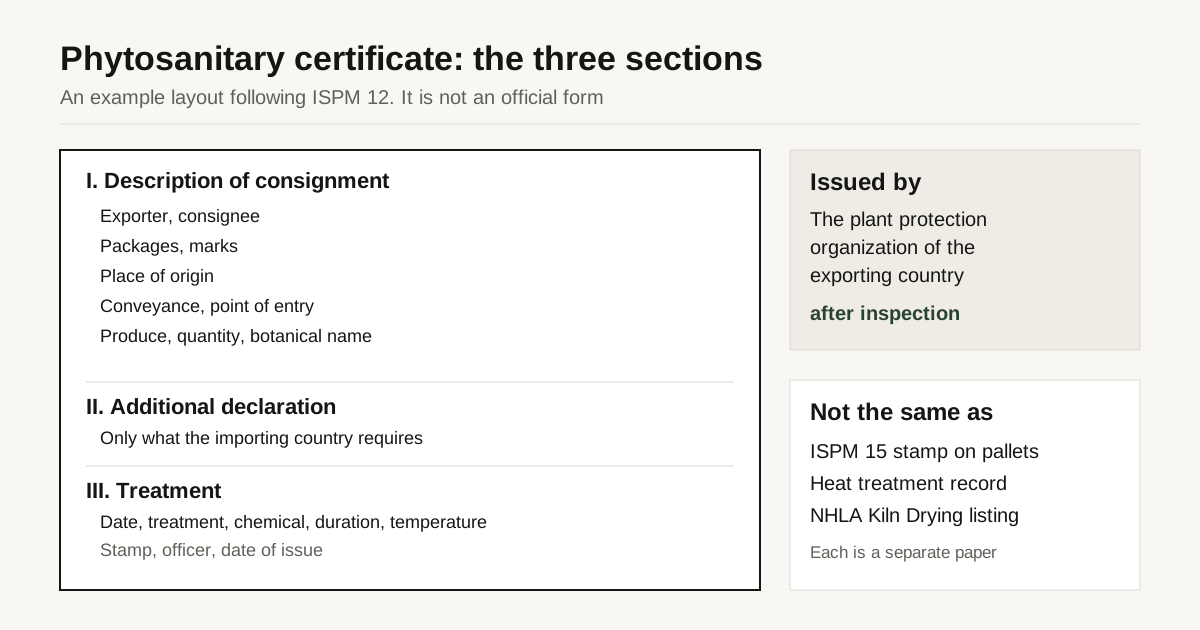
A phytosanitary certificate is a government document that says a consignment was inspected under official procedures and meets the plant health conditions of the importing country. For lumber, it is one of three separate things that get called “phytosanitary”: the certificate for the lumber, a treatment record and the ISPM 15 stamp on wood packaging. This page covers the first, from the exporter’s side: who issues it, what it states, how to apply and what to have ready.
| Section of the certificate (ISPM 12) | What goes there | What the mill or exporter supplies |
|---|---|---|
| Description of consignment | Exporter name and address, declared consignee, number and description of packages, distinguishing marks, place of origin, declared means of conveyance, declared point of entry, name of produce and quantity, botanical name | Invoice, packing list, bundle labels, species list, booking details |
| Additional declaration | Specific plant health statements the importing country requires | The import condition or permit number, and the evidence for it |
| Treatment | Date, treatment, chemical, duration and temperature, concentration, additional information | Heat or fumigation record if a treatment is claimed |
| Issuing office | Official stamp, name of authorized officer, date, signature | Nothing: the plant protection officer completes it |
This page is general information as of October 2026. ISPM 12 is under revision, and importing countries change their conditions. Confirm the current rules with the plant protection authority of the exporting country and with the importer.
Who issues it and when
ISPM 12 is the international standard that guides phytosanitary certificates. It says the certificate is issued by the national plant protection organization of the exporting country, after inspection or testing of the consignment under appropriate official procedures. The certifying statement says the plants, plant products or other regulated articles described have been inspected and are considered free from the quarantine pests specified by the importing country and to conform with its current phytosanitary requirements.
The consequences for an exporter are practical:
- The certificate is for a specific consignment. It describes the lot, the packages and the quantity, so it cannot be prepared in bulk ahead of time.
- The issuing officer signs it only after it is complete. The date is the date of issue.
- If a certificate is issued after dispatch and the importing country requires it, the date of inspection is added to the additional declaration.
- Alterations make a certificate doubtful. ISPM 12 says they should be avoided and that invalid or fraudulent certificates should not be accepted.
- Where countries agree, electronic phytosanitary certificates can be used.
What goes in each box
ISPM 12 gives guidance on each field. The ones that cause errors for lumber:
- Place of origin. The place where the commodity was grown or produced and possibly exposed to pests. The standard says that a commodity that gained its status from more than one place can be declared as country of export with the country of origin in brackets.
- Distinguishing marks. Lot numbers, container numbers or other marks that tie the certificate to the consignment. For bulk timber, the standard says containers or railcars can count as the package.
- Name of produce and quantity. Describe the commodity so that the importing authority can check the contents, with units and, if useful, customs codes. The standard says to specify the intended use or degree of processing and not to use trade names, sizes or other commercial terms.
- Botanical name. The accepted scientific name, at least to genus and preferably to species. A trade name such as “red oak” is not enough. Our page on EN 13556 timber names shows why the botanical name should be on every document.
- Declared point of entry. The first point of arrival in the country of destination, or the country name if unknown. Entry elsewhere is normally not a non-compliance unless the importing country prescribes entry points.
The additional declaration
The additional declaration carries specific plant health information that the importing country requires, or information the exporter asks for to support a future certificate for re-export. ISPM 12 says to keep it brief, not to repeat the certifying statement or the treatment section, and to say which option was applied where the import rules allow several alternatives. Import permit numbers can be cited here. Treatments go in section III, not here.
For lumber, typical subjects are bark (debarked or bark free), a drying or heat treatment statement and conditions for particular species or origins. As an example of a specific rule, the EU handles oak logs with bark from the United States under special requirements of Regulation (EU) 2019/2072 because of the oak wilt pathogen, and Implementing Regulation 2023/1312 gave a time-limited exception for such logs intended for veneer. That concerns logs with bark, not sawn boards, and the exception was set to run to 30 September 2026. Read the current text for your product.
The treatment section
If a treatment is performed to meet an import condition, the certificate lists the date, the type of treatment (for example heat treatment), the chemical active ingredient if there is one, the duration and temperature, the concentration and any additional information. ISPM 12 says the treatments listed should be those acceptable to the importing country, performed under the supervision or authority of the exporting country’s plant protection organization.
A kiln run is not automatically a certified heat treatment, and the NHLA Kiln Drying certification is a different thing from the government certificate. NHLA says its Kiln Drying certification validates a drying process and its documentation, and that it can reach the same goals as the APHIS phytosanitary certificate for exporters. Whether an importing country accepts that in place of the certificate is for the importer to confirm. Our guide to phytosanitary certificates, heat treatment and fumigation explains the difference between the certificate, the treatment and the ISPM 15 mark, and the page on kiln drying quality lists the drying record fields.
Validity
ISPM 12 says the exporting country’s plant protection organization may restrict the validity of a certificate after issue and before export, taking into account the chance of infestation, packaging and storage, the type of commodity and conveyance and the time of year. The importing country may also set how long a certificate remains valid. Ask both sides for the period. One state agriculture department guide notes that inspections are typically valid for 30 days, and that some countries set shorter limits, so the timing of loading matters.
How a US exporter applies
In the United States, APHIS runs the export certification program. Its materials point exporters to certification specialists in each state and to the Phytosanitary Certificate Issuance and Tracking system, PCIT. State agriculture departments often do the inspection of lumber and similar products as authorized certification officials. One state guide says to submit the inspection request, the PPQ form 572, about two weeks before the intended inspection date if possible, and says the certificate is available online once issued.
The steps usually look like this:
- Find the importing country’s plant health conditions for sawn hardwood of your species and origin, in writing.
- Contact the state’s certification specialist or authorized certification official before the lumber is loaded.
- Set up a PCIT account for the company and request the inspection.
- Prepare the consignment so the inspector can see it: bundles accessible, labels visible, the treatment or drying record ready.
- Apply for the certificate with the data from the box table above.
- Check the issued certificate against the invoice, the packing list and the bill of lading before the documents leave.
Other countries have their own authorities and procedures. Use the exporting country’s plant protection organization.
ISPM 15 is separate
The ISPM 15 stamp applies to wood packaging material such as pallets, crates and dunnage. It is shown by a mark on the wood. It is not a certificate for the lumber. A container can be held for an unmarked pallet even when the lumber certificate is perfect. See our guide to hardwood container loading, bundles and tally for the wood that counts as packaging.
Common errors
| Error | Result | Fix |
|---|---|---|
| Trade name instead of botanical name | Delay or query from the importing authority | Botanical name to genus at least, species where known |
| Quantity in a unit that differs from the invoice | Mismatch at the port | Use the same unit and number on every document |
| Container or bundle marks missing | Certificate cannot be tied to the lot | Marks on the certificate match the labels |
| Treatment claimed without a record | Rejection or retest | Keep the heat or fumigation record with the lot |
| Certificate issued too early or too late | Outside the validity window | Time the application close to loading |
| Additional declaration copied from an old shipment | Wrong statement for this lot | Take the wording from the current import condition |
| Altered certificate | Not accepted | Ask the issuing office for a replacement |
What a mill can say about itself
Hardwood Vendor does not issue phytosanitary certificates, inspect lumber or treat wood. The certificate comes from the plant protection authority of the exporting country. A mill that says it can supply a certificate is saying it will apply for one and have the consignment inspected.
What to write on the RFQ
- Destination country and port of arrival.
- Whether a phytosanitary certificate is required and the additional declaration wording, copied from the importer’s conditions.
- Treatment required: none, certified heat treatment with record or fumigation.
- Debarked or bark free, if the importer asks.
- ISPM 15 mark on all wood packaging and bracing.
- Who applies for the certificate, who pays and the date it must be issued by.
- How the original travels: courier or electronic where both countries accept it.
Send your lumber RFQ with the certificate and treatment you need, and we pass it to up to 3 mills or yards that say they can supply them. They reply to you directly.
RFQ line: Red oak (Quercus rubra group), No.1 Common, 4/4 rough, KD 6-8%, debarked, phytosanitary certificate issued by the exporting authority with the importer's additional declaration, ISPM 15 mark on all wood packaging, original sent by courier.
Frequently asked questions
Who issues a phytosanitary certificate?
The national plant protection organization of the exporting country, through its authorized officers. ISPM 12 says the certificate is issued after the consignment has been inspected or tested under official procedures. An exporter cannot issue one itself, and a mill or a buyer cannot replace it with its own letter.
What is an additional declaration?
A statement added to the certificate to give specific plant health information that the importing country requires, or that the exporter asks for in order to support a later re-export certificate. ISPM 12 says it should be kept brief, should not repeat the certifying statement or the treatment section, and should name which measure was used where several are allowed.
Does the certificate say how long it is valid?
ISPM 12 says certificates may have a limited duration of validity and that either the exporting or the importing country's plant protection organization may set it. Ask the issuing office for the period and the importing country for any limit on arrival.
Is ISPM 15 the same as a phytosanitary certificate?
No. ISPM 15 covers wood packaging material such as pallets and dunnage and is shown by a stamp. A phytosanitary certificate is a government document for the consignment itself. A shipment can need both, or only one.
Sources
- IPPC: ISPM 12 Phytosanitary certificates (adopted 2014, published 2017)
- IPPC: specification 79, revision of ISPM 12 (2026)
- APHIS: export certification program (PCIT and certification specialists)
- Minnesota Department of Agriculture: phytosanitary certification process (state inspection of lumber)
- NHLA: certification programs (Kiln Drying certification)
- EUR-Lex: Implementing Regulation (EU) 2023/1312 (oak wood with bark from the United States)
Standards and rules are cited as references, not as claims about Hardwood Vendor or any mill. Editions and status change: confirm with the issuing body, your customs broker or the regulator.
Know what you need? Send the spec.
Tell us the species, grade, thickness and board feet. We pass it to up to 3 mills or yards that carry it and reply within 24 business hours.
Send my lumber RFQMore in lumber papers and certificates
- Lacey Act Declaration (PPQ 505) for Hardwood Lumber, Field by Field
- FSC Certified Hardwood Lumber: Certificate Codes, Claims and Scope
- Testing Lumber Moisture: Oven-Dry, Resistance and Capacitance Methods
- NHLA Inspection Reports for Hardwood Lumber: What a Graded-Lot Report Should Show
- Kiln Drying Quality: Moisture Spread, Gradient and Case Hardening Checks
- Hardwood Lumber Import Documents: The Set an Importer Should Receive