Guides / Cost and Ordering
How to Write a Lumber Tally Sheet Buyers Trust: Fields, Rounding Rules and a Worked Bundle
February 12, 2027
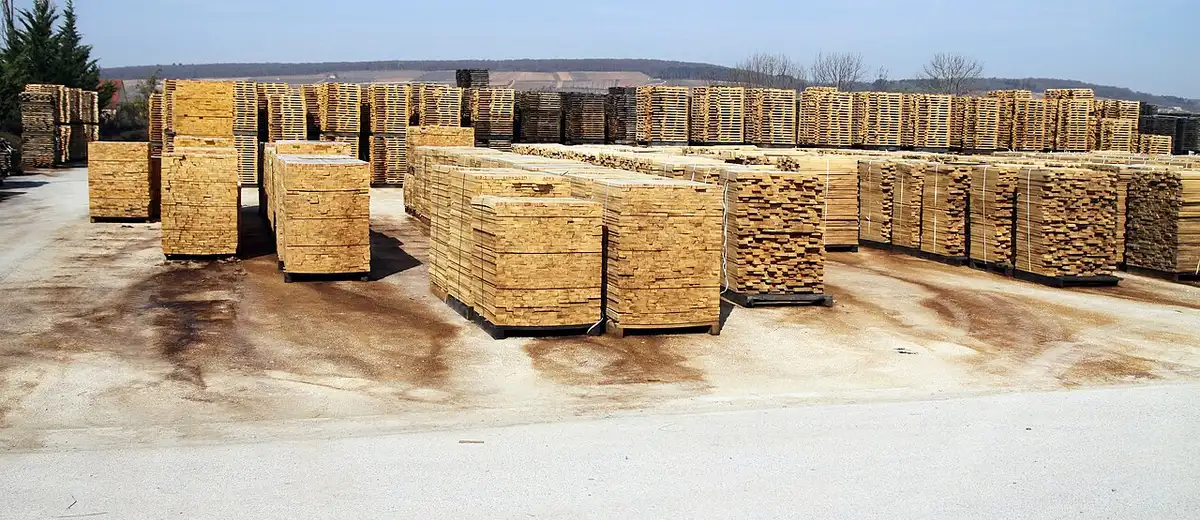
A tally sheet is the seller’s statement of what is in the shipment, and the invoice, the customs papers and any later claim all start from it. A sheet buyers trust names the basis of the count, lists every bundle with its tag number, shows the rounding rule and adds up the same way the buyer will. This guide is for mills, yards and exporters: the fields to include, the two ways to count a bundle, the rounding rules published by AHEC, the net and gross trap and a worked bundle with its arithmetic.
This is general information as of October 2026. The NHLA rule book governs where a contract names it, and I could not open it, so the rounding rules below come from AHEC and WoodWeb. The sample sheet is made up to show the format.
What the sheet is for
Three people read it: the buyer checking receipt, the customs broker matching the packing list to the invoice and an inspector if there is a dispute. A sheet that works for all three is complete and consistent, and it states how it was measured. Our buyer-side guide to hardwood lumber tally explains why two honest counts can differ. This guide is the other half: how to write the sheet so they do not.
The fields
| Field | Why it is there |
|---|---|
| Shipment and order numbers, date | Ties the sheet to the contract and invoice |
| Container number and seal number, or truck and trailer ID | Lets the buyer prove it arrived sealed |
| Species, common and botanical name | Customs and legality documents need it |
| Grade and the rule it is graded to | Avoids a grade argument after the fact |
| Thickness in quarters, and mm | AHEC lists 4/4 as 1 in (25.4 mm) and 8/4 as 2 in (50.8 mm) |
| Surfacing and drying | Rough, S2S or other, and air dried or kiln dried |
| Bundle tag number | Matches the physical tag to a line |
| Pieces in the bundle | Lets the buyer recount |
| Width and length, per piece or by block | See the next section |
| Board feet or cubic meters per bundle | The number that is billed |
| Totals per item and per shipment | Matches the invoice lines |
| Tally basis and rounding rule | Prevents most disputes |
| Tallied by and date | Someone is accountable |
The AHEC measurement page notes that a bundle tally records each board’s width and length, which means the per-piece list is the evidence behind the bundle total.
Per piece or block
There are two common ways to count a bundle, and they give different answers.
- Per piece. Each board gets its own rounded width and length, and its board feet are counted. This follows the grade the board actually has and is usual for graded stock.
- Block. The bundle is counted as one rectangle of width times length times thickness, less an allowance for gaps. WoodWeb’s technical advisor Gene Wengert noted in 2015 that a block tally of a bundle 48 in wide and 10 ft long is 48 x 10 / 12 = 40 board feet per layer.
A WoodWeb thread from April 2015 shows the gap in practice. A buyer received a bundle tallied at 263 board feet of 4/4 lumber, six layers, up to 48 in wide and 10 ft long, and calculated 240. Per-piece counting explained it: in Wengert’s example a layer of six pieces near 48 in wide could total 36 board feet and a layer of seven narrower pieces 42, so 263 was plausible, while the block calculation gave 40 per layer. He advised specifying in advance whether footage is counted per piece or by block. A contributor added that regional habits differ, with some Northeast suppliers counting a 5 1/2 in board as 6 in. The supplier later confirmed the tally and credited the difference.
So the sheet must say which method it uses. If you mix methods between items, say so line by line.
Rounding rules
AHEC publishes rules for export bundle tallies:
- Widths above or below the half inch round to the nearest whole inch.
- Widths exactly on the half inch alternate between rounding up and down.
- Lengths between whole feet always round down to the whole foot. A 5 1/4 in by 8 1/2 ft board is tallied as 5 in by 8 ft.
- Board feet are width in inches times length in feet times thickness in inches, divided by 12.
Wengert’s alternation rule works the same way for a board exactly on a boundary between two board-foot values: the first rounds up, the next rounds down, and so on. If your sheet uses these rules, print them in a footer. If you use a different convention, print that one. A rule the buyer cannot see is a dispute waiting to happen.
Net or gross
Net tally is board feet counted after kiln drying. Gross, or green, tally is counted before drying. AHEC says a buyer can expect roughly 7% fewer board feet than a gross figure. In 2000 Wengert wrote that the National Conference on Weights and Measures adopted a standard in 1977 saying hardwood sold after kiln drying is sold on net board footage with no addition for kiln drying shrinkage, and that people were still adding back footage 23 years later. Keith Atherholt, writing on WoodWeb in 2001, says shrinkage across the width runs 5% to 9%, with 7% accepted as the industry standard.
For a sheet:
- Default to net, measured on the dried boards.
- If you tally gross, print the shrinkage percentage and the conversion formula on the sheet, and do not hide it in a price.
- Never mix net lines and gross lines in one total.
Our board feet and pricing guide shows the formula and why dividing by 0.93, not adding 7%, gives the right net price.
A worked bundle
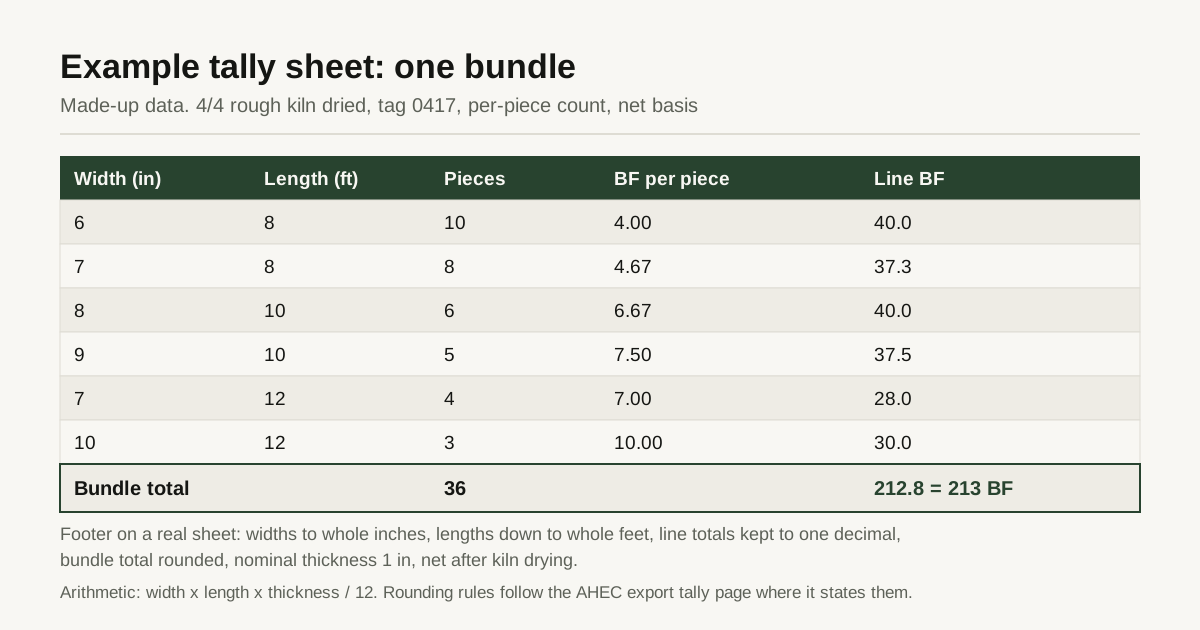
The sample below is made up. It shows one bundle of 4/4 rough kiln dried boards, counted per piece, with widths in whole inches and lengths in whole feet.
| Width (in) | Length (ft) | Pieces | Board feet per piece | Line total |
|---|---|---|---|---|
| 6 | 8 | 10 | 6 x 8 x 1 / 12 = 4.00 | 40.0 |
| 7 | 8 | 8 | 7 x 8 x 1 / 12 = 4.67 | 37.3 |
| 8 | 10 | 6 | 8 x 10 x 1 / 12 = 6.67 | 40.0 |
| 9 | 10 | 5 | 9 x 10 x 1 / 12 = 7.50 | 37.5 |
| 7 | 12 | 4 | 7 x 12 x 1 / 12 = 7.00 | 28.0 |
| 10 | 12 | 3 | 10 x 12 x 1 / 12 = 10.00 | 30.0 |
| Bundle | 36 | 212.8, shown as 213 |
Two conventions are visible here and both must be printed on a real sheet: line totals are kept to one decimal and only the bundle total is rounded, and the thickness counted is the nominal 1 in for 4/4. A buyer who rounds each piece to a whole board foot first will get a slightly different number, which is exactly why the footer matters. The AHEC page adds that rough kiln dried boards may be a little scant of nominal thickness after drying (up to 1/16 in for 3/8 to 1 3/4 in stock), so say whether footage is counted at nominal or measured thickness, and give cubic meters on the same basis if you quote them. AHEC gives 1 m3 as 424 board feet.
Habits that prevent disputes
- Tag every bundle with the same number as the sheet, and photograph the tag on the bundle when you load.
- Recount a sample of bundles before loading, using the same rule the sheet states, and fix errors before the sheet is final.
- Sign and date it, and keep a copy with the loading photos and the container and seal numbers.
- Send the sheet before the ship arrives, not with the documents, so the buyer can prepare the receiving count.
- Agree a tolerance in the contract, for example a stated percentage on quantity, and say who credits or pays beyond it.
- Do not change the method between shipments without telling the buyer. A repeat buyer who sees a different count for the same product will ask why.
- Keep the per-piece list, even when you only send bundle totals, so you can answer a question quickly.
Our guides on container loading and tally and on claims show what the buyer does with the sheet on arrival, and our guide for exporters on what to publish for buyers covers how to describe your tally basis before an order.
For the order that the tally sheet has to match, see hardwood lumber specifications. For how the sheet fits the quote, the order and the claim, see wholesale hardwood lumber.
Next step
If you sell hardwood lumber and want requests from buyers whose species, grade and thickness fit your stock, register your mill or yard. Tell us your tally basis along with your species, grades, drying and minimum order. We pass a buyer’s spec to you only when it fits. Each request goes to 3 suppliers at most and the buyer deals with you directly. We reply within 24 business hours, and we make no promise of orders.
Sources
- AHEC, board feet, tally and kiln dried measurement
- WoodWeb, Hardwood Lumber Tallies (2015)
- WoodWeb, Gross tally vs. net tally (Wengert, 2000)
- WoodWeb, Net measure vs. gross measure (Atherholt, 2001)
Frequently asked questions
What should a lumber tally sheet include?
Container and seal numbers, species, grade, thickness, a line per bundle with its tag number, piece count and board feet, totals per item and per shipment, plus the tally basis. AHEC says export bundle tallies record each board's width and length, so a per-piece list can back up the totals.
Should a mill tally net or gross?
Net, measured after kiln drying. AHEC defines net as the board feet after drying and says buyers can expect about 7% fewer than a gross figure. A 1977 standard cited by wood scientist Gene Wengert says kiln dried hardwood is sold on net footage with no add-back for shrinkage.
How are board widths and lengths rounded on a tally?
AHEC's export rules round widths to the nearest whole inch, alternate up and down on exact half inches and round lengths down to the whole foot. A 5 1/4 in by 8 1/2 ft board tallies as 5 in by 8 ft. If you use another rule, print it on the sheet.
Why does the buyer's count differ from my tally?
Usually rounding or method. A WoodWeb thread shows a bundle tallied at 263 board feet against a buyer's block calculation of 240, explained by per-piece rounding. Another cause is a gross count against a net count. State the method on the sheet so both sides compare like with like.
Know what you need? Send the spec.
Tell us the species, grade, thickness and board feet. We pass it to up to 3 mills or yards that carry it and reply within 24 business hours.
Send my lumber RFQ