Guides / Choosing a Supplier
Reaching Export Buyers: What a Sawmill or Lumber Yard Should Publish Online
February 13, 2027
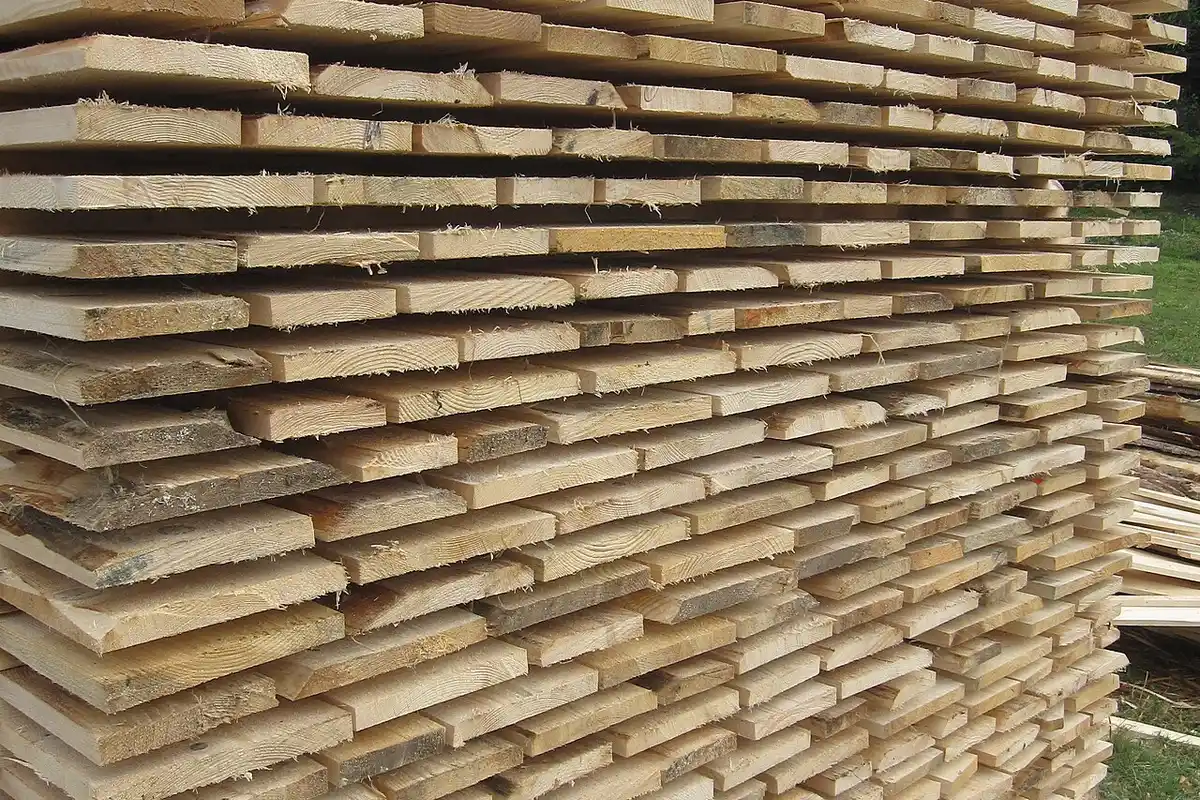
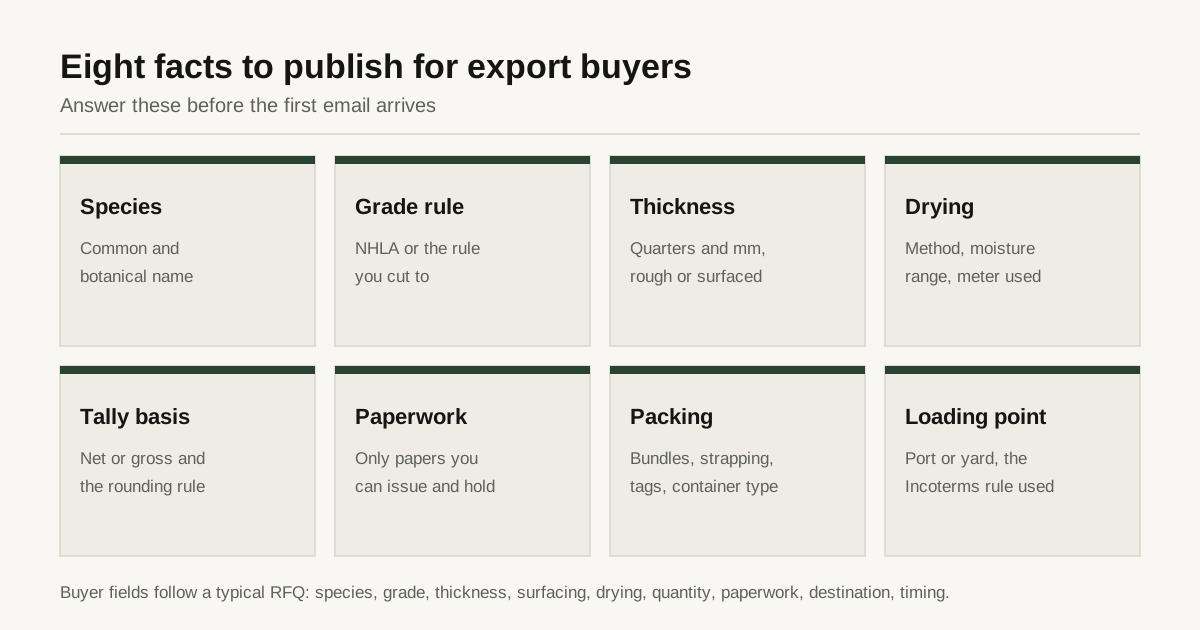
A buyer abroad cannot walk your yard, so the first thing they read decides whether they send you a request for quote. Publish what they have to know to judge fit before they write: which species and grades you cut, how thick, how dry, how you count the footage, what paperwork you can issue and how you ship. Buyers who send a specification through this site give us species, grade, thickness, surfacing, drying, quantity, paperwork, destination and date needed, so those are the fields to answer first. This guide goes through them and what to leave out, written for sawmills, concentration yards and exporters.
This is general information as of October 2026. Where a rule or date matters, the source is named and you should confirm it with your broker. I found no public survey of what export buyers read first, so the order below follows the fields a buyer’s spec needs, not a statistic.
Answer the buyer’s spec, field by field
A buyer’s request has to be quotable. If your page does not show that you can meet each field, the buyer cannot tell whether to ask.
| Buyer’s field | What to publish | Example wording (format only) |
|---|---|---|
| Species | Common name and botanical name | White oak (Quercus alba group) |
| Grade | The grading rule and the grades you cut | NHLA FAS, Select, No.1 Common, No.2A Common |
| Thickness | In quarters with millimeters, rough or surfaced | 4/4 (25.4 mm) and 8/4 (50.8 mm), rough |
| Surfacing | What you can run | Rough, S2S, SLR1E, S4S |
| Drying | Air dried or kiln dried, target moisture and how you measure | Kiln dried to a stated range, meter type |
| Quantity | Typical lot and the largest you can ship, and your minimum | Per truck or per container |
| Paperwork | Documents you can issue, only those you hold | See the section on paperwork |
| Destination | Ports or regions you ship to and from where | Loading location and country |
| Timing | Usual lead time from order to loading | Stated in weeks |
Use the exact grading names of the rule you cut to. For hardwood in North America that is normally the NHLA rule, and our guide to NHLA grades shows how the names map to usable cuttings. If you cut to another standard, name it and say how it compares.
Say how you count the footage
Disputes after shipment often start with the tally, and the buyer will ask before they order. The American Hardwood Export Council (AHEC) defines net tally as the board feet measured after kiln drying and gross, or green, tally as the board feet measured before drying, and says a buyer can expect roughly 7% fewer board feet than a gross figure. Write which basis you quote and your rounding rule.
- Tally basis: net after kiln drying, measured. If you use gross, state the shrinkage rate and the formula.
- Rounding: AHEC’s export bundle rules round widths to the nearest whole inch, alternate on exact half inches and round lengths down to the whole foot. If you use a different rule, publish it.
- Thickness basis: rough nominal quarters, and the scant you allow after kiln drying.
- Units: board feet or MBF, and cubic meters if you sell in them, with the thickness the volume is based on.
Our guide to hardwood lumber tally explains why a quote that looks cheaper can cost more once both sit on the same basis, which is why buyers look for this line.
Publish only the paperwork you can issue
This is where an honest page earns trust, and an overstated one loses it.
- Species and origin data. For the United States, the USDA APHIS page on the Lacey Act says the importer of record or their agent files the declaration, and that importers should get the scientific name of each plant product and where it was harvested. A mill that lists genus, species and harvest region gives the importer what they need.
- EU buyers and the EUDR. The European Commission says wood is a covered commodity and that the regulation applies from 30 December 2026 to large and medium operators and from 30 June 2027 to micro and small operators, with a separate date for some micro and small operators already under the old timber regulation. The operator in the EU files the statement, so your EU customer will ask for harvest plot data. Our guide to the EUDR for hardwood lumber lists the data a mill has to supply. Say plainly whether you can supply it and from what date.
- CITES species. If you sell a listed species, say that a CITES export permit is arranged by you or your exporter, and name the species by botanical name. See our CITES guide.
- Certificates. List FSC, PEFC or other chain-of-custody certificates only if you hold them, with the certificate number and the scope. Never say “certified” for an item that is not covered. Do not publish any claim you cannot show on request.
- Plant-health papers. Say whether you issue a phytosanitary certificate and which treatment (heat or fumigation) you apply, as covered in our guide to phytosanitary and fumigation rules.
Show packing and the loading point
Buyers want to know what arrives. Cover:
- Bundle size and how bundles are strapped, wrapped and tagged.
- Whether you load containers, flatbeds or break-bulk, and the container types you load. Our guide to container loading shows the sheet and bundle details buyers will check.
- The port or yard where you load and how far it is from your mill.
- The Incoterms rule you quote under, for example FOB or FCA, and what it means in your offer. Say which version of the rules you refer to.
- The payment terms you accept and any deposit. Buyers compare these closely, as our payment terms guide explains.
Add photos and a dated stock list
A buyer who has never seen your lumber needs evidence. Publish:
- Photos of real lifts with the tag visible: the species, grade and thickness should match what the tag says.
- A close photo of each grade’s face and a photo of the end of a bundle.
- A stock list with a date. A stale list costs you credibility, so remove lines that sold and update the date every time you change it.
- Moisture readings, with the meter and the number of boards measured.
Take photos in even daylight, label them and do not use a picture of a different species or a different mill’s stock. If you use a stock image anywhere, label it as an illustration.
What not to publish
- Certifications, memberships or customer names you cannot show or have not agreed to publish.
- Quantities you do not hold, or “unlimited supply.”
- Prices you will not honor, or prices without a unit, tally basis, Incoterms rule and date.
- Hype such as “best quality” or “world class.” Buyers read grade, tally and moisture, not adjectives.
- Promises of volume. Nobody can guarantee orders, and a matching service only passes on requests that fit your list.
Respond within a stated time
State your response time and keep it. A clear reply lists species, grade, thickness, quantity, tally basis, price unit, Incoterms rule, lead time and how long the quote stands. If you cannot quote, say so and say why, so the buyer can move on.
Buyers compare offers as described in wholesale hardwood lumber; the facts they ask for are the ones listed here.
Register your mill or yard
If you sell hardwood lumber, dimension parts or flooring stock to manufacturers and yards, register as a supplier. Tell us your species, grades, thicknesses, drying, minimum order and the paperwork you can issue. When a buyer’s spec fits, we pass it to you. Each request goes to 3 suppliers at most and the buyer deals with you directly. We reply within 24 business hours. We are a matching service, not a sawmill, and we make no promise of orders.
Sources
- AHEC, board feet, tally and kiln dried measurement
- USDA APHIS, Lacey Act declaration requirements
- European Commission, Regulation on deforestation-free products
- WoodWeb, Net measure vs. gross measure (Atherholt, 2001)
- WoodWeb, Hardwood Lumber Tallies (2015)
Frequently asked questions
What should a sawmill put on its website for export buyers?
Species with botanical names, the grading rule used, thicknesses, surfacing, drying method and moisture range, tally basis, annual and per-shipment volume, packing, loading location, the papers you can issue and how fast you reply. Add photos of typical lifts and a dated stock list.
Do export buyers need the botanical name of the species?
Yes, for imports into the United States. The USDA APHIS Lacey Act page says the importer should obtain the scientific name of each plant product and where it was harvested. A mill that lists the genus and species and the harvest region saves its buyer a round of questions.
Should a mill publish prices?
Only if you will honor them for a stated period. Many mills publish none and quote per request. If you do publish, name the unit (MBF or cubic meter), the tally basis (net or gross), the Incoterms rule and the date, or the figure cannot be compared.
How can a mill get matched with buyers who need its lumber?
Register the species, grades, thicknesses, drying, minimum order and papers you can issue on the suppliers page. When a buyer's spec fits, we pass it on and the buyer contacts you directly. There is no promise of orders, and the more exact your list, the fewer requests you cannot quote.
Know what you need? Send the spec.
Tell us the species, grade, thickness and board feet. We pass it to up to 3 mills or yards that carry it and reply within 24 business hours.
Send my lumber RFQ