Home / Lumber papers and certificates / SFI Chain of Custody for a Hardwood Sawmill: Steps, Records and Audits
SFI Chain of Custody for a Hardwood Sawmill: Steps, Records and Audits
Reference page · Last reviewed 18 March 2027
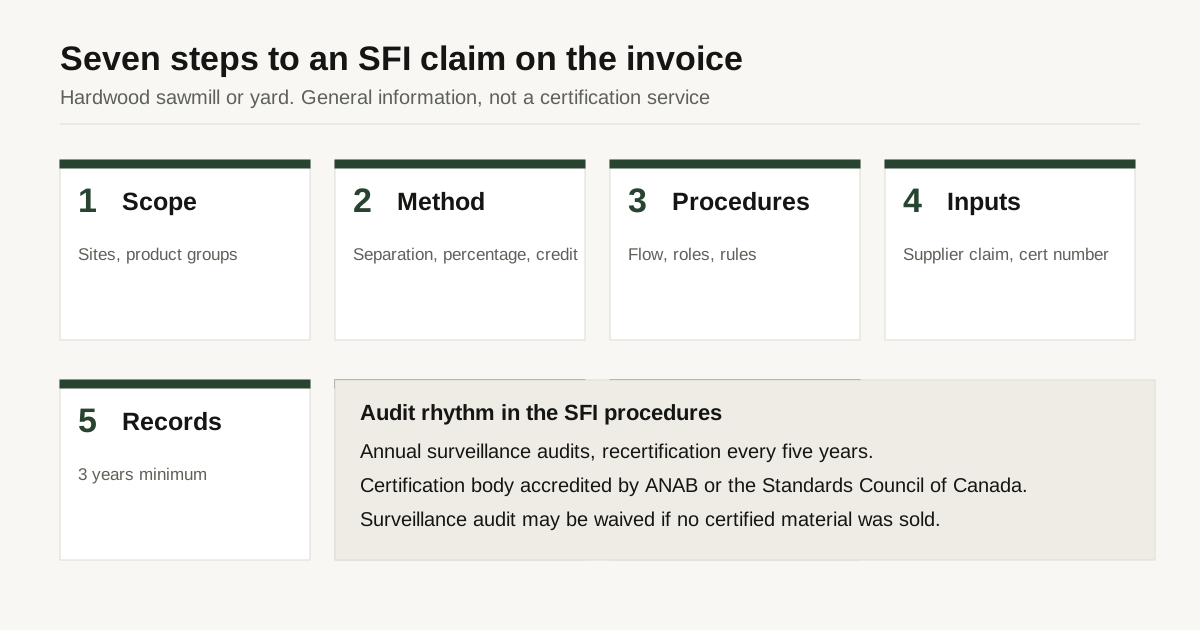
A hardwood sawmill or yard that wants to sell lumber with an SFI chain of custody claim has to do seven things: set the scope, choose how it will account for certified wood, write the procedures, collect the right documents from its suppliers, keep the records, pass an audit by an accredited certification body, and state the claim on every sale. This page lists those steps in order, with the records an auditor will ask for. It is written for the supplier side of a lumber order. It is general information, not a certification service.
| Step | What the mill does | What the standard asks for |
|---|---|---|
| 1. Scope | List sites, product groups and who handles the wood | Standard applies to anyone who sources, processes, manufactures, handles, trades or converts forest-based products |
| 2. Method | Pick physical separation, percentage or credit | Separation is preferred where certified inputs are not mixed |
| 3. Procedures | Write how wood moves and who is responsible | Material flow, responsibilities and procedures for every requirement |
| 4. Inputs | Collect the claim and certificate number from each supplier | Supplier, quantity, date, category of origin, supplier certificate number |
| 5. Records | Keep suppliers, purchases, calculations, sales, audits | Minimum of three years |
| 6. Audit | Internal audit, then certification audit | Internal audit at least annually and before the first audit |
| 7. Claim | State the SFI claim on invoices and shipping papers | Official SFI claim, certified organization’s identification, quantity, date |
The text used here is the SFI 2022 Chain-of-Custody Standard (Section 4) in the version dated April 15, 2021, and the October 2021 Standards and Rules. SFI revises its standards. Confirm the current text with SFI or a certification body before you plan.
Step 1: decide the scope
The standard applies globally to any organization that sources, processes, manufactures, handles, trades, converts or prints forest-based products. Two things narrow the field:
- A wood producer that delivers roundwood or field chips direct from the forest to a manufacturing facility does not need SFI chain of custody certification.
- A certified warehouse or distribution center that passes on SFI certified product in its original packaging, identified with an SFI chain of custody on-product label, does not need its own chain of custody system.
A mill that saws, dries, regrades or repacks hardwood is a manufacturer or handler. Primary producers must also conform to the SFI 2022 Fiber Sourcing Standard. The SFI definitions decide whether a given mill is a primary producer, so ask the certification body before you assume.
List each site, each product group (for example rough kiln-dried hardwood lumber) and the activities at each site. This list becomes the scope on the certificate.
Step 2: choose a method
SFI offers three approaches:
| Method | Idea | What a hardwood mill needs |
|---|---|---|
| Physical separation | Certified content is kept apart or clearly identified so it is not mixed with or replaced by uncertified content | Separate storage, time or permanent identification of certified lots, kiln charges and bundles |
| Percentage method | Certified share is calculated for a product group and a claim period, then all products in the group carry that percentage | A claim period (maximum three months for credibility, per the standard) and a calculation record |
| Credit method | Credits from certified inputs are placed in an account and applied to output | A credit account, with credits limited to what entered in the last 24 months |
SFI names physical separation as the preferred option where certified and recycled inputs are not mixed with other raw material. Percentage and credit methods suit mills that mix sources. A label under the percentage method needs at least 70% certified content. Below that, the percentage is stated.
Step 3: write the procedures
The procedures should be documented and cover at least the flow of raw material in the production process, the organization structure and responsibilities and the procedures that cover every requirement of the standard. For a hardwood mill, that usually means a short written description of:
- How logs or green lumber arrive and are tagged with their SFI category.
- How certified lots are kept apart in the yard, the kiln and the packing line.
- Who checks the supplier’s certificate and claim on each delivery.
- How kiln charges and bundles are numbered so a shipped bundle can be traced to its input.
- Who writes the claim on the invoice and who checks it.
Step 4: collect the input documents
Every delivery of certified raw material needs documents that show, at a minimum, the supplier, the quantity, the date, the category of origin and the supplier’s SFI certificate number, as applicable. The categories are the SFI claims: X% Certified Forest Content, X% Certified Sourcing, recycled content and the others in the standard. The mill must also confirm that the supplier’s certified content criteria are met, through documents or access to confirmation.
A mill that buys logs from independent loggers needs to look at the Fiber Sourcing side of the system, because that is where the origin of the logs is verified. The standard states that primary producers must also conform to the SFI 2022 Fiber Sourcing Standard, and that producers with a valid chain of custody certificate can make SFI certified sourcing claims if they meet the calculation requirements of the Certified Sourcing Standard.
Step 5: keep the records
The standard lists the records a certified organization keeps for at least three years:
- suppliers of forest-based material, with information that confirms their requirements are met
- purchased raw material, with its origin
- how the certified percentage for each product group was calculated
- products sold and their claimed origin, including credit account movements
- internal audits, nonconformities and corrective actions
- top management’s periodic review
Staff who affect chain of custody must be competent through training, education, skills and experience. The mill must also provide and maintain the facilities it needs to run the system.
Step 6: audit and certificate
The mill performs an internal audit at least annually and before the initial certification audit. A certification body accredited by ANAB or the Standards Council of Canada performs the certification audit. The SFI audit procedures set surveillance audits on an annual basis and recertification every five years. For an initial audit, a nonconformity found during the audit blocks the certificate until the certification body verifies that the corrective action has worked.
A certified mill that has sold no certified material since the last audit may ask its certification body to waive a surveillance audit by signing a declaration and committing to contact the body before it sells certified material again.
SFI Inc. does not audit. The certification body does. Ask several bodies for scope, plan and calendar, and ask what they need from the mill before the audit.
Step 7: the claim on the invoice
At the point of sale, the mill gives the next company written information confirming its certification status and an official SFI claim that states the input category. The documents must show the certified organization’s identification, the quantity, the date and the claim. The standard accepts an invoice, bill of lading, shipping document or letter. The wording of the claim must match one of the official claims in the standard.
If the mill wants to use an SFI label, it needs authorization from SFI’s label office and must follow the rules for on-product labels. The mill can also use the claim in documents without a label.
What it costs and how long it takes
Cost depends on the number of sites, product groups, audit days and how much of the record keeping the mill already does. Ask two or three certification bodies for written quotes and a calendar. The SFI rules set the structure, not a price. Plan the timeline around the internal audit and the earliest available audit slot, and allow time to fix any nonconformity found.
What it does not do
An SFI certificate says the mill runs an audited chain of custody system. It does not grade the lumber, prove legal harvest in any country or replace a Lacey Act declaration. See SFI and PEFC certified hardwood lumber for how buyers read the claim, and FSC certified hardwood lumber for the other scheme most buyers ask about.
What a buyer sees
A buyer will look for the claim wording on the invoice, the mill’s certificate number and the status in the SFI database. Giving them those three things in the quotation saves several email rounds. Our supplier page explains how mills register to receive matching requests.
What a mill can say about itself
Hardwood Vendor does not certify mills, hold an SFI certificate or offer certification services. It matches buyer requests with mills and yards that say they can meet them. A mill that says it holds SFI chain of custody certification should show its original certificate and the certification body that issued it.
Checklist before the first audit
- Scope list: sites, product groups, activities.
- Method chosen and written down.
- Procedures covering every requirement.
- Supplier list with certificate numbers and claim categories.
- A sample invoice with the official claim.
- Records of at least one claim period.
- Internal audit report and management review.
- Named people for chain of custody, with training records.
Register as a supplier to receive buyer requests that name SFI, or send your lumber RFQ if you are a buyer who needs the claim.
Frequently asked questions
Does a lumber yard need its own SFI chain of custody certificate?
Not always. SFI says a certified warehouse or distribution center that passes on SFI certified product does not need its own chain of custody system if the product stays in its original packaging and carries an SFI chain of custody on-product label. A yard that cuts, regrades, repacks or relabels material is outside that exception.
Which method should a hardwood mill choose?
SFI names physical separation as the preferred option where certified content is not mixed with other raw material. If certified and uncertified inputs mix, the mill uses the percentage method or the credit method. The choice depends on how the mill handles logs, green lumber and kiln charges.
How often is the certificate audited?
The SFI audit procedures call for surveillance audits on an annual basis and recertification audits every five years. A mill can ask its certification body to waive a surveillance audit if it has not sold any certified material since the last audit, with a signed declaration.
How long must records be kept?
The standard sets a minimum of three years unless the law says otherwise. Records cover suppliers, purchases, how the certified percentage was calculated, sales and their claims, internal audits and management review.
Sources
- SFI 2022 Chain-of-Custody Standard, Section 4 (text dated April 15, 2021)
- SFI 2022 Standards and Rules (October 7, 2021), including Section 10 audit procedures
- SFI: 2022 Chain-of-Custody Standard (overview)
- SFI: on-product labels
- SFI certified organizations and certification database
Standards and rules are cited as references, not as claims about Hardwood Vendor or any mill. Editions and status change: confirm with the issuing body, your customs broker or the regulator.
Know what you need? Send the spec.
Tell us the species, grade, thickness and board feet. We pass it to up to 3 mills or yards that carry it and reply within 24 business hours.
Send my lumber RFQMore in lumber papers and certificates
- Lacey Act Declaration (PPQ 505) for Hardwood Lumber, Field by Field
- FSC Certified Hardwood Lumber: Certificate Codes, Claims and Scope
- Testing Lumber Moisture: Oven-Dry, Resistance and Capacitance Methods
- NHLA Inspection Reports for Hardwood Lumber: What a Graded-Lot Report Should Show
- Kiln Drying Quality: Moisture Spread, Gradient and Case Hardening Checks
- Hardwood Lumber Import Documents: The Set an Importer Should Receive