Home / Lumber papers and certificates / SFI and PEFC Certified Hardwood Lumber: Claims, Labels and How They Compare with FSC
SFI and PEFC Certified Hardwood Lumber: Claims, Labels and How They Compare with FSC
Reference page · Last reviewed 17 March 2027
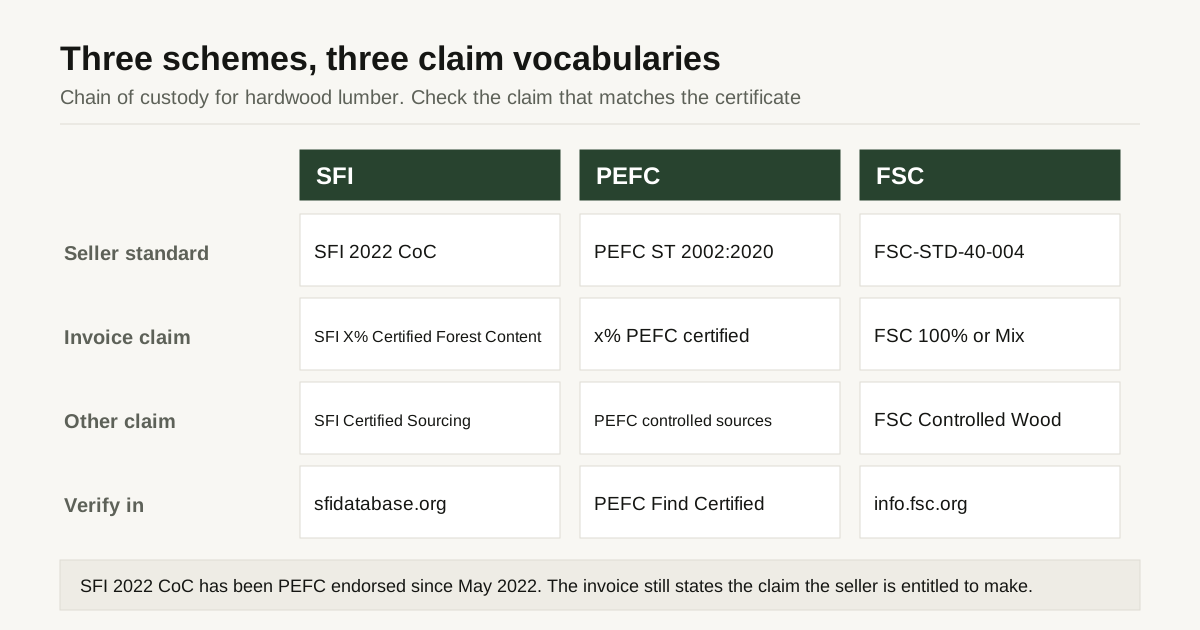
SFI and PEFC are the two other chain of custody schemes a hardwood buyer meets next to FSC. They work the same way at the big-picture level: a certified company tracks wood from certified or controlled sources through its yard and kiln, and states a claim on the invoice. They differ in claim wording, labels and where you check the certificate. The table sets the three side by side. Details follow for SFI and PEFC, and our page on FSC certified hardwood lumber covers FSC.
| Item | SFI | PEFC | FSC |
|---|---|---|---|
| Standard for the lumber seller | SFI 2022 Chain-of-Custody Standard (Section 4) | PEFC ST 2002:2020 | FSC-STD-40-004 |
| Typical invoice claim | SFI X% Certified Forest Content, SFI 100% Certified Forest Content, SFI Certified Sourcing and others | x% PEFC certified, PEFC controlled sources | FSC 100%, FSC Mix, FSC Controlled Wood |
| Seller’s certificate number on the document | Part of the input records the standard asks a buyer to keep, as applicable | Required on delivery documents | Required |
| Where to check | SFI certification database (sfidatabase.org) | PEFC Find Certified | FSC certificate database (info.fsc.org) |
| Cross-recognition | SFI 2022 CoC is PEFC endorsed since May 2022 | Receives claims from SFI certified organizations | Separate scheme |
This page is general information as of October 2026. Standards and claim wording change. Confirm the current text with the scheme or the certification body.
SFI chain of custody: what the claim is built from
The SFI 2022 Chain-of-Custody Standard is an accounting system that tracks forest fiber content from raw material to end product. It applies to any organization that sources, processes, manufactures, handles, trades, converts or prints forest-based products. A certified company can pick one of three methods: physical separation, the percentage method or the credit method for mixed inputs.
On the invoice, the standard lists the official claims. They include SFI X% Certified Forest Content, SFI 100% from a Certified Forest, SFI 100% Certified Forest Content, SFI at Least X% Certified Forest Content, SFI X% Certified Sourcing or SFI Certified Sourcing and the recycled-content variants. Percentages of any combination are permitted. At the point of sale, the seller must give the next company written information confirming its certification status and an official SFI claim, on an invoice, bill of lading or similar document.
Two details matter to a buyer:
- The 70% threshold. A product can carry the SFI Chain-of-Custody label only if it reaches at least 70% certified forest content or recycled material under the percentage method. Below that, the actual percentage is disclosed.
- Certified Sourcing is a different thing. SFI says the Certified Sourcing label covers noncontroversial raw material sources, logger training, recycled content, certified forests and small family forest owners, and makes no claims about certified content. A line that says “SFI Certified Sourcing” is a sourcing statement, not a certified forest content claim.
SFI’s page on labels lists four on-product labels: Chain of Custody, Recycled Content, a label recognizing global standards such as PEFC (intended for use in the US and Canada, with a separate application) and Certified Sourcing. Only organizations with a valid SFI certificate from an accredited certification body may apply for them, and use requires authorization from SFI.
PEFC chain of custody: what the claim is built from
PEFC ST 2002:2020 sets the requirements for the same kind of system. It specifies physical separation, percentage and credit methods. Its claim vocabulary is short: “x% PEFC certified” and “PEFC controlled sources”. The standard also allows the wording “100% PEFC Origin” for certified material that was never mixed with controlled sources material.
The standard asks that delivery documents for material with a claim show:
- the name of the customer receiving the PEFC claim
- the PEFC claim for each claimed product
- the certificate number of the seller’s PEFC certificate, a unique numerical or alphanumeric identifier
A buyer who receives lumber with a PEFC claim should check that all three are on the invoice or delivery note. Under the standard, the certified company must verify its own suppliers on the PEFC website. You can do the same check in the other direction.
Two PEFC rules are useful when sellers mix wood. If inputs with different certified content go into one product group under physical separation, the output claim uses the lowest certified content of the inputs. If PEFC certified and PEFC controlled sources material go into the same product group, the output is claimed as PEFC controlled sources. The credit method must be applied for a single claim: a yard that receives wood with both a PEFC claim and a claim from another scheme has to either use a combined credit or pick one claim for its credits.
How SFI and PEFC relate
PEFC announced in May 2022 that the SFI 2022 Chain-of-Custody Standard passed its assessment and is PEFC endorsed. Organizations certified to it can use the PEFC on-product label and make PEFC claims, and PEFC certified organizations can receive PEFC claims from SFI certified organizations. SFI states that the endorsement applies from 17 May 2022. This is a recognition of the standard, not a merger: the invoice must still carry the claim the seller is entitled to make, and the certificate to check is the one that matches the claim.
Which buyers ask for which
Do not assume. Ask the end customer which scheme and which claim wording their program accepts, and write the answer on the RFQ. A buyer who says “certified” without naming the scheme leaves the mill to choose, and a mill certified to one scheme cannot supply another scheme’s claim.
| Customer says | Ask the customer | Ask the mill |
|---|---|---|
| “FSC” | Which claim: 100%, Mix, Controlled Wood | FSC certificate code and product scope |
| “SFI” | Chain of custody claim or Certified Sourcing | SFI certificate number and the exact invoice claim |
| “PEFC” | Which claim: x% PEFC certified or controlled sources | PEFC certificate number and claim |
| “Any recognized scheme” | Which ones are accepted | Which scheme the mill holds and for which products |
How to check a certificate
- Ask the mill for the scheme, the certificate number and the claim on the invoice.
- Search the number in the scheme’s database: SFI certification database (sfidatabase.org) for SFI, PEFC Find Certified for PEFC. The PEFC database can show expired, terminated or withdrawn certificates, so read the status.
- Match the company name, the status and the product scope to the supplier and the product.
- Match the claim on the invoice to what the standard allows.
- Keep the record and the date you checked, and repeat on later orders.
SFI certificates are issued after an audit by a certification body accredited by ANAB or the Standards Council of Canada. The SFI audit rules call for annual surveillance audits and recertification every five years. Ask the certification body for the current rules.
What these certificates do not prove
- Legal harvest and import duties. None of them replaces the Lacey Act declaration, CITES permits or EU due diligence. See Lacey Act declaration (PPQ 505) and CITES permits for timber.
- Grade or moisture. A grade report says that, not a chain of custody certificate. See NHLA inspection reports.
- Species. The scheme tracks wood claims, not botanical identity. Keep the botanical name on the paper.
For the EU side, our guide to the EU deforestation regulation for hardwood lumber explains why a certificate is evidence and not a substitute for the importer’s own due diligence.
What a mill can say about itself
Hardwood Vendor does not hold or issue any SFI, PEFC or FSC certificate and does not certify mills. Ask the mill for its original certificate and check it in the scheme’s database yourself.
What to write on the RFQ
- The scheme: SFI, PEFC or FSC, or the list of accepted schemes.
- The claim wording needed: for example “x% PEFC certified, minimum 70%” or “SFI 100% Certified Forest Content”.
- The seller’s certificate number on the quote and on every invoice.
- A copy of the certificate before the order is confirmed.
- A clause that lets you reject lumber that arrives without the claim on the invoice.
Send your lumber RFQ with the scheme and the claim, and we pass it to up to 3 mills or yards that say they can supply it.
RFQ line: Red oak (Quercus rubra group), No.1 Common, 4/4 rough, KD 6-8%, PEFC claim "x% PEFC certified" with minimum 70% and seller certificate number on each invoice, certificate copy before order.
Frequently asked questions
Is SFI certified lumber the same as PEFC certified lumber?
No, they are separate schemes with their own standards, claim wording and databases. In 2022 PEFC endorsed the SFI 2022 chain of custody standard, so an organization certified to it can make PEFC claims and use the PEFC on-product label, and PEFC certified organizations can receive PEFC claims from SFI certified organizations. The invoice still has to state the claim being made.
What does the SFI Certified Sourcing label mean?
SFI says it covers noncontroversial raw material sources, logger training, recycled content, certified forests and small family forest owners, and that it makes no claim about certified content. It is not the same as a chain of custody claim.
What does a PEFC invoice claim look like?
The PEFC chain of custody standard uses the claims x% PEFC certified and PEFC controlled sources, stated in sales and delivery documents, together with the certificate number of the seller. A percentage claim carries the share. Check the exact wording in the current standard.
Does an SFI or PEFC certificate prove the lumber is legal?
No. Like FSC, these are chain of custody and sourcing schemes. The Lacey Act declaration, CITES permits and EU due diligence are separate duties of the importer. Treat the certificate as one document in a due diligence file.
Sources
- SFI: 2022 Chain-of-Custody Standard (overview)
- SFI 2022 Chain-of-Custody Standard, Section 4 (text dated April 15, 2021)
- SFI: on-product labels (Chain of Custody, Recycled Content, Global Standards, Certified Sourcing)
- SFI 2022 Standards and Rules (October 7, 2021), Section 10 audit procedures
- PEFC ST 2002:2020 Chain of Custody of Forest and Tree Based Products, Requirements
- PEFC: SFI chain of custody standard achieves PEFC endorsement (May 2022)
- PEFC Find Certified (certificate database)
- FSC: what do the FSC labels mean
Standards and rules are cited as references, not as claims about Hardwood Vendor or any mill. Editions and status change: confirm with the issuing body, your customs broker or the regulator.
Know what you need? Send the spec.
Tell us the species, grade, thickness and board feet. We pass it to up to 3 mills or yards that carry it and reply within 24 business hours.
Send my lumber RFQMore in lumber papers and certificates
- Lacey Act Declaration (PPQ 505) for Hardwood Lumber, Field by Field
- FSC Certified Hardwood Lumber: Certificate Codes, Claims and Scope
- Testing Lumber Moisture: Oven-Dry, Resistance and Capacitance Methods
- NHLA Inspection Reports for Hardwood Lumber: What a Graded-Lot Report Should Show
- Kiln Drying Quality: Moisture Spread, Gradient and Case Hardening Checks
- Hardwood Lumber Import Documents: The Set an Importer Should Receive