Home / Lumber papers and certificates / Certificate of Origin for Hardwood Lumber: Non-Preferential Certificates and Tariff Preference Proofs
Certificate of Origin for Hardwood Lumber: Non-Preferential Certificates and Tariff Preference Proofs
Reference page · Last reviewed 9 March 2027
Three different questions get called “origin” in a lumber order. Where do customs treat the goods as coming from? Does the buyer qualify for a lower duty under a trade agreement? Where did the trees stand? Each has its own document, and a certificate of origin answers only the first.
| Document | Question it answers | Who issues or makes it | Used for |
|---|---|---|---|
| Certificate of origin (non-preferential) | Which country are the goods treated as coming from | Chamber of commerce | Customs, letters of credit, buyer requirement, trade measures |
| Preferential origin proof (EUR.1, statement on origin, USMCA certification) | Do the goods qualify for a duty preference under an agreement | Customs, registered exporter or the importer, exporter or producer, depending on the agreement | Claiming a lower or zero duty |
| Lacey Act declaration | Country of harvest, species, value, quantity | The importer or its broker | US import filing |
| CITES permit | Country of export and, where required, origin for listed species | CITES authorities | Listed species only |
This page is general information as of October 2026. Origin rules and forms differ by agreement and change. Confirm with your customs broker and the importing authority.
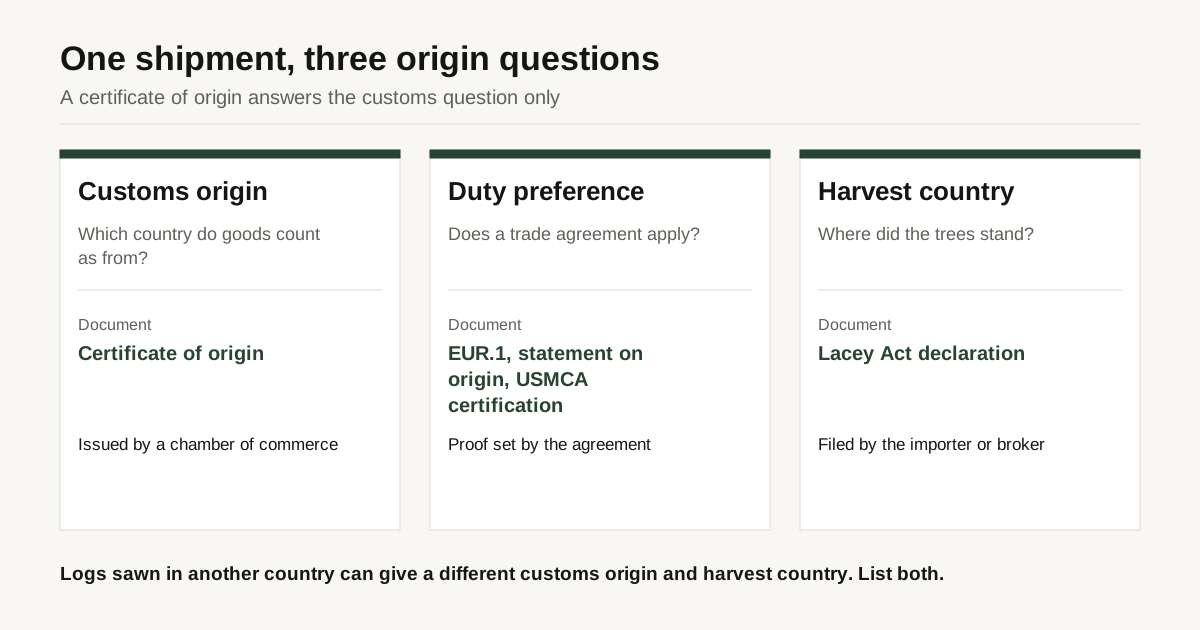
The non-preferential certificate
A non-preferential certificate of origin states the country of origin of the goods in a shipment. The ICC World Chambers Federation says certificates of origin authenticate the origin of exported goods, helping customs, banks and businesses determine tariffs, trade measures and compliance, and that they are issued by chambers of commerce. Chambers that join the ICC accreditation chain apply ICC guidelines and may show a quality label on their certificates. A verification platform for chain members helps customs and chambers check certificates.
A certificate of this kind does not lower the duty. It is a statement of origin used for customs files, marking, quotas or trade measures, or because a letter of credit or a buyer asks for it. For hardwood, the shipment is usually sawn wood under HS heading 4407, or continuously shaped wood such as flooring strips under 4409. The certificate describes the goods and the origin, signed and stamped by the chamber. It has no connection to the quality of the lumber.
Some importing countries ask for their own format or for legalization of the certificate. Confirm the destination requirement before you ship.
Preferential proofs
A preferential origin proof is a different thing. The importer uses it to claim a duty preference under a trade agreement. The goods must meet the agreement’s rules: the European Commission describes the general conditions as products wholly obtained or sufficiently worked or processed, with rules on tolerance, cumulation, insufficient operations, direct transport and non-manipulation. The agreement says which proof it accepts.
- EUR.1 or similar movement certificates are issued by the exporting country’s customs, in agreements that call for an official certificate.
- Statement on origin is made by the exporter on an invoice or another commercial document. In the EU system this is linked to REX registration. The European Commission’s guidance says an EU exporter must be registered in REX and indicate the REX number for consignments above a value threshold, and that below the threshold any exporter may make the statement. The threshold and rules are set in the legal text and the agreement, so confirm them with a broker.
- USMCA certification of origin. There is no prescribed format. It can be completed by the importer, exporter or producer. It must include the minimum data elements: certifier, exporter, producer and importer details, description and HS classification of the good, the origin criterion, an authorized signature and date and a certification statement, plus the blanket period if used. It can cover multiple shipments of identical goods for up to 12 months, and the importer must have it when the claim is made.
For a lumber exporter, the practical step is to ask the buyer’s broker whether any preference is being claimed. If it is, ask which proof the agreement accepts and which entries and statements have to appear on the commercial invoice.
Harvest country is a different field
Customs origin follows origin rules, which usually look at where the goods were wholly obtained or last substantially transformed. The Lacey Act declaration asks for the country where the plant was harvested. For a mill that buys logs from another country, the two can differ. A certificate that says “origin: country of the mill” does not remove the need to list the country of harvest on the Lacey declaration. Our page on the Lacey Act declaration explains the four fields.
The same is true of species identity. A certificate of origin does not name the species. Keep the botanical name on the invoice and the tally. Our page on EN 13556 timber names shows how trade names, codes and botanical names fit together.
Tariff measures depend on origin too. Our guide to the Section 232 lumber tariff and the guide to the US hardwood export China tariff explain two cases where the country on the paper changes the duty. Check the current text before relying on any figure.
Where the certificate sits in the document set
The certificate belongs to the set that an importer assembles. Our page on the hardwood lumber import documents checklist lists the full set: invoice, tally, transport document, plant health, origin, legality data and the drying record. Check each document against the others before the shipment leaves.
Common errors
| Error | Result | Fix |
|---|---|---|
| Goods description differs from the invoice | Customs query, delay | Copy description and HS heading from the invoice |
| Exporter name differs from the seller on the invoice | Rejection by the chamber or customs | Use the legal name on both |
| Origin stated as “Made in” the port country | Wrong origin, possible duty issue | State the country customs will treat as origin, after checking with the broker |
| Certificate issued after shipment without a note | Customs may refuse it | Apply before the shipment leaves |
| Species missing or only a trade name | Cannot be tied to the Lacey or CITES papers | Botanical name on every line |
| Preference proof used where the agreement does not allow it | Preference refused | Confirm the proof type with the broker |
| Certificate unstamped or unsigned | Rejected | Check stamp, signature and date before dispatch |
What a supplier can prepare
A mill that exports regularly can keep a one-page origin note per lot: species, harvest country, sawing country, invoice number and HS heading. With that note, the commercial invoice, the tally and a chamber application can be filled from the same data.
What a mill can say about itself
Hardwood Vendor does not issue certificates of origin or preference proofs, and does not advise on origin rules. Ask your customs broker or the chamber of commerce which document and wording apply to your route.
What to write on the RFQ
- Whether a non-preferential certificate of origin is required and who pays for it.
- Whether a preference is claimed and which agreement, so the supplier prepares the right proof.
- Country of harvest and country of sawing, listed separately.
- Botanical name on every invoice and tally line.
- Timing: the certificate applied for before the lumber ships, with the original sent with the documents.
Send your lumber RFQ with the origin documents you need, and we pass it to up to 3 mills or yards that say they can issue them.
RFQ line: Red oak (Quercus rubra group), No.1 Common, 4/4 rough, KD 6-8%, chamber of commerce certificate of origin with original stamp, country of harvest and country of sawing listed on invoice, botanical name on every line.
Frequently asked questions
Who issues a certificate of origin?
A non-preferential certificate of origin is normally issued by a chamber of commerce. The ICC World Chambers Federation runs a voluntary accreditation chain of chambers that apply its guidelines and show a quality label on their certificates. Preferential proofs come from customs or from the exporter, depending on the trade agreement.
Is a certificate of origin the same as the Lacey Act country of harvest?
No. A customs origin certificate states the country the goods are treated as coming from under origin rules. The Lacey Act declaration asks for the country where the plant was harvested. They can differ, for example when logs from one country are sawn in another. List both on the paperwork.
Do I always need a certificate of origin to import hardwood lumber?
No. Many shipments clear customs without one. You need a certificate when the importing country, the buyer, a letter of credit or a tariff measure asks for it, and a preference proof when you claim a duty preference under an agreement. Ask your customs broker which applies.
Does USMCA use a fixed form?
No. The USMCA has no prescribed format. A certification of origin can be completed by the importer, exporter or producer and must contain the minimum data elements. It can cover a single shipment or identical goods over a period of up to 12 months, and the importer must hold it when claiming the preference.
Sources
- ICC World Chambers Federation: certificates of origin
- European Commission: rules of origin (preferential)
- European Commission: REX system, general information
- European Commission: REX guidance document (May 2022)
- Arent Fox Schiff: who can make a USMCA certification
- APHIS: file a Lacey Act declaration (country of harvest)
Standards and rules are cited as references, not as claims about Hardwood Vendor or any mill. Editions and status change: confirm with the issuing body, your customs broker or the regulator.
Know what you need? Send the spec.
Tell us the species, grade, thickness and board feet. We pass it to up to 3 mills or yards that carry it and reply within 24 business hours.
Send my lumber RFQMore in lumber papers and certificates
- Lacey Act Declaration (PPQ 505) for Hardwood Lumber, Field by Field
- FSC Certified Hardwood Lumber: Certificate Codes, Claims and Scope
- Testing Lumber Moisture: Oven-Dry, Resistance and Capacitance Methods
- NHLA Inspection Reports for Hardwood Lumber: What a Graded-Lot Report Should Show
- Kiln Drying Quality: Moisture Spread, Gradient and Case Hardening Checks
- Hardwood Lumber Import Documents: The Set an Importer Should Receive