Guides / Cost and Ordering
How the China Tariff Fight Changed US Hardwood Lumber Supply for Buyers
January 11, 2027
US hardwood lumber sales to China are still falling while log sales to China have rebounded, and that split matters to anyone who buys lumber. In the first half of 2026 US hardwood lumber exports to Greater China fell 10.7% in value to $283.0 million, even though total hardwood exports to the region rose 17.4% to about $510 million on a 94.3% jump in log value. This guide uses that data to show which species are most tied to China, what the shift may mean for buyers elsewhere and what to do about it in quotes and contracts.
The figures come from a market report by the American Hardwood Export Council (AHEC) for Southeast Asia and Greater China, dated August 2026 and based on USDA data. AHEC represents exporters, so read it as directional and check it against your own quotes. The sections on buyer effects are my reading of the data, not published findings.
What the numbers show
| First half of 2026 | Value | Change on a year earlier |
|---|---|---|
| Hardwood lumber to Greater China | $283.0 million | down 10.7% (volume down 13.6% to 372,077 m3) |
| Hardwood logs to Greater China | $225.6 million | up 94.3% (volume up 74.3%) |
| All hardwood to Greater China | about $510 million | up 17.4% |
| Hardwood lumber to Southeast Asia | $147.2 million | up 4.8% |
| Hardwood logs to Southeast Asia | $336.9 million | up 46.7% |
| All hardwood to Southeast Asia | about $499.7 million | up 30.0% |
Two points follow. First, the recovery is in logs, and the same report describes the context as US-China tension, tariffs and an eight-month ban on US log imports. Lumber is still under pressure. Second, Southeast Asia is the larger and growing outlet for logs, while its lumber purchases barely moved.
Chinese traders quoted in the AHEC survey describe a split. Mid and high-end furniture and interior makers in China still rely on North American hardwoods such as ash and red oak. At the same time, buyers are de-risking by sourcing from European and Southeast Asian sawmills, and one trader worried that US share is being diluted over the long run. These are opinions gathered by phone and messaging, not statistics.
Lawmakers in a bipartisan letter of July 2026 asked the US Trade Representative to put hardwood lumber, not only logs, into the US-China framework. They said domestic hardwood lumber production has fallen 48.3% since 2018 and that China once took roughly 25% of it. Those are the lawmakers’ figures and I did not check them against a primary data series.
Which species depend on China
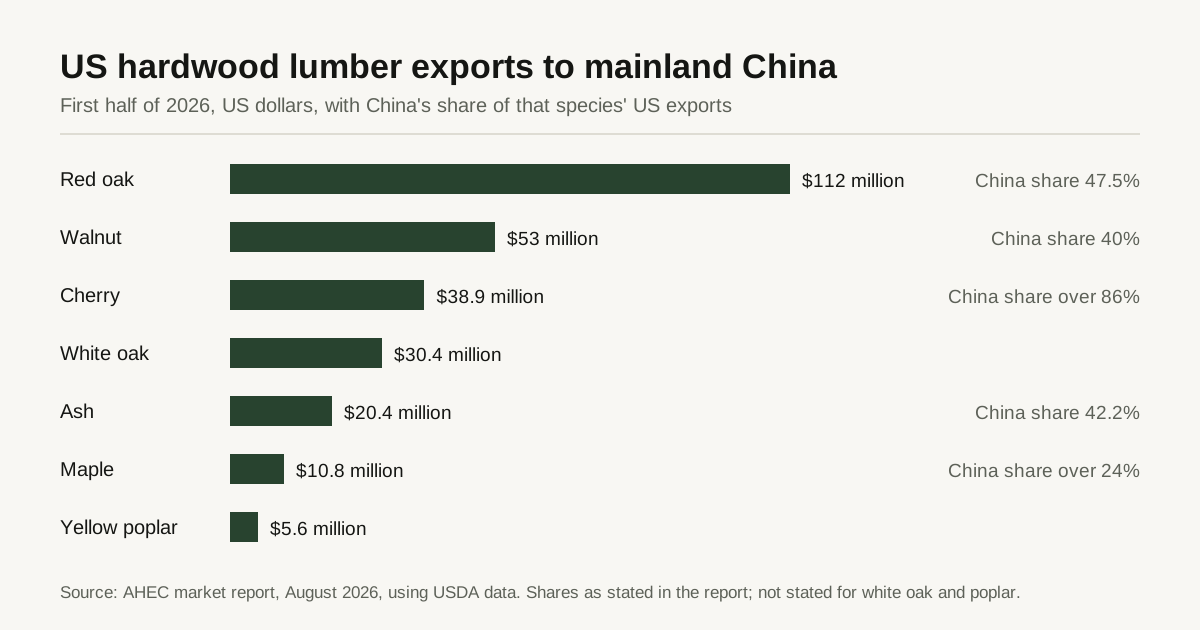
The AHEC report lists US lumber exports to mainland China by species for the first half of 2026 and the share of each species’ total US exports that went there:
| Species | Value to mainland China | Share of US exports of that species going to China |
|---|---|---|
| Red oak | $112 million | 47.5% |
| Walnut | $53 million | 40% |
| Cherry | $38.9 million | over 86% |
| White oak | $30.4 million | not stated |
| Ash | $20.4 million | 42.2% |
| Maple | $10.8 million | over 24% |
| Yellow poplar | $5.6 million | not stated |
Red oak, walnut, cherry, white oak, ash and maple together made up more than $265.9 million, over 95% of US hardwood lumber shipments to mainland China in the period. Cherry is the clear outlier. A species that sends 86% of its exports to one country is exposed to every change in that country’s market, up or down.
What it may mean for buyers outside China
Treat the points below as reasoning to test, not as findings.
- Species with high China exposure move most. If Chinese demand for cherry, ash, walnut or red oak softens, more lumber may be available to other buyers, and quotes may soften. If China cuts tariffs, the same species could tighten quickly. I found no public price series that quantifies either effect, so the check is your own quotes.
- Logs and lumber compete for the same trees. A 94% rise in log export value points to sawlog buyers paying for wood that US sawmills also want. That can raise log costs for mills. Whether it reaches the price of boards depends on grade, region and season.
- Southeast Asian mills are an outlet and a competitor. The region takes more US logs and sends sawn and manufactured wood to other markets. For a buyer, that adds more places to source a species, and also more places that compete for a US log.
- Relief is only proposed. China’s list under the 30-for-30 framework covers 146 US wood tariff lines in chapter 44, including hardwood lumber subheadings for oak, beech, maple, cherry, ash, birch and poplar, according to trade press in late September 2026. The reports say no rates and no start date were set. I could not open an official schedule showing the current Chinese duty on US hardwood lumber, so I do not give one.
What to do in quotes and contracts
- Quote the same spec twice. Ask two or three suppliers for the same species, grade, thickness and quantity now and again in 60 to 90 days. A matched comparison shows more than any headline. Our guide to board feet and hardwood pricing explains how to put quotes on one basis.
- Ask the supplier about its China share. A mill that sells a large part of its cherry or walnut to China is exposed to that market, and the price you are offered may move with it.
- Add a price review clause. For a blanket order, tie a review to a documented event, such as a published tariff change on the lines that matter to you, and not to a vague “market change”.
- Have a second species ready. If cherry or ash tightens, a substitute reduces the risk. See the hardwood species hub, and the guides on white ash supply and steamed vs unsteamed walnut.
- Check the full landed cost. Freight, packing and tally rules decide what you pay per usable board foot. See container loading, bundles and tally.
- Spread the sources. Our guide on how to choose a hardwood lumber supplier lists checks that apply when you add a second mill.
If you want quotes on a species that is in play, send your lumber RFQ with the species, grade, thickness, board feet and destination. We pass it to up to 3 mills or yards that say they can supply it, and they reply to you directly. Mills and yards that want to see these requests can register as a supplier.
Sources
- AHEC, Southeast Asia and Greater China market report, August 2026 (USDA export data)
- Rep. Chris Pappas, press release on the hardwood lumber letter to USTR, 2 July 2026
- Lesprom, China includes US hardwood lumber in its tariff-cut product list, 28 September 2026 (trade press)
- Scrap Monster, US secures hardwood lumber a place on China’s tariff relief list, 30 September 2026 (trade press)
Frequently asked questions
How much US hardwood lumber goes to China now?
In the first half of 2026 US hardwood lumber exports to Greater China were worth $283.0 million, down 10.7% in value and 13.6% in volume from a year earlier, according to the AHEC report built on USDA data. Total hardwood exports to the region rose 17.4% only because log shipments rebounded.
Which US hardwood species depend most on China?
In the first half of 2026 mainland China took over 86% of US cherry lumber exports, 47.5% of red oak, 42.2% of ash, 40% of walnut and over 24% of maple, per the same report. Red oak was the largest line at about $112 million. The more a species depends on China, the more a change there moves its supply.
Are China's tariffs on US hardwood lumber going down?
Not yet. US hardwood lumber is among 146 wood tariff lines on China's list under the US-China 30-for-30 framework published in September 2026, but trade press reports no rates and no start date. Any cut must go through each country's legal process. Treat it as possible relief, not a plan.
Does weak China demand make US lumber cheaper for other buyers?
It can, but I found no public price series that shows how much. Less demand from one large buyer can leave more lumber for others, while log exports rising can tighten sawlog supply. The practical test is to get quotes on the same grade, species and thickness at two dates and compare them.
Know what you need? Send the spec.
Tell us the species, grade, thickness and board feet. We pass it to up to 3 mills or yards that carry it and reply within 24 business hours.
Send my lumber RFQ