Home / Lumber grades and size rules / Hardwood Dimension Stock: Cut Size Specs, Face Rules and Yield Math
Hardwood Dimension Stock: Cut Size Specs, Face Rules and Yield Math
Reference page · Last reviewed 10 March 2027
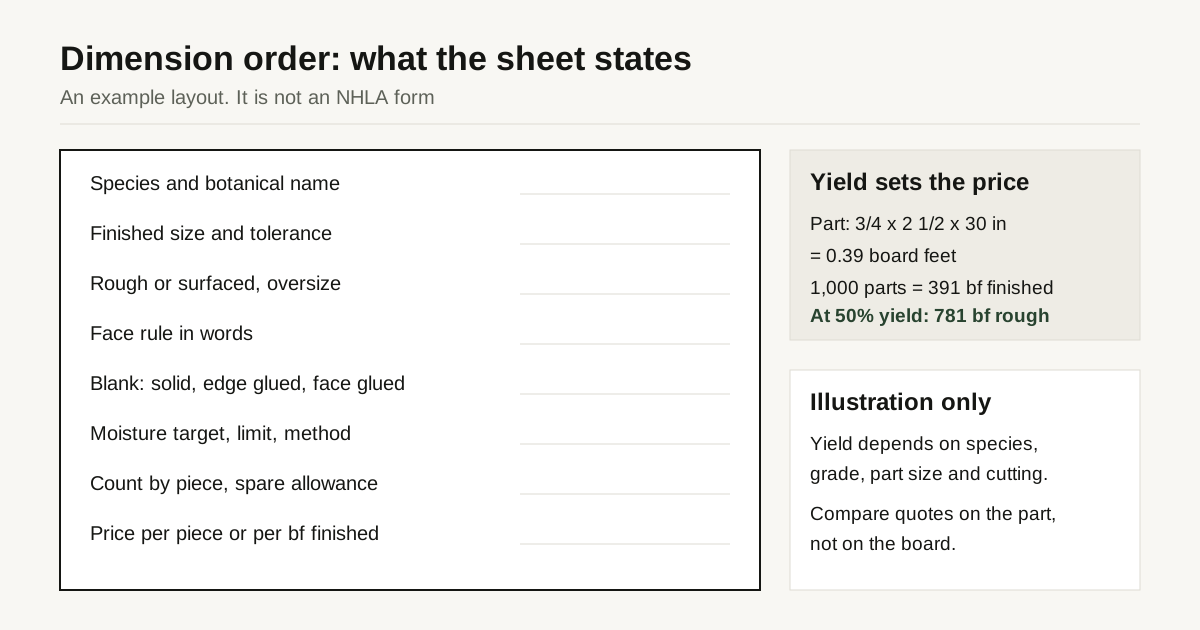
Dimension stock is hardwood cut to the size of the part before it reaches your plant. That changes what you write on the order. For lumber, the grade rule carries most of the spec. For dimension stock, the part drawing carries it, and the grade only tells you what the mill started from. This page lists what a dimension order should state and shows the arithmetic that sets the price.
| Spec line | What to write | Why it matters |
|---|---|---|
| Species and botanical name | Hard maple (Acer saccharum), not just “maple” | Species changes hardness, color and the paperwork |
| Finished size | Thickness x width x length, with a tolerance | The part you will machine next |
| Rough or surfaced | Rough, S2S, S4S or ripped and crosscut only | Decides the oversize allowance |
| Face rule | Which faces must be clear, which may show sound defects | Replaces the lumber grade for the part |
| Blank type | Solid, edge glued or face glued | Glue lines, color match and moisture risk |
| Moisture | Target and upper limit, with the test method | Parts move after cutting if the stock is wet |
| Count and tally | By piece, with spare allowance | Dimension is bought by the part, not by the board |
| Packing | Bundled by size, end sealed, labeled | Protects the stock and speeds receiving |
What NHLA grades cover and what they do not
NHLA grades describe lumber that will be cut into smaller pieces. A board’s grade depends on how much of it can be cut into clear pieces of a minimum size. The factory grades, FAS, F1F, Selects, No.1 Common and No.2A Common, are clear face cuttings grades, and No.2B Common is the sound cuttings grade, where sound defects are admitted in the cuttings. Our NHLA grades guide and the Selects and F1F page show the numbers.
The USDA and extension summaries that describe these grades say plainly that a summary is not the full rulebook. The rulebook holds exceptions by species and special rules. No public, widely cited grade set for finished dimension parts turned up in the sources used for this page, so the page does not quote one. Do this instead:
- Name the rulebook edition if you refer to NHLA at all.
- Write the face rule for the part in your own words: for example “both faces clear, edges and ends sound” or “one face clear, reverse face sound defects allowed”.
- Attach the drawing or a photo of an accepted part.
That is how a buyer and a mill agree when no published dimension grade is named. It is also how a cabinet or furniture plant writes the same rule twice, once for the show face and once for the hidden face.
From lumber grade to part yield
A dimension order is a yield problem. The mill chooses a grade of board, cuts out the clear pieces and discards the rest. The cost per part is the cost of the board divided by the parts it yields, plus the cutting.
The arithmetic uses board feet. One board foot is 144 cubic inches of finished volume.
| Step | Example part | Result |
|---|---|---|
| Part size, finished | 3/4 x 2 1/2 x 30 in | 56.25 cubic inches |
| Board feet per part | 56.25 / 144 | 0.39 bf |
| Parts needed | 1,000 | 390.6 bf of finished parts |
| Rough lumber at 50% yield (illustration) | 390.6 / 0.50 | 781 bf of rough |
| Rough lumber at 40% yield (illustration) | 390.6 / 0.40 | 977 bf of rough |
The yield figures are illustrations, not typical values. Real yield depends on species, grade, part size, kerf and planing losses and how the mill cuts. The point is that a 10-point yield change moves the rough lumber need by about a quarter. A lower grade of board at a lower price per board foot can cost more per part, and a higher grade can cost less. Ask the mill for its yield basis or for a price per piece, and compare quotes on the part, not on the board.
The same logic explains why Common grades exist. The upper grades suit long clear work, and the Common grades are meant to be cut into shorter clear pieces. That favors Common grades for short parts. For long parts, such as stair stringers or door stiles, the upper grades give more usable length per board. Our guide to rough lumber versus S4S versus dimension parts compares the product forms. The guide to straight line rip and gang rip edge options covers how edges are prepared before cutting.
Sizes and oversize allowance
Write the size twice: the finished size you need and the size the mill ships.
- Finished size and tolerance. For example 3/4 in thick, plus or minus an agreed amount, measured at a stated moisture.
- Rough oversize. If your plant planes and rips the parts, the mill ships oversize in thickness, width and length. The allowance depends on your machines and on how much the stock will move, so agree it on the order.
- Crosscut or random length. Say whether the parts are cut to length, cut to a length range or sold in random lengths with a minimum.
- Imperial and metric. The NHLA rules are written in inches and feet. If your drawing is metric, give both units and say which one is the reference.
Solid, edge glued and face glued blanks
A blank is a piece cut or glued to a size larger than the part.
- Solid blanks come from one board. Color and grain match within the part, and width is limited by the board.
- Edge glued blanks join strips side by side to make a wider panel. The spec should name the glue line spacing, the color match rule and how strips are arranged for balance.
- Face glued blanks build thickness by laminating boards flat. They are used for legs and thick parts. Name the number of plies and the grain direction.
Name the adhesive type if the part has a service condition such as moisture or heat. Do not rely on the word “glued” alone.
Defects, color and sorting
Face rules are easiest to set when you list what you accept and what you refuse:
| Item | Common ways to write it |
|---|---|
| Knots | None on show faces. Sound tight knots up to a stated size on hidden faces |
| Stain and color | Natural color variation accepted. Sticker stain, mineral streak or sapwood limits stated per species |
| Checks and splits | None through the part. End checks removed |
| Wane | None on finished dimension |
| Worm holes | Pin holes accepted on hidden faces only, or none |
| Heartwood and sapwood | Mixed, sapwood only or heartwood only for colors that matter |
For species where color matters, such as hard maple (white sapwood) or walnut (dark heartwood), also say whether a color sort is required.
Moisture and stability
Parts cut from drier wood stay closer to size. Ask for a moisture target and an upper limit, the method that decides disputes and a sampling plan. Our page on lumber moisture test methods explains the oven-dry reference and the meters. Parts that are cut and surfaced should be bundled and wrapped soon after cutting, because thin pieces take up moisture quickly in damp storage. End sealing on long parts reduces end checking in transit.
Tally and receiving
Dimension is counted by the piece. A tally should show quantity by size, plus the spare allowance the order permits. Ask for a count by bundle and a label on each bundle with the size, species and lot. Our guide to hardwood lumber tally covers the habits that carry over from lumber.
On receipt:
- Count the pieces in a sample of bundles against the label.
- Measure a sample against the drawing, in all three directions.
- Check the show faces against the face rule, with the accepted part photo in hand.
- Check moisture on a sample.
- Record the result against the order and send it to the supplier the same day.
What a mill can say about itself
Hardwood Vendor does not cut dimension parts, grade them or set any dimension rule. A mill that quotes dimension stock should state its yield basis, its face rule and its tolerance in writing. Ask for a sample or a photo of an accepted part before the first order.
What to write on the RFQ
- Species and botanical name, and the color sort if it matters.
- Part drawing or finished size with tolerance, and the rough oversize if you plane.
- Face rule in words, and the reference photo.
- Blank type: solid, edge glued or face glued, with glue line rules.
- Moisture target, upper limit and test method.
- Quantity by piece, with the spare allowance and the pricing basis (per piece or per board foot of finished parts).
- Packing: bundled by size, end sealed, labeled.
Send your lumber RFQ with the part size and the face rule, and we pass it to up to 3 mills or yards that cut dimension stock.
RFQ line: Hard maple (Acer saccharum), dimension stock 3/4 x 2 1/2 x 30 in S4S, one face clear and reverse sound, solid blanks, KD 6-8%, count 1,000 pieces plus 2%, priced per piece, bundles labeled by size.
Frequently asked questions
Are there NHLA grades for dimension parts?
NHLA grades are written for lumber that will be cut up: they rate the clear cuttings a board yields. The factory grades from FAS to No.2B Common are the ones in common use. No current, widely quoted public grade set for finished dimension parts was found for this page, so write the face rules for the part into the order and confirm in the NHLA rulebook that nothing in the edition you name changes them.
What is the difference between dimension stock and lumber?
Lumber is sold in random widths and lengths by board foot. Dimension stock is cut to the sizes of the part, usually priced by the piece or by the board foot of finished parts, and often surfaced or glued into blanks. The buyer's drawing replaces the grade as the main spec.
Why does the price per piece change with grade?
Higher grades yield more usable parts per board, and lower grades yield fewer. The mill prices the part from the board cost divided by the yield, plus cutting and surfacing. A cheaper board can cost more per part if the yield is low.
Should I buy rough dimension or surfaced dimension?
Rough dimension leaves the final planing to your plant and needs extra thickness and width. Surfaced dimension arrives at finished size with a tolerance. Choose by what your machines do next, and write the oversize allowance on the order.
Sources
- American Hardwood Export Council: grading sawn lumber
- American Hardwood Export Council: NHLA grades (clear face and sound cuttings grades)
- NHLA: grading rules and four-year review
- Purdue Extension FNR-130: Lumber grades (summarizing the 1998 NHLA rules)
Standards and rules are cited as references, not as claims about Hardwood Vendor or any mill. Editions and status change: confirm with the issuing body, your customs broker or the regulator.
Know what you need? Send the spec.
Tell us the species, grade, thickness and board feet. We pass it to up to 3 mills or yards that carry it and reply within 24 business hours.
Send my lumber RFQMore in lumber grades and size rules
- FAS Lumber: What the Firsts and Seconds Grade Allows
- NHLA Measurement Rules: Surface Measure, Board Feet and Tally Rounding
- Selects and F1F Hardwood Lumber: When One Clear Face Is Enough
- EN 1313-2: Permitted Deviations and Preferred Sizes for Hardwood Sawn Timber
- EN 13556 Timber Names: How to Read Trade Names and Codes on a European Quote
- Hardwood Flooring Stock Grades: NWFA and NOFMA Names, Lengths and the EN 14342 Note