Home / Lumber grades and size rules / Selects and F1F Hardwood Lumber: When One Clear Face Is Enough
Selects and F1F Hardwood Lumber: When One Clear Face Is Enough
Reference page · Last reviewed 3 March 2027
Selects and FAS One Face (F1F) are the grades for buyers who need one clean face and do not need the back to match. Each board has a better face that meets FAS and a poorer face that meets No.1 Common. The back can be used where it is hidden, which is why these grades can cost less than FAS for the same part.
| Grade | Face rule | Typical minimum board | Typical yield |
|---|---|---|---|
| FAS | Both faces meet FAS (poorer face decides) | 6 in wide, 8 ft long | 83 1/3% (10/12) clear cuttings |
| F1F (FAS One Face) | Better face FAS, poorer face No.1 Common | 6 in wide, 8 ft long (trade summaries, check) | Better face 83 1/3% |
| Selects | Better face FAS, poorer face No.1 Common | 4 in wide, 6 ft long | Better face 83 1/3% |
| No.1 Common | Poorer face decides | 3 in wide, 4 ft long | 66 2/3% (8/12) to under 83 1/3% |
| No.2A Common | Poorer face decides | 3 in wide, 4 ft long | 50% (6/12) to under 66 2/3% |
The NHLA rulebook governs. Sizes and yields are typical figures from published summaries. The F1F minimum comes from trade summaries and one extension summary describes F1F as Selects with a 6 in width requirement, so check it in the rulebook edition your contract names.
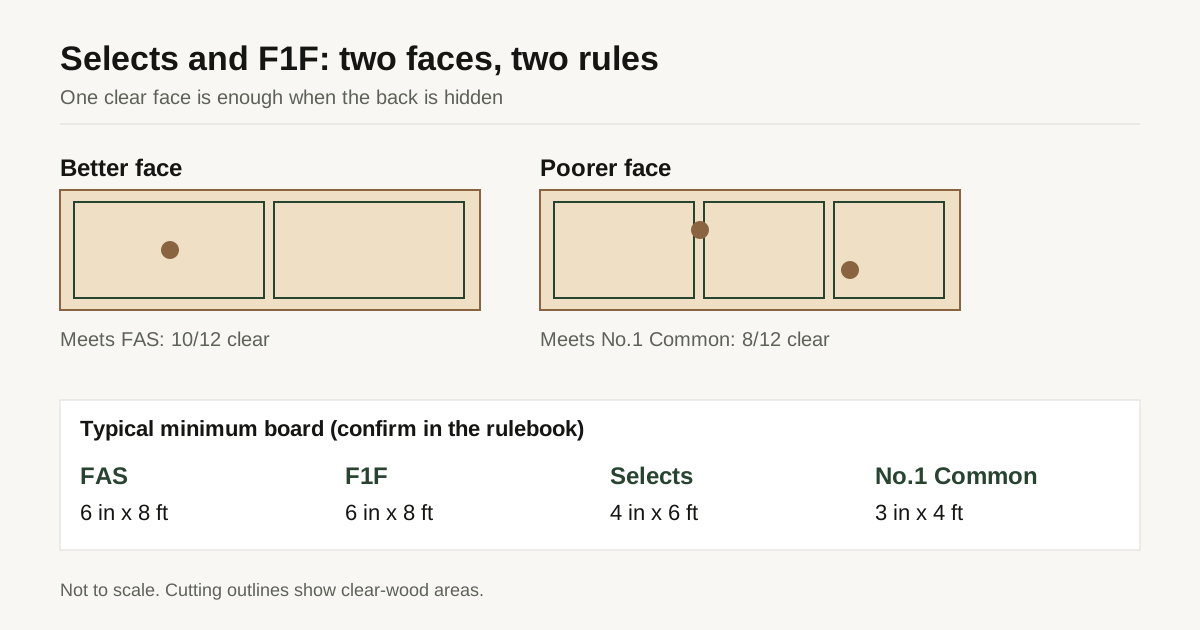
How the grade is decided
For most NHLA grades the board is graded from its poorer face. The grader counts clear cuttings of a minimum size on that face and checks that they cover the share of the surface that the grade asks for. For FAS the share is 10/12 of the surface. For No.1 Common it is 8/12.
Selects and F1F break that pattern. The better face has to meet the FAS rule. The reverse face has to meet No.1 Common. Purdue Extension adds that the reverse side of the cuttings does not have to be sound for these two grades, and that special wane limits apply to each of them. In practice a Selects board can have a clear, good face and a back with knots, as long as the back still meets the No.1 Common yield.
Where Selects and F1F fit
Because the back is allowed to be plainer, these grades suit parts where only one side is seen. The rule is simple: if both faces of the part will be visible, use FAS. If one face is hidden, F1F or Selects can supply the same visible quality.
| Part | Faces seen | Grade to quote |
|---|---|---|
| Cabinet door stiles and rails, painted or stained on the front | Front only | Selects or F1F, or FAS if both sides show |
| Face frames | Front only | Selects or F1F |
| Drawer fronts | Front only | Selects or F1F |
| Table tops and panels | Both faces may show | FAS or the better face on the top, agreed in writing |
| Stair treads | Top and nosing | FAS, or Selects with the better face up |
| Interior parts, drawer sides, backs | Hidden | No.1 Common or a lower grade |
This is a practical rule drawn from how the grades are defined, not an NHLA requirement. Tell the mill which face is the show face, and ask how it marks that face in the bundle. Our guide to NHLA lumber grades explains the other grades.
Selects and better, F1F and better
Many mills sell Selects and better (the Selects and FAS grades together) or F1F and better as one price. That is a mix: FAS boards and Selects boards in one pile. Purdue Extension notes the practice. Before you accept it, ask what share of the load is FAS and what share is Selects or F1F. If your parts use the better face only, the mix is fine. If both faces show, you need a FAS-only quote.
Species and size exceptions
The standard rule is written for the common species. Some species have their own modifications:
- Walnut and butternut: FAS admits shorter and narrower boards than the standard 6 in by 8 ft. Purdue Extension lists a 5 in minimum width and boards 6 and 7 feet long.
- Cherry: small knots not over 1/8 inch in diameter can be admitted in the cuttings under the rule for that species.
- Oak: plain red oak and white oak follow the standard rule, with a consideration for mineral stain.
Confirm the species rule and the rulebook edition for the species you buy. Our guide to hardwood grading rules compared shows how NHLA names relate to European and other systems, and the measurement rules page explains how surface measure sets the number of cuttings.
How to check a Selects shipment
- Ask which face the mill graded as the better face, and that it is marked.
- Pull a sample of boards across several bundles and look at the better face first.
- Turn the board over and check the reverse face against No.1 Common.
- Measure a few boards against the minimum size of the grade you bought. A board narrower or shorter than the minimum is out of grade, whatever its faces look like.
- Write the result against the contract grade. For the process of agreeing a pre-shipment check, read pre-shipment lumber grading.
What to write on the RFQ
Quote the grade name, the face rule and the share of FAS if the mix is “and better”. Say which face is the show face. Then send your lumber RFQ and we pass it to up to 3 mills or yards that carry that grade.
RFQ line: Hard maple (Acer saccharum), Selects, 4/4 rough, KD 6-8%, better face FAS, NHLA edition named, no FAS-only requirement.
Frequently asked questions
What is the difference between Selects and F1F?
Both need one face that grades FAS and a reverse face that grades No.1 Common. Published summaries differ on size: F1F is listed at 6 inches wide and 8 feet long, and Selects at 4 inches wide and 6 feet long. Check the minimums in the rulebook edition your contract names.
Is F1F cheaper than FAS?
Usually yes. Purdue Extension notes that Selects and F1F were priced somewhat below FAS, and that many mills now sell Selects and better, or F1F and better, at one price. Prices move with species and market, so treat any ratio as something to ask for in the quote.
Which face is graded on a Selects board?
Most NHLA grades are decided from the poorer face. Selects and F1F are the exceptions: the board is judged on a better face that meets FAS and a reverse face that meets No.1 Common.
Do walnut and cherry follow the same Selects rules?
Not exactly. Some species have their own modifications. Purdue Extension notes, for example, that walnut and butternut FAS admits shorter and narrower boards than the standard grade. Ask the mill which species rule it applies.
Sources
- American Hardwood Export Council: NHLA grades (FAS, F1F, Selects, No.1 Common, No.2A and 2B Common)
- Purdue Extension FNR-130: Lumber grades (face rules, wane, walnut and cherry modifications, summarizing the 1998 NHLA rules)
- NHLA: grading rules and four-year review
Standards and rules are cited as references, not as claims about Hardwood Vendor or any mill. Editions and status change: confirm with the issuing body, your customs broker or the regulator.
Know what you need? Send the spec.
Tell us the species, grade, thickness and board feet. We pass it to up to 3 mills or yards that carry it and reply within 24 business hours.
Send my lumber RFQMore in lumber grades and size rules
- FAS Lumber: What the Firsts and Seconds Grade Allows
- NHLA Measurement Rules: Surface Measure, Board Feet and Tally Rounding
- EN 1313-2: Permitted Deviations and Preferred Sizes for Hardwood Sawn Timber
- EN 13556 Timber Names: How to Read Trade Names and Codes on a European Quote
- Hardwood Flooring Stock Grades: NWFA and NOFMA Names, Lengths and the EN 14342 Note
- Hardwood Dimension Stock: Cut Size Specs, Face Rules and Yield Math