Guides / Grades and Specs
Hardwood Grading Rules Compared: NHLA, European and Tropical Grades and What to Name on an Order
February 18, 2027
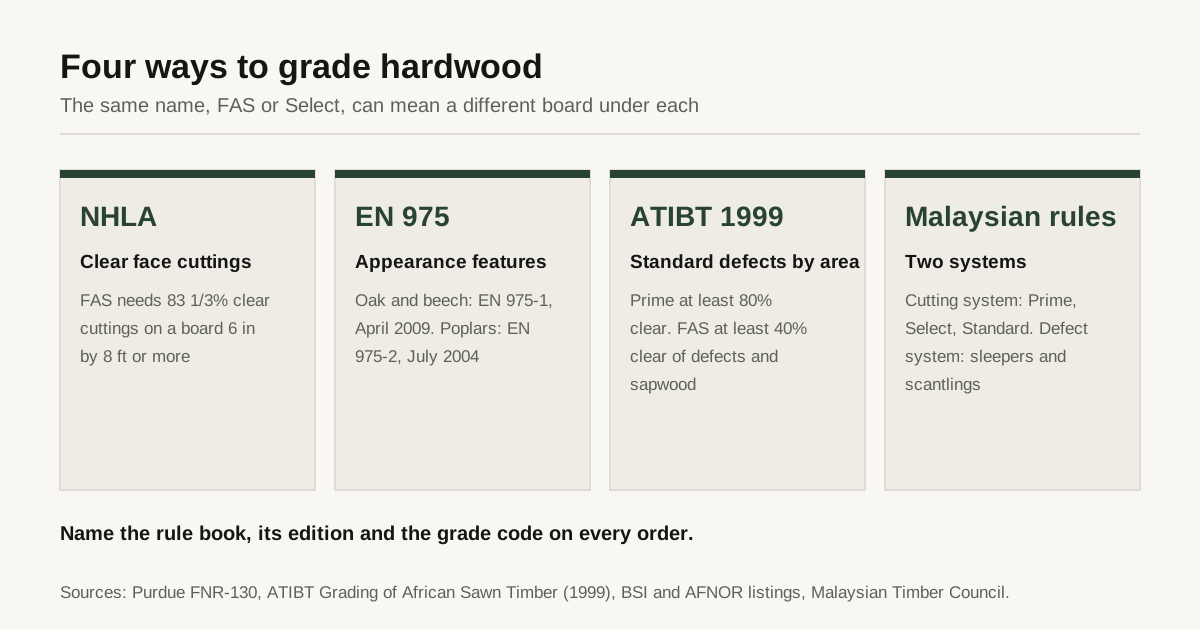
Hardwood grading rules are not interchangeable. NHLA grades measure the clear wood a board yields, the ATIBT rules for African timber count standard defects against piece size, EN 975 sets appearance limits by product type and the Malaysian rules use two systems side by side. The same name, FAS or Select, can mean a different board under each, so the order has to name the rule book. This post is part of our guide to hardwood lumber specifications, and it compares the four main systems so you can name the right one.
Hardwood Vendor is a matching service, not a sawmill. We own no mills, kilns or stock, and nothing here ranks one origin above another. Values below are typical and come from the sources listed, and the rule books govern. The NHLA rulebook text was not read for this post; the NHLA figures come from the Wood Handbook and a Purdue summary of the 1998 rules.
The four systems at a glance
| Criterion | NHLA (North American hardwoods) | EN 975 (European oak, beech, poplar) | ATIBT 1999 (African sawn timber) | Malaysian Grading Rules |
|---|---|---|---|---|
| What it measures | Clear face cuttings as a share of the board | Appearance features allowed, judged visually, by product type | Number of standard defects by piece area, plus clear share | Cutting system and defect system |
| Top grade name | FAS | Codes such as QBA and QF2 | Prime, then FAS | Prime, then Select |
| Top grade test | 83 1/3% clear cuttings, 6 in by 8 ft board | Not read (standard text is paywalled) | Prime: at least 80% clear. FAS: at least 40% clear | Percent clear cuts, licensed grader |
| Face graded | Poorer face, except FAS 1-Face and Selects | Not read (standard text is paywalled) | Worse face | Per rules |
| Units | Inches, feet, board feet | Not read for part 1 (part 2 is in mm) | Meters, centimeters | Per rules |
| Public text | Rulebook from NHLA, public summaries | Standard sold by national bodies | PDF on the ATIBT site | Overview on the MTC site |
Caption: Purdue FNR-130 and Wood Handbook (NHLA); BSI and AFNOR listings and AHEC (EN 975); ATIBT, Grading of African Sawn Timber, April 1999; Malaysian Timber Council overview. Typical values; the current rule books govern.
How each system measures a board
NHLA is a calculation. The Wood Handbook says that since 1932 the grade has been set by the proportion of a piece that can be cut into clear cuttings of a minimum size. Purdue gives the arithmetic: a 12 in by 12 ft FAS board has a surface measure of 12 and needs 120 of its 144 units in clear cuttings, which is 10/12 or 83 1/3%. The Wood Handbook adds that, before 1932, grading was based on the number and size of visual features.
The ATIBT rules start by saying there are two methods in the world: counting standard defects against piece size, and grading by clear surface. The grade text of the African traditional rules combines a clear percentage with a cap on standard defects by piece area. A standard defect is, for example, one knot of 16 to 32 mm, and a piece under 1.00 m² may have one such defect in Prime or FAS, a piece of 1.00 to 1.50 m² two, and a larger piece three. Percentages in those rules are calculated by volume. AHEC describes European temperate hardwood grading as the visual judgment of an individual grader, and says that can differ between mills and countries. AHEC promotes American hardwoods, so read that comparison as its view.
Read more: NHLA lumber grades explained: FAS, Select and Common.
The ATIBT grade ladder
The ATIBT edition of April 1999 sets out the grades in the table below. It says its rules define the poorest piece allowed in each grade, that each piece is graded on its worse face and that a parcel as a whole must be representative of species and grade.
| Grade | Clear of defects and sapwood | Sapwood allowed | Standard defects by piece area |
|---|---|---|---|
| Prime | At least 80% | Clear sapwood up to 5% of width | 1 under 1.00 m², 2 from 1.00 to 1.50 m², 3 above |
| FAS | At least 40% | Clear sapwood up to 10% of width | Same as Prime |
| No.1 Common and Select | Not stated | Clear sapwood up to 20% of width | 1 under 0.60 m², 2 to 1.00 m², 3 to 1.50 m², 4 above |
| No.2 Common | Not stated | Clear sapwood without limit | Same as No.1 Common and Select |
Caption: ATIBT, Grading of African Sawn Timber, April 1999, sections 2 and 3. The edition may have been revised since; check the current ATIBT text.
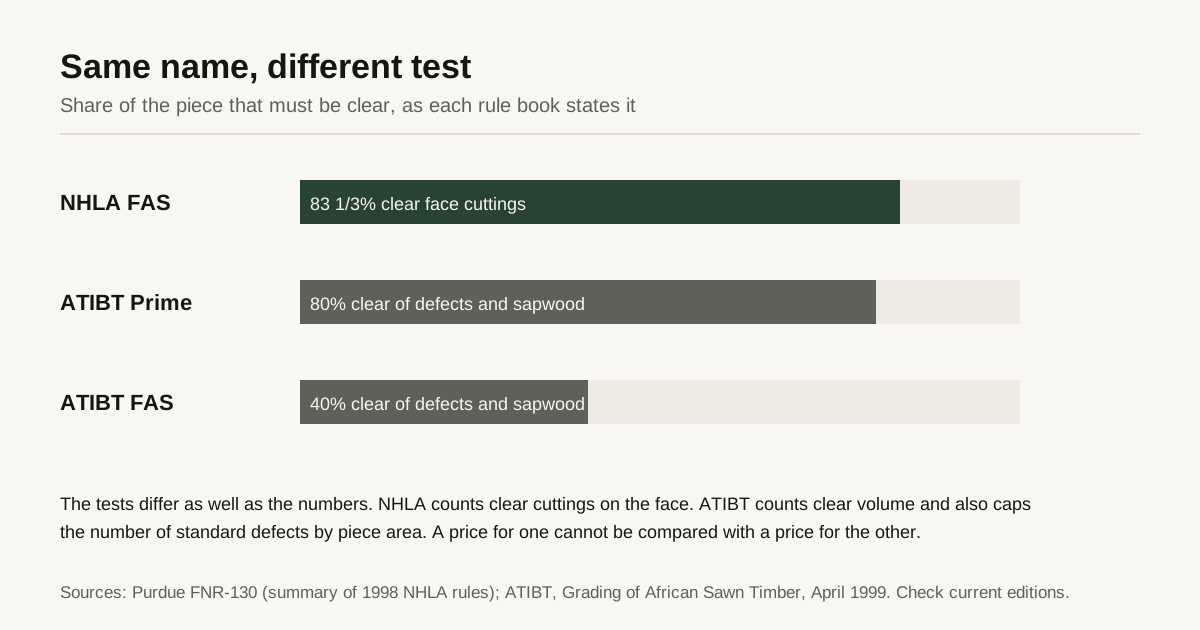
Compare the two FAS grades. NHLA FAS needs 83 1/3% clear face cuttings on at least a 6 in by 8 ft board. ATIBT FAS needs at least 40% clear of defects and sapwood, with defects capped by piece area. Same letters, different wood. Neither is wrong, but a price quoted for one cannot be compared with a price quoted for the other.
European standards
EN 975-1 covers oak and beech: the BSI edition is dated 30 April 2009 and is listed as current and under review. It sets quality rules for appearance-graded temperate hardwood and covers rough sawn and regularized products. EN 975-2 covers poplars, applies to boards 15 to 34 mm thick and 100 to 250 mm wide and is dated July 2004 in the AFNOR listing. I could not open the full text of either, which is sold by national standards bodies, so the details of knot limits are not repeated here.
For oak, grade codes such as QBA and QF2 and the flooring trade labels that sellers use are covered in our post on European oak lumber grades. For comparison purposes, the supplier guides behind that post describe allowed features, not a clear yield, so an NHLA grade and an EN code do not appear to convert one to one.
Malaysian rules and other origins
The Malaysian Timber Council describes the Malaysian Grading Rules as two systems. The cutting system grades by the share of defect-free cuts and is used for timber that will be re-sawn. Its grades are Prime, Select, Standard, Sound, Serviceable and Utility. The defect system allows certain natural imperfections that do not affect use and covers items such as sleepers and scantlings. A suffix “& UP” means the lowest piece meets the stated grade and the parcel may include better pieces. The Malaysian Timber Industry Board is named as the grading authority, grading is done by licensed graders and Board inspectors can check-grade on request.
For other origins I found no public text of a national sawn hardwood grading rule from Indonesia or Brazil that I could open. AHEC says the NHLA rules generally apply to North American commercial species with a few exceptions. If a seller of another origin quotes NHLA grade names, do not assume the NHLA rules were applied in full, and ask for the written grading rule or the seller’s own limits.
Sapwood, color and measure
Rules differ on sapwood. NHLA grades judge clear area, and AHEC lists sapwood and heartwood as characteristics, not defects, so sapwood is accepted unless you order a color sort. ATIBT sets a sapwood limit by grade, as the table shows. Units differ too. The ATIBT rules round lengths down to whole decimeters and widths down to whole centimeters, give a standard length of 1.80 m and up and a minimum width of 15 cm, and require the contract thickness at 20% moisture content, with permitted excess thickness for shipping dry lumber of 2 mm up to 49 mm, 3 mm for 50 to 75 mm, 4 mm for 76 to 100 mm and 6 mm above. AHEC says American hardwoods are typically kiln dried to 7 to 9% and European hardwoods to about 10 to 12%. So a metric quote and an inch quote differ in moisture basis as well as in units.
Which rule to name
| Choose | When |
|---|---|
| NHLA | North American species, board foot pricing and a yield you can calculate from your cut list |
| EN 975 | European oak, beech or poplar sold in metric sizes, with the code and product letter written out |
| ATIBT | African species sold in meters, with the 1999 text or the current edition named |
| Malaysian rules | Southeast Asian species where the seller grades to the MGR, and the grade carries the licensed grader’s mark |
| Seller’s own grade | Only with written limits, photos and a sample, because nothing public defines it |
Picking wrong costs money in a specific way. A buyer who reads a 40% clear FAS as an 83 1/3% FAS gets a lower cutting yield than the cut list assumed, and the shortfall shows up on the rip line, not at the gate. Run a cut list through a sample of the lot before a large order.
What to write on the RFQ
- The rule book, with its edition year, for example “NHLA rules, current edition” or “ATIBT Grading of African Sawn Timber, April 1999”.
- The grade code exactly as the rule book writes it.
- The face that is graded, and whether grading is rough or surfaced.
- Sort lines on top of the grade: sapwood, color, width, length.
- The measure basis: board feet or cubic meters, and the moisture at which thickness is checked.
- The inspector or dispute route named in the rule book.
For the rest of the order, follow the hardwood lumber specifications stack, then send your lumber RFQ. We pass it to up to 3 mills or yards that say they carry it, and they quote you directly.
Sources
- Purdue Extension, FNR-130 Hardwood lumber grades (summary of the 1998 NHLA rules)
- USDA Forest Products Laboratory, Wood Handbook chapter 5, Commercial Lumber (FPL-GTR-113, 1999)
- American Hardwood Export Council, Technical Matters 6: hardwood lumber grading
- American Hardwood Export Council, Technical Matters 3: kiln drying
- ATIBT, Grading of African sawn timber, April 1999 edition (PDF)
- Malaysian Timber Council, Malaysian Grading Rules
- BSI, BS EN 975-1:2009 Appearance grading of hardwoods, oak and beech
- AFNOR, NF EN 975-2 poplars
Frequently asked questions
Is FAS the same grade everywhere?
No. NHLA FAS needs 83 1/3% clear face cuttings on a board at least 6 in wide and 8 ft long. The ATIBT rules for African timber also have a grade called FAS, but define it as not less than 40% clear of defects and sapwood, with limits on the number of standard defects. Name the rule book on the order.
Which grading rules apply to European oak?
European oak and beech are covered by EN 975-1, whose BSI edition is dated April 2009. BSI describes it as an appearance-grading standard, and the supplier guides cited in our European oak post describe allowed features rather than a clear yield. NHLA grades do not convert to it one to one, so a quote has to state the system and the code.
Can I order tropical hardwood by NHLA grade?
AHEC says the NHLA rules generally apply to commercial North American hardwoods, with a few exceptions. Tropical sellers often use African, Malaysian or house rules. Some may quote NHLA names, but I found no public text that defines that practice, so ask for the written rule and limits.
What should the order say about grading rules?
Name the rule book, its edition year, the grade code and the face that is graded. Add any sort, such as sapwood or color, as a separate line. If the supplier uses its own grades, attach its written limits and photos of a typical lot.
Know what you need? Send the spec.
Tell us the species, grade, thickness and board feet. We pass it to up to 3 mills or yards that carry it and reply within 24 business hours.
Send my lumber RFQ