Home / Lumber papers and certificates / Is Solid Hardwood Lumber Covered by the TSCA Title VI Formaldehyde Rules?
Is Solid Hardwood Lumber Covered by the TSCA Title VI Formaldehyde Rules?
Reference page · Last reviewed 25 March 2027
The US formaldehyde rule for wood, TSCA Title VI (40 CFR part 770), covers three kinds of panel: hardwood plywood with a veneer or composite core, medium-density fiberboard and particleboard. Sawn hardwood lumber is not one of them. The rule does reach component parts and finished goods that are made from those panels, so a lumber order that includes panel-based mouldings, stair parts or blanks is where the question comes up. This page reads the scope of the rule for a lumber buyer. It is not legal advice.
| Product in a lumber order | Covered by the Title VI emission rules? | Basis |
|---|---|---|
| Sawn hardwood boards, rough or surfaced | Not one of the three product types | 770.3 definition of composite wood product |
| Finger-jointed lumber | Named exclusion | 770.1(c)(9) |
| Glued laminated lumber (structural) | Named exclusion | 770.1(c)(7) |
| Wood packaging, pallets, crates, dunnage | Named exclusion | 770.1(c)(10) |
| Edge-glued solid wood blank | Not named. Not a panel with veneer or composite core | Ask the broker |
| Veneered panel with MDF or particleboard core | Covered. Hardwood plywood, laminated product | 770.3, 770.4 |
| MDF or particleboard | Covered | 770.3 |
| Component part or finished good with a covered panel inside | Covered through the panel it contains | 770.1(b)(3), 770.30 |
This page is general information as of October 2026, based on the eCFR text of 40 CFR part 770. Confirm your own product with a customs broker or counsel.
What the rule covers
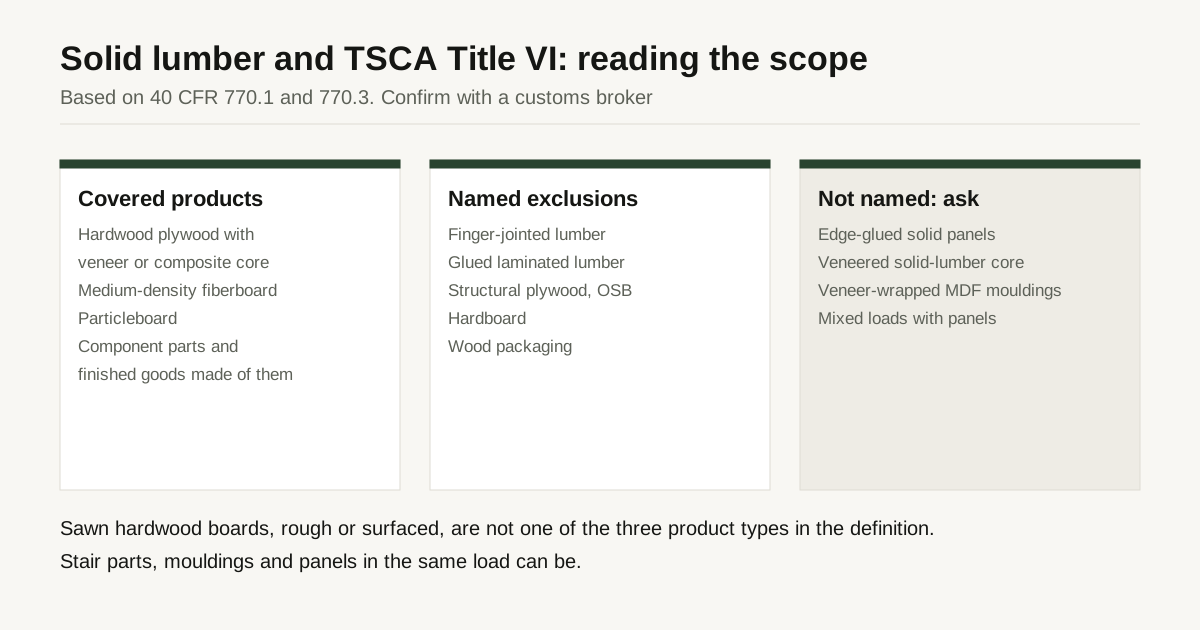
40 CFR 770.1 says the part applies to composite wood products, and to component parts or finished goods that contain them, that are sold, supplied, offered for sale or manufactured (including imported) in the United States. Section 770.3 then defines the term. A composite wood product is hardwood plywood made with a veneer or composite core, medium-density fiberboard and particleboard.
The same section defines the pieces around it:
- Hardwood plywood: an interior-use hardwood or decorative panel made of veneer plies joined with adhesive over a core. The core may be lumber, particleboard, MDF, hardboard, veneer or another special core.
- Composite core: a platform of particleboard, MDF or a combination, used to make hardwood plywood or laminated products.
- Component part: a non-panel object that contains a composite wood product and is used to build or assemble a finished good.
- Finished good: a non-panel product that contains a composite wood product and is not a component part.
The detail to notice is that the list of covered products speaks of a veneer or composite core. The definition of hardwood plywood lists a lumber core, but the definition of composite wood product does not. A panel with a solid lumber core is therefore a point to settle with the broker and the panel supplier, not one to assume either way.
What the rule names as excluded
Section 770.1(c) lists products to which the emission, testing and certification subparts do not apply. Those relevant to a lumber and stock buyer:
| Named exclusion | Why it matters in a lumber order |
|---|---|
| Finger-jointed lumber | Finger-jointed hardwood stock and mouldings are not in scope |
| Glued laminated lumber, as specified in ANSI A190.1 | A structural product, not an appearance blank |
| Structural plywood, structural panels, oriented strand board, structural composite lumber, prefabricated wood I-joists | Structural products |
| Hardboard | Not treated as a composite wood product |
| Wood packaging, including pallets, crates, spools and dunnage | Packing for a lumber shipment is outside the rule |
| Finished goods already sold to an end user | Antiques and secondhand furniture |
The list is specific. It does not use the word “solid wood” anywhere, and it does not mention edge-glued panels. What is not a covered panel is outside the rule because it is not in the definition, not because it is on the exclusion list.
Edge-glued blanks and dimension stock
A glued-up solid hardwood blank, such as a stair tread or a panel made of boards glued edge to edge, has no veneer ply and no particleboard or MDF core. On the definitions above it does not look like hardwood plywood or a composite panel. The rule does not say so in as many words, and the exclusion list names finger-jointed lumber but not edge-glued panels. For a blank that is a regular part of your order:
- Ask the supplier what the blank is made of: boards only, or a core of another material.
- Ask what adhesive joins the boards. The adhesive is not the test under the rule, but it is a fair question.
- Ask your broker to confirm in writing that the blank is outside part 770 for your product and tariff line.
- Keep the answer with the order file.
Our page on dimension stock specifications explains solid and glued blanks as a lumber buyer reads them.
Mouldings, stair parts and mixed loads
Hardwood mouldings and stair parts are often solid wood. Some are a veneer or laminate wrapped around an MDF or particleboard core. The second kind is a component part or a laminated product that contains a covered panel, and the rule reaches it. A mixed load needs a line-by-line answer:
| Line in the load | Question to ask | Document to ask for |
|---|---|---|
| Solid hardwood moulding | Is it solid wood or finger-jointed? | None needed under part 770 on the text, confirm with the broker |
| Veneer-wrapped moulding | What is the core? | If MDF or particleboard, a written Title VI statement from the supplier and the panel producer’s name |
| Edge-glued panel | Any veneer ply or composite core? | Written answer from the supplier, kept in the file |
| Plywood panel for the same project | Who produced it, who certified it? | Supplier statement on the invoice, certifier name, label on the panel |
What compliant composite products carry
When a covered panel is in the load, the rule sets duties for the importer, fabricators, distributors and retailers. Under 40 CFR 770.30:
- They must take reasonable precautions to ensure the composite products they sell comply.
- The importer shows this by keeping, for three years, bills of lading, invoices or comparable documents with a written supplier statement that the product is Title VI compliant (or was produced before 1 June 2018), together with records of the panel producer and the production date.
- Importers of regulated composite wood articles must also follow the TSCA chemical import certification rules at 19 CFR 12.118 to 12.127. Confirm with the broker what applies to your entry.
Only certified panels may be sold from 1 June 2018, under 770.15, and panels carry a label that identifies the producer. California’s CARB composite wood rules are a separate check for goods sold there.
Laminated products
A laminated product is a wood veneer affixed to a particleboard, MDF or veneer core and used as a component part. Section 770.4 exempts a laminated product from the hardwood plywood definition only if the veneer is attached with phenol-formaldehyde resin or a no-added-formaldehyde cross-linked resin, and the platform was made in compliance with part 770. Since 22 March 2024, laminated products that do not meet those conditions are hardwood plywood and must meet the requirements for panel producers. This mostly matters to a millwork or flooring buyer who buys veneered parts alongside lumber.
What to ask the mill
- Is anything in the shipment a panel, a laminated part or a part with an MDF or particleboard core?
- If yes, who produced the panel and which third-party certifier covers it?
- Will the invoice or bill of lading carry the written Title VI statement?
- Is any blank finger-jointed, edge-glued or veneered, and what is the core?
A mill that ships only sawn boards can say so on the quotation and avoid most of the questions.
What a mill can say about itself
Hardwood Vendor does not test panels, certify products or give regulatory advice. It matches buyer requests with mills and yards that say they can meet them. A supplier that says its panels are Title VI compliant should name the panel producer and the third-party certifier and show the statement it puts on invoices.
What to write on the RFQ
- Say whether the order is sawn lumber only. If it includes blanks, mouldings or panels, list each product and its construction.
- For any panel or panel-based part: the producer, the certifier and the written Title VI statement on the invoice.
- For any finger-jointed or edge-glued blank: the construction and adhesive stated in writing.
- Your broker’s name, so the supplier can send the papers early.
Send your lumber RFQ with the product list and the destination, and we pass it to up to 3 mills or yards that say they can quote on that basis. For the other papers that go with a US-bound order see the import documents checklist and the Lacey Act declaration.
RFQ line: Red oak (Quercus rubra), FAS, 4/4, KD 6-8%, S2S sawn boards only, no panels, no MDF or particleboard cores. Any glued blank to be described in writing.
Frequently asked questions
Is sawn hardwood lumber covered by TSCA Title VI?
Not on the text of the rule. 40 CFR 770.3 defines composite wood product as hardwood plywood made with a veneer or composite core, medium-density fiberboard and particleboard. Sawn boards are none of these. Confirm your own product with a customs broker, because the rule also reaches component parts and finished goods that contain a composite panel.
Are finger-jointed or edge-glued hardwood blanks covered?
The rule names finger-jointed lumber among the products to which its emission, testing and certification subparts do not apply. It does not name edge-glued solid panels, and they are not one of the three product types in the definition. The text does not settle every case, so ask the broker or EPA about a specific blank.
What is a laminated product under the rule?
A product in which a wood veneer is affixed to a particleboard, MDF or veneer core, used as a component part. Since 22 March 2024 laminated products are treated as hardwood plywood unless they meet the conditions in 40 CFR 770.4, such as a phenol-formaldehyde or no-added-formaldehyde resin on a compliant platform.
What do I need if a load includes MDF-core mouldings or plywood?
Panels, component parts and finished goods that contain a covered composite product need a written supplier statement of Title VI compliance on the invoice or bill of lading, kept for three years by the importer, and the label rules apply to panels. The supplier should be able to name the panel producer and its third-party certifier.
Sources
- 40 CFR 770.1, scope and applicability (exclusions in paragraph c)
- 40 CFR 770.3, definitions (composite wood product, hardwood plywood, laminated product, component part, finished good)
- 40 CFR 770.4, laminated products
- 40 CFR 770.30, importers, fabricators, distributors and retailers (reasonable precautions, three-year records, TSCA import certification)
- EPA: formaldehyde emission standards for composite wood products (overview, lists the three regulated products)
Standards and rules are cited as references, not as claims about Hardwood Vendor or any mill. Editions and status change: confirm with the issuing body, your customs broker or the regulator.
Know what you need? Send the spec.
Tell us the species, grade, thickness and board feet. We pass it to up to 3 mills or yards that carry it and reply within 24 business hours.
Send my lumber RFQMore in lumber papers and certificates
- Lacey Act Declaration (PPQ 505) for Hardwood Lumber, Field by Field
- FSC Certified Hardwood Lumber: Certificate Codes, Claims and Scope
- Testing Lumber Moisture: Oven-Dry, Resistance and Capacitance Methods
- NHLA Inspection Reports for Hardwood Lumber: What a Graded-Lot Report Should Show
- Kiln Drying Quality: Moisture Spread, Gradient and Case Hardening Checks
- Hardwood Lumber Import Documents: The Set an Importer Should Receive