Guides / Species
European Oak vs American White Oak Lumber: What Differs When You Buy
January 19, 2027
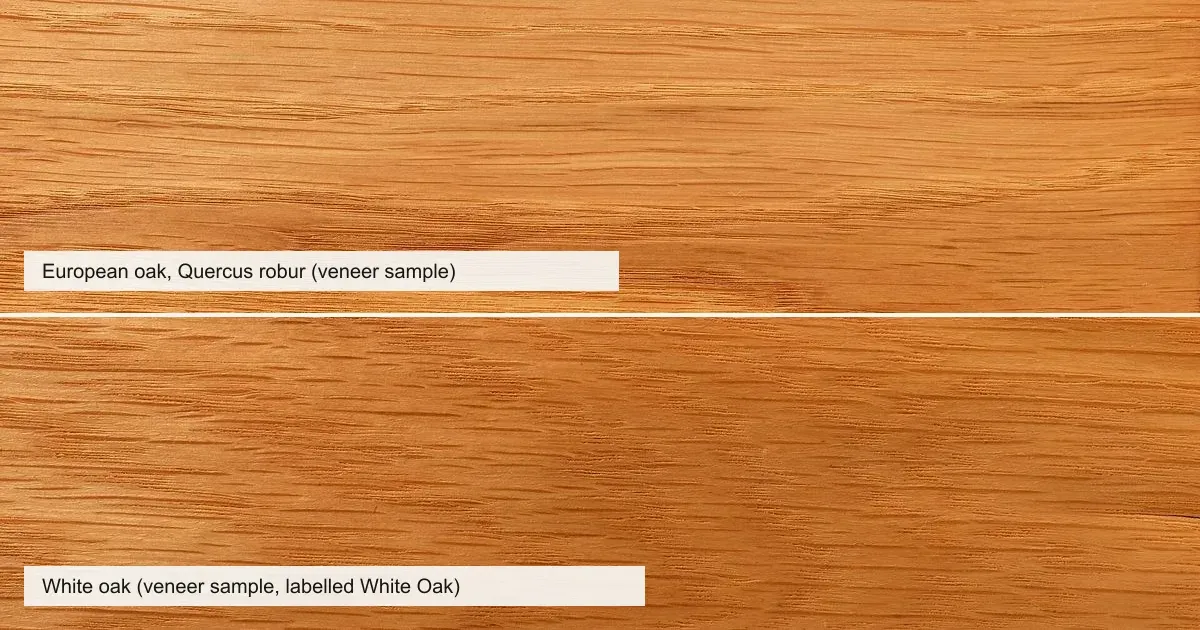
European oak and American white oak are two different species groups that look alike at the sample stage and differ at the order stage. Both are white oaks, so the published color, grain and decay resistance are close. The things that change your purchase are the grading system (European appearance codes against NHLA clear cuttings), the unit (cubic meters and millimeters against board feet and quarters) and the paperwork each origin needs. This guide sets out the published figures, what I could and could not verify and how to put two quotes on the same footing.
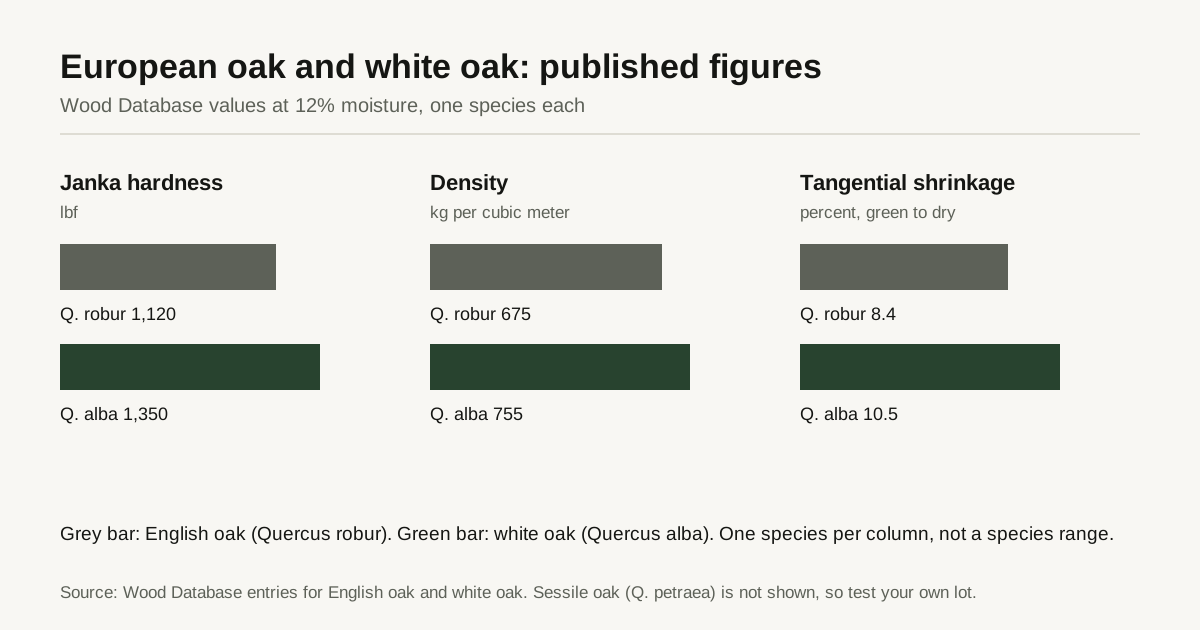
This is general information as of October 2026, not a technical specification. Wood properties vary by tree, site and drying, and the figures below are single published values for one species each.
Which species you are comparing
“European oak” on a quote usually means Quercus robur (English or pedunculate oak) or Quercus petraea (sessile oak), often sold mixed. “American white oak” has Quercus alba as its reference species, grown in the eastern United States. The Wood Database lists English oak as native to most of Europe, Asia Minor and North Africa, and says it shares many traits with white oak. It is not commonly seen in the US, where it counts as imported lumber.
I found a Wood Database entry for English oak and for white oak, but none for sessile oak. If your supplier sells petraea, ask for its own figures or test a sample.
What the published numbers say
| Property (12% moisture) | English oak, Quercus robur | White oak, Quercus alba |
|---|---|---|
| Dried weight | 675 kg/m³ (42 lbs/ft³) | 755 kg/m³ (47.0 lbs/ft³) |
| Janka hardness | 1,120 lbf (4,980 N) | 1,350 lbf (5,990 N) |
| Modulus of rupture | 14,100 lbf/in² (97.1 MPa) | 14,830 lbf/in² (102.3 MPa) |
| Shrinkage, radial | 4.7% | 5.6% |
| Shrinkage, tangential | 8.4% | 10.5% |
| Shrinkage, volumetric | 13.0% | 16.3% |
| Decay resistance | Very good | Very durable |
Source: Wood Database entries for English oak and white oak.
Read the gaps. White oak is about 12% denser and about 20% harder on these figures, and its bending strength is about 5% higher. Its tangential shrinkage is about a quarter larger. For a cabinet or furniture plant that machines dry stock in a controlled room, those differences are modest. For floors and exterior parts, where the wood moves with humidity, the larger shrinkage of white oak is something to plan for, with the cut and the drying moisture.
AHEC, the American Hardwood Export Council, states that European structural tests found white oak has greater inherent fibre strength than European oak. That is a promotional source for American wood, and the Wood Database numbers point the same way by a small margin. AHEC’s white oak page also shows obvious typing errors in some values, so I used the Wood Database figures here.
The Wood Database notes abundant tyloses in the large pores of white oak heartwood, and AHEC says the heartwood is not porous, which suits wine barrels. I found no reliable published comparison of tylose content between the two origins that I could open, so treat claims either way as unverified. It matters for barrels and liquid tight work and not for most cabinet and flooring orders.
Color and grain: do not trust the label
The Wood Database describes both woods the same way: heartwood light to medium brown, often with an olive cast, straight grain and coarse, uneven texture. Retail articles disagree on which is warmer or darker, which suggests the species label is a weak guide to color. Boards from different regions, sapwood content, cut and drying schedule all move the color more than the origin does.
Ray fleck, the shiny pattern on quartersawn faces, depends mainly on how the board is cut. AHEC notes that white oak rays are longer than red oak rays, but that is a comparison with red oak. If ray figure matters for your design, specify the cut and ask for photos of the actual lift. Our guide to plain, quarter and rift sawn lumber explains what each cut shows, and white oak against red oak covers the other common oak choice.
Grading: the real difference
NHLA grades American white oak by the clear wood it yields. AHEC lists FAS at 83 1/3% clear, No. 1 Common at 66 2/3% and No. 2 Common at 50%, with minimum clear piece sizes. Our NHLA grades guide walks through the cutting logic.
European oak is graded by appearance under EN 975-1 with codes such as QF2 or QBA, or by a merchant’s own letters. AHEC says grading of European hardwood is visual and can differ between supplying countries such as France, Ukraine and Croatia. Our guide to European oak lumber grades explains the codes.
The practical consequence: FAS and QF1 are not the same thing, and no table converts one to the other. Compare by yield on your own cutting list, not by name.
Units, thickness and tally
A European quote often counts cubic meters and millimeters. A US quote counts board feet and quarters. Convert before you compare:
- 1 cubic meter is 35.3147 cubic feet, so about 423.8 board feet (35.3147 x 12).
- 1 board foot is about 0.00236 cubic meters.
- 4/4 stock is a nominal 1 inch, which is 25.4 mm, but rough thickness and the allowance for planing vary between mills, so state the thickness you need after surfacing as well.
Then ask which tally rule applies: net or gross, green or dry measure. Our board feet and pricing guide and the container loading and tally guide cover this.
Price
I found no public price series that compares European oak and American white oak on one specification, so I will not give a price gap. The Wood Database says white oak usually costs slightly more than red oak in the United States, with thicker or quartersawn boards costing more, and says nothing on European oak. Price swings with grade, thickness, drying, freight, currency and the destination.
The fair test is a landed cost per usable unit:
- Ask both suppliers to quote the same species, thickness, surfacing and drying, in one unit.
- Add freight, duty and any paperwork cost, using the same delivery term for both.
- Divide by the yield on your cutting list, not by the tally.
Paperwork by origin
Both origins carry documents, and the rules differ by destination. Into the US, the Lacey Act and legal timber documents apply to imported oak. Into the EU, the EUDR covers sawn wood placed on the EU market from 30 December 2026 for large and medium operators. On US duties, see Section 232 lumber tariffs. Ask a customs broker to confirm current rules for your shipment.
When to choose which
- Choose European oak when you want appearance-graded boules or selected boards, you work in metric and you buy in Europe or close to it.
- Choose American white oak when you work in NHLA grades and board feet and want a sorted clear yield by grade.
- Test a sample of each when color, finish or ray figure drives the design, because the label does not settle it.
To get quotes that spell out species, grade system, unit and delivery term, send your lumber RFQ. We pass it to up to 3 mills or yards that say they can supply it, and they reply to you directly. The hardwood species hub lists other species by use.
See also: white oak lumber and red oak lumber, our reference pages on the two American oak groups.
Sources
- Wood Database, English oak (Quercus robur)
- Wood Database, white oak (Quercus alba)
- AHEC, American white oak species page (promotional, directional)
- American Hardwood Export Council, hardwood lumber grading
- BSI, BS EN 975-1:2009 appearance grading of oak and beech
Frequently asked questions
Is European oak the same as American white oak?
No. They are different species in the same white oak group. European oak is mainly Quercus robur and Quercus petraea. American white oak is Quercus alba and its close relatives. The Wood Database describes both as light to medium brown with an olive cast, so write the botanical name on the order.
Which is harder, European oak or American white oak?
On the Wood Database figures, white oak (Quercus alba) is harder: 1,350 lbf Janka against 1,120 lbf for English oak (Quercus robur). White oak is also denser at 755 kg per cubic meter against 675. These are single species values, so samples from your lot may differ.
Which is cheaper for a lumber buyer?
No public series compares the two on one specification, so I cannot name a winner. Price depends on grade, thickness, drying, origin, freight and currency. Ask both suppliers to quote the same species, grade system, thickness and delivery term, then compare on a landed cost per usable board foot or cubic meter.
Can I mix European and American white oak in one job?
Sometimes, but test it. Color and grain are close, yet the species differ, and shrinkage and stain response can differ. Finish a sample from each lot with your own finish and keep each lot together within a product line, for example one lot for all door frames.
Know what you need? Send the spec.
Tell us the species, grade, thickness and board feet. We pass it to up to 3 mills or yards that carry it and reply within 24 business hours.
Send my lumber RFQ