Guides / Species
Sapele, Khaya and African Mahogany: What Buyers Need to Know
December 1, 2026
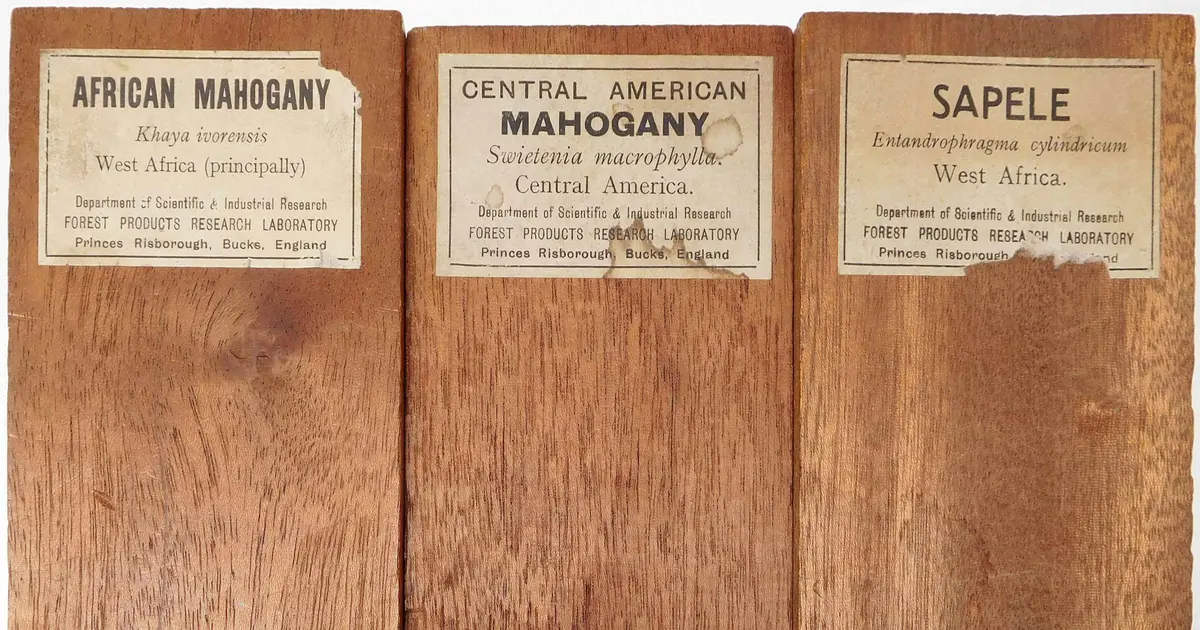
Sapele and khaya are the two African hardwoods most often offered as alternatives to mahogany. Both have the reddish-brown color buyers want, both are available in wide boards, and both cost less than the true mahogany they replace. They are not the same wood. Sapele is harder, denser and often shows a striped figure. Khaya is lighter, softer and usually plainer. Treating them as one product leads to the wrong grade, the wrong price and sometimes the wrong paperwork.
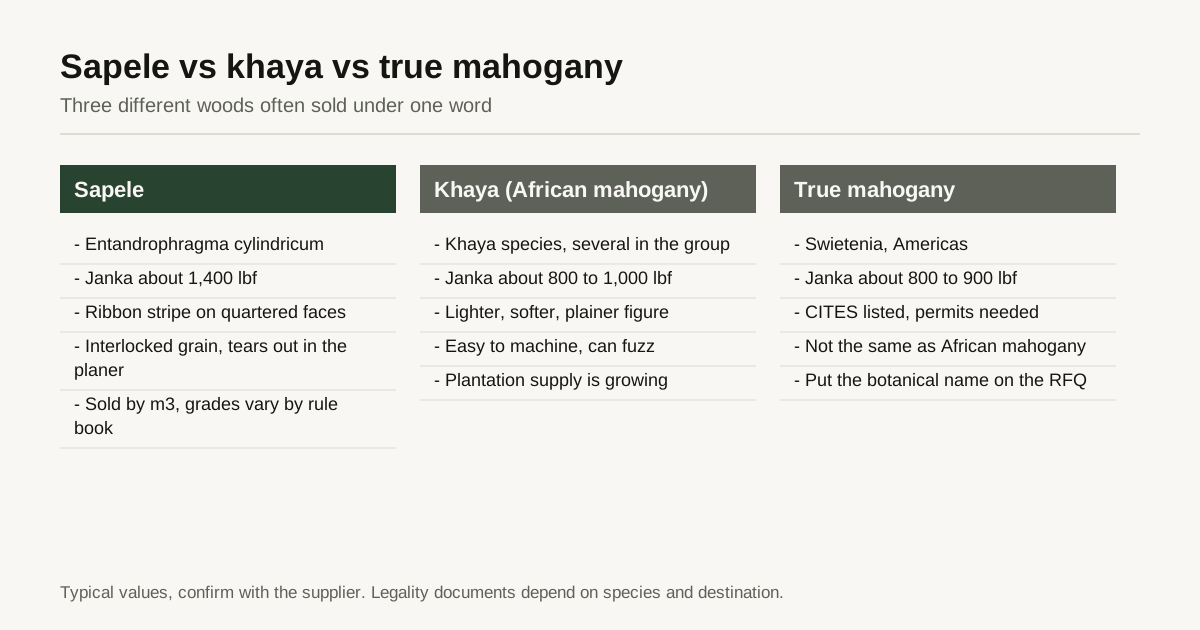
This guide explains the differences, how the lumber is graded and measured, what to watch when machining, and which documents to ask for before you place an order.
Which woods are in the group
- Sapele is Entandrophragma cylindricum, from the West and Central African forest belt. Related species in the same genus are sipo (utile), tiama and kosipo, sold under their own names.
- Khaya is a genus of several species, including Khaya ivorensis, Khaya anthotheca, Khaya grandifoliola and Khaya senegalensis. Trade sells the heartwood as African mahogany, sometimes with the species or the port name.
- True mahogany is Swietenia, with Swietenia macrophylla (big-leaf mahogany) the main commercial species. It is a different genus, from Central and South America, and it is regulated under CITES.
When a quote says only “mahogany”, ask which wood it is. African mahogany means khaya. Some suppliers use “mahogany” for any red-brown tropical wood, so the botanical name on the RFQ avoids confusion.
Properties compared
| Property | Sapele | Khaya (African mahogany) | True mahogany (reference) |
|---|---|---|---|
| Genus | Entandrophragma | Khaya | Swietenia |
| Janka hardness | about 1,400 lbf | about 800 to 1,000 lbf | about 800 to 900 lbf |
| Density at 12% moisture | about 640 to 700 kg/m3 | about 500 to 560 kg/m3 | about 530 to 600 kg/m3 |
| Color | Medium to dark reddish brown | Pink to reddish brown, darkens with time | Reddish brown |
| Figure | Ribbon stripe on quartered faces, sometimes pommele or quilted | Plain, with occasional ribbon | Plain to figured |
| Grain | Interlocked | Straight to slightly interlocked | Straight to interlocked |
| Workability | Good with sharp tools, tears out when planed | Easy, can fuzz | Easy |
These are typical values for the group. Individual species and lots vary, and published figures differ between sources.
How each one looks and behaves
Sapele is known for the ribbon stripe that appears on quartered or rift faces, a series of light and dark bands that change as the angle of light changes. Boards cut with the grain in this orientation are the premium sort. Plain sawn sapele shows a more regular, subdued figure. Sapele is also sold as pommele or quilted, a rare bubbly figure that is picked out by hand and priced separately.
Khaya is lighter in weight and color, and the figure is less pronounced. It is easier to cut and shape, which makes it popular for boat building, doors and furniture. Because the group includes several species, color and density vary more between lots. Some suppliers sort by color.
Both woods darken with exposure to light. A clear finish with UV protection slows the change.
Machining and finishing
Sapele’s interlocked grain is the main challenge. The fibers run in alternating directions, so a planer knife on one pass lifts the fibers on the next. Practical steps:
- Use sharp carbide knives and a shear cut head if available.
- Take light passes, especially on the last pass.
- Plane or sand in the direction with the least tear out, and accept some hand work on figured boards.
- Sand with a block after machining, since scrapes and ridges show under a clear finish.
- Pre-drill for screws and nails.
Both woods contain mineral and silica traces in some boards that dull edges faster than the density suggests. Khaya machines more easily but can fuzz on the surface, and a sharp edge is again the answer.
Finishing is straightforward. Both take oil, lacquer and varnish well. Open pores may need filling for a glossy finish. Because the color changes with light, finish a test sample and keep it in the sun to see how it ages.
Drying and stability
Both woods are sold kiln dried, often to about 12 percent for export, since that suits many climates and cuts the risk of over-drying. Interior work in cooler, drier regions usually needs 6 to 8 percent, so plan to re-dry or acclimate the lumber at your shop. Sapele can warp, particularly in thick boards with interlocked grain, and shows more movement than a species such as maple. Our kiln drying guide explains the questions about schedule and stress, and our moisture meter guide shows how to check the load.
Quarter sawn sapele is more stable than plain sawn. The guide to plain, quarter and rift sawn lumber explains the difference.
Grading and measuring tropical lumber
NHLA rules were written for North American hardwoods. Tropical lumber is sold under several rule sets, and a mill may use its own grades. Typical points:
- Grade names. You may see FAS, Select and Standard, or grades from other rule books. Ask which rules apply and request them in writing.
- Measure. Tropical lumber is usually sold by the cubic meter, with thickness in millimeters, for example 26, 32, 38, 52 and 63 mm. Board feet are common in North American trade. Agree the unit and conversion before comparing quotes. One cubic meter is about 424 board feet.
- Widths and lengths. Random widths and lengths are normal. Set minimum widths and lengths and the share of long boards.
- Surfacing. Lumber is sold rough, planed or sometimes cut to dimension. Ask what thickness tolerances apply after planing.
Our guide to board feet and pricing shows how to convert and compare quotes on the same basis.
Legality, certification and permits
Tropical hardwood comes with more paperwork than temperate species. This is general information, not legal advice, and the rules change, so confirm with your broker.
- Legal origin. Buyers in the United States need a Lacey Act declaration, and buyers in the European Union need due diligence records under the timber rules, with the new deforestation rules also coming into force. Ask the supplier for species, country of harvest and the harvest permit information.
- Certification. Some lots carry FSC or PEFC certificates. The claim must be on the invoice and linked to a valid chain of custody certificate.
- CITES and conservation lists. True mahogany is listed. Some African species and genera are on national or international lists, or are being considered, so ask the supplier to confirm the status of the exact species before you order.
- Plant health. Some importers ask for a phytosanitary certificate or treatment. See our guide to phytosanitary and fumigation rules.
Documents take time. Ask what the supplier can issue and how long it takes, before the price is agreed.
Supply and price
African hardwood supply comes from a limited number of countries, and export rules, log policies and shipping can change. Sapele and khaya are available as sawn lumber from many mills, with sapele the more consistently priced. Plantation khaya from outside Africa is entering the market, which adds an alternative with clear origin. Prices depend on grade, thickness, figure, drying and shipping terms.
Common terms include FOB, CIF and ex-mill. Confirm which one applies, because freight and insurance differ widely. Container loads of tropical lumber are usually limited by weight or volume as described in our container loading guide.
Where each one fits
Sapele suits work where figure, hardness and a rich color matter: furniture, guitar and instrument bodies, flooring, stair parts, veneer-faced work and high-end joinery. Its hardness handles wear better than khaya, so it is common for tabletops and floors.
Khaya suits work where weight, workability and price matter: doors, windows, boat building, paneling, moulding and general furniture. It is also a common choice for exterior joinery when treated and finished properly, though the durability of the wood varies with species and lot, so check the data for the one you buy.
Questions for the supplier
- Which exact species is in this lot, and can you confirm the botanical name in writing?
- What rules do you grade under, and what share of the lot is in each grade?
- Is the lumber quarter sawn, rift or plain, and are photos available from the same lot?
- What moisture content do you ship at, and how is it checked?
- Which legality documents and certificates can you issue, and how long do they take?
- What are the shipping terms, and which port?
What to put on the RFQ
- Botanical name and trade name, for example Entandrophragma cylindricum (sapele)
- Grade rules and grade name
- Thickness in mm or quarters, and the surfacing
- Widths and lengths, and the share of long boards
- Sawing pattern, such as quarter sawn for ribbon stripe
- Moisture range, and who checks it
- Legality documents and certification needed for your market
- Unit and price terms, cubic meters or board feet, FOB or CIF
Closing checklist
- Decide whether you need sapele for hardness and figure or khaya for weight and price
- Put the botanical name on the RFQ
- Agree on grade rules, unit and tally method
- List the legality documents your market requires
- Plan sharp tooling and a finish test before a full order
If you want sapele or khaya quoted by several suppliers, send your lumber RFQ with the species, thickness and the documents you need. We pass it to up to 3 mills or yards that carry the item, and they reply to you directly.
Frequently asked questions
Is sapele the same as mahogany?
No. Sapele is Entandrophragma cylindricum, in the same plant family as true mahogany but a different genus. It is harder and heavier than khaya and often has a ribbon stripe. True mahogany is Swietenia, which is listed on CITES and needs permits to trade. Always write the botanical name on the RFQ.
Why does sapele tear out when planed?
Sapele has interlocked grain, where fibers change direction from layer to layer, so a planer knife lifts them instead of cutting them. Sharp knives, a shear cut angle, light passes and sanding after planing give better results than a heavy single pass.
What documents should come with tropical hardwood?
At minimum the origin and species, a legality record that meets the rules of the importing country, and any permits for species on conservation lists. Buyers in the United States and the European Union have specific due diligence requirements. Ask suppliers which documents they can issue before you place an order.
Know what you need? Send the spec.
Tell us the species, grade, thickness and board feet. We pass it to up to 3 mills or yards that carry it and reply within 24 business hours.
Send my lumber RFQ