Home / Hardwood species / Black Cherry Lumber: Color, Gum and Grades
Black Cherry Lumber: Color, Gum and Grades
Reference page · Last reviewed 11 April 2027
Black cherry lumber is the sawn wood of Prunus serotina, the only native North American cherry cut for lumber. It has a fine, even texture, machines very well and is stable once dry. Its reddish brown heartwood darkens with light, and gum pockets, pin knots and pith flecks are part of the wood. It is graded under the NHLA rules, with a small allowance for knots in cuttings, and is sold mostly in 4/4 to 8/4.
| Item | Typical for black cherry lumber |
|---|---|
| Species | Prunus serotina |
| Heartwood | Light to dark reddish brown with a luster, darkens with light |
| Sapwood | Creamy white, narrow in old trees, wider in second growth |
| Natural marks | Gum pockets and streaks (vary by region), pin knots, small pith flecks |
| Side hardness (Janka) | about 950 lbf at 12% moisture |
| Specific gravity | 0.47 green, 0.50 at 12% moisture |
| Shrinkage, green to oven dry | radial 3.7%, tangential 7.1%, volume 11.5% |
| Heartwood decay resistance | Moderately resistant (Wood Handbook group) |
| Common thicknesses | 4/4, 5/4, 6/4, 8/4. 10/4 and 12/4 limited |
| Average dried weight | about 2.9 lb per board foot (NHLA guide) |
| US tariff line | 4407.94 (cherry) |
Figures are typical for the species from the USDA Wood Handbook and the NHLA species guide, not guarantees for a lot. The NHLA rulebook governs grades.
Where cherry comes from
The Wood Handbook says black cherry grows from southeastern Canada through the eastern half of the United States, with production centered in the Middle Atlantic States. The NHLA species guide gives US cherry growing stock as 423.6 million cubic meters, about 2.9% of all US hardwood growing stock. Cherry is readily available as lumber and veneer in a range of grades and sizes, but thick stock is limited.
Region matters for appearance. The NHLA guide notes that gum occurrence varies by region. Lumber from different areas can also differ in heartwood color and in the width of the sapwood. If you match cherry to existing work, ask the mill where its logs come from and buy enough from one lot.
Color: light, sapwood and steaming
Cherry’s color is its selling point and its most frequent complaint.
| Feature | What happens | What to put on the order |
|---|---|---|
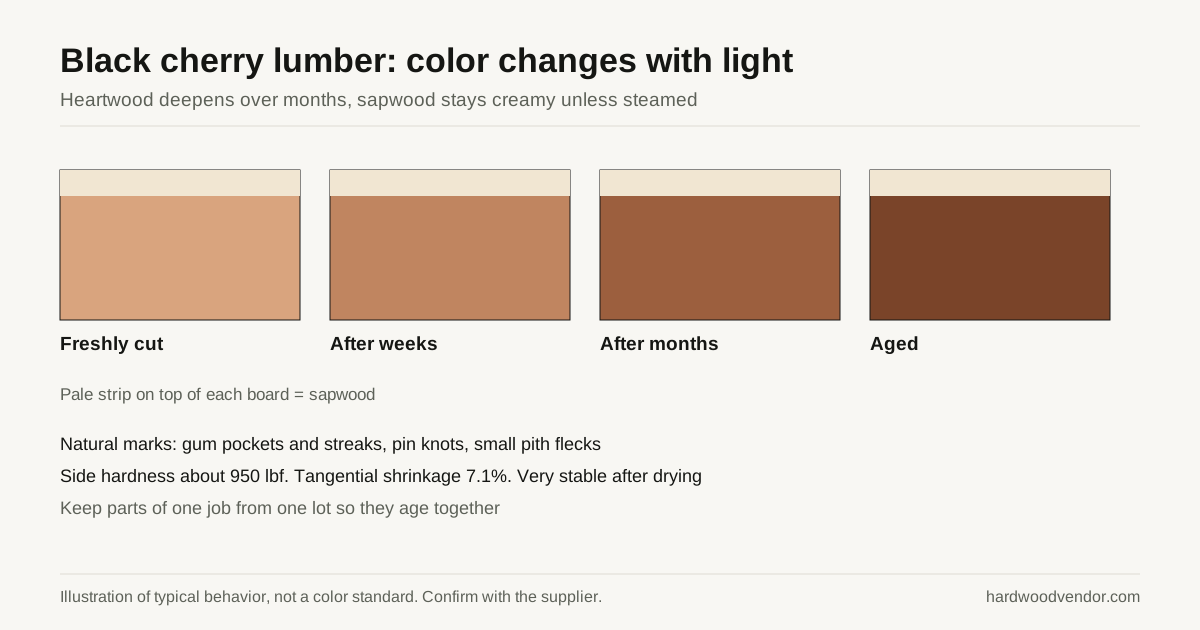
| Darkening | Heartwood deepens to reddish brown with light over months | Approve finish samples aged or exposed to light, keep one lot per job |
| Sapwood | Creamy white band, marked contrast with heartwood | A sap rule: sap on back only, or a percentage of the face |
| Steaming | Reduces the contrast between sapwood and heartwood (NHLA guide) | Steamed or unsteamed, stated |
| Color variation | Lot to lot and board to board | Color sort if offered, or select at the yard |
Sapwood is not a grade defect in the standard grades, so a FAS cherry board can carry a pale edge. Many furniture makers buy “heart one face” or a sap limit at a premium, or place sapwood on hidden faces in the rough mill. Write the rule in measurable words so it can be checked when the lumber is graded.
Gum, pith flecks and knots
The NHLA species guide lists gum pockets or streaks, pin knots and small brown pith flecks as natural characteristics of cherry. They are not defects within the grade limits. Extension summaries of the NHLA rules note that small knots not over 1/8 in across can be admitted in cherry cuttings. Check the cherry section of the current rulebook for the exact allowance.
| Mark | Look | Effect |
|---|---|---|
| Gum pocket or streak | Dark, sometimes resinous line or spot | Visible under clear finish, may need selection |
| Pith fleck | Small brown streak | Minor, part of the character |
| Pin knot | Very small dark knot | Admitted in cuttings within the cherry rule |
| Mineral | Dark stain | Treated like other species under grade rules |
A buyer who needs clear, gum-free faces should say so on the order and expect a higher price, because it removes part of each grade. For the grade rules, see the FAS grade page and the lumber grades hub.
Properties and working
| Property | Black cherry | Black walnut | Hard maple (sugar) |
|---|---|---|---|
| Side hardness at 12% | about 950 lbf | about 1,010 lbf | about 1,450 lbf |
| Specific gravity at 12% | 0.50 | 0.55 | 0.63 |
| Modulus of rupture at 12% | about 12,300 psi | about 14,600 psi | about 15,800 psi |
| Tangential shrinkage | 7.1% | 7.8% | 9.9% |
Values from the Wood Handbook tables. The Handbook describes cherry as moderately heavy, strong, stiff and moderately hard, with high shock resistance and very good machining properties. It is softer than oak and maple, so it suits furniture and cabinets better than floors in heavy-traffic rooms. It can burn under a dull cutter or slow feed, so keep tools sharp. See also black walnut lumber and hard maple lumber.
Grades and uses
| Use | Grade usually quoted | Note |
|---|---|---|
| Fine furniture | FAS and F1F, heart one face | Long clear parts, color matched |
| Kitchen cabinets | No.1 Common and F1F | Short parts, sap on hidden faces |
| Doors, paneling, mouldings | FAS, F1F | Stain grade, aging considered |
| Flooring | Common grades | Softer, character marks accepted |
| Musical instruments, boat interiors | Selected stock | Special sorts |
For choosing who supplies it, see how to choose a hardwood lumber supplier.
Drying
Cherry dries without great difficulty, but its color reacts to drying conditions. Mills that sell for appearance dry carefully to avoid sticker stain and uneven color. For interior use in North America the usual target is 6 to 8%. Ask for the kiln record or moisture readings at loading. Our guide to sticker stain in lumber explains the stain that shows after planing.
What to write on the RFQ
Name the species, grade and rulebook, sap rule, gum rule if needed, steamed or not, thickness, surfacing, drying, width and length limits, board feet and paperwork. Our hardwood lumber specifications guide explains every field.
RFQ line: Black cherry (Prunus serotina), FAS and F1F, NHLA rules (edition named), heart one face, light gum allowed on back, 4/4 rough, KD 6-8%, 5 in and wider, 8-12 ft, 2,000 BF, Lacey Act data.
Send it through our lumber RFQ form and we pass it to up to 3 mills or yards that carry cherry in that grade. More species are on the hardwood species hub.
Frequently asked questions
Does cherry lumber get darker over time?
Yes. Black cherry heartwood darkens on exposure to light. Freshly machined cherry looks pale pinkish brown and turns a deeper reddish brown over months. Plan finish samples with that in mind and keep parts of one piece of furniture from one lot so they age together.
Are gum pockets a defect in cherry lumber?
The NHLA species guide describes gum pockets and streaks as natural characteristics of cherry whose occurrence varies by region, along with pin knots and small pith flecks. Within the grade limits they are accepted. If you need gum-free faces, write that as an extra specification.
What thickness of cherry lumber can I buy?
4/4, 5/4, 6/4 and 8/4 are common. The NHLA guide says 10/4 and 12/4 are in limited supply. Thick, wide cherry is a special order.
Is cherry stable after drying?
Yes. The Wood Handbook describes black cherry as having moderately high shrinkage but being very dimensionally stable after drying. Its tangential shrinkage from green to oven dry is about 7.1%, lower than oak or hard maple.
Sources
- NHLA species guide: cherry (availability, thicknesses, gum, color, growing stock)
- USDA Forest Products Laboratory: Wood Handbook, FPL-GTR-190 (2010), black cherry description, Tables 4-3, 5-3b and 14-1
- American Hardwood Export Council: NHLA grades
- US International Trade Commission: Harmonized Tariff Schedule, 4407.94 (cherry)
Standards and rules are cited as references, not as claims about Hardwood Vendor or any mill. Editions and status change: confirm with the issuing body, your customs broker or the regulator.
Know what you need? Send the spec.
Tell us the species, grade, thickness and board feet. We pass it to up to 3 mills or yards that carry it and reply within 24 business hours.
Send my lumber RFQ