Home / Lumber import rules / Importing Hardwood Lumber Into the EU: EUDR, Plant Health, CITES and Grading
Importing Hardwood Lumber Into the EU: EUDR, Plant Health, CITES and Grading
Reference page · Last reviewed 12 April 2027
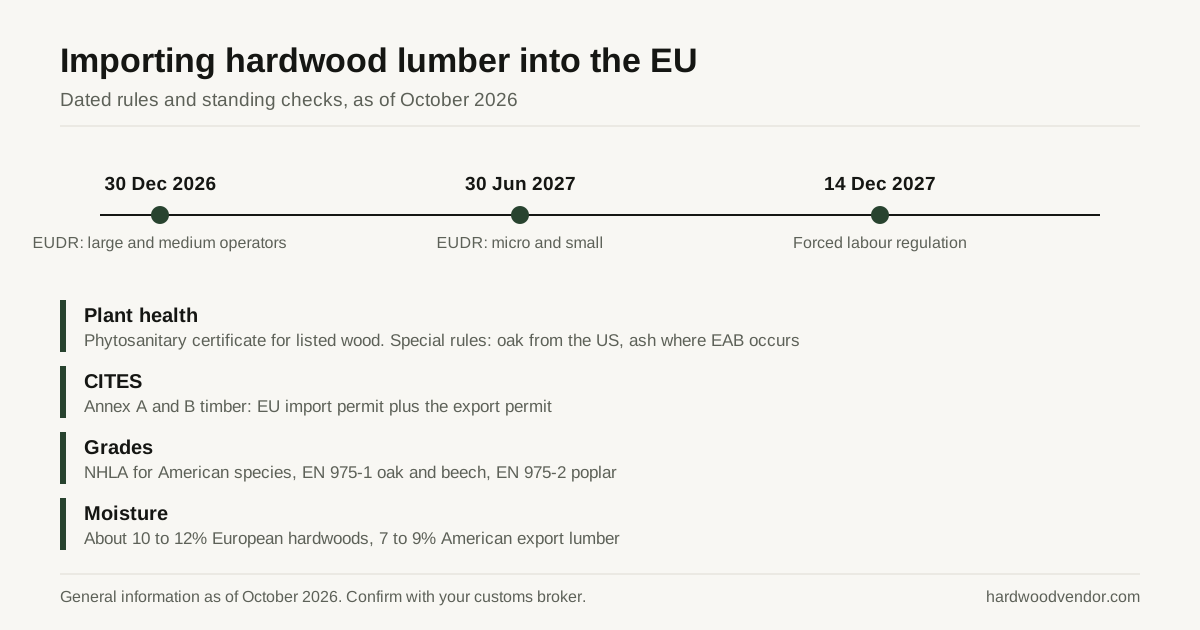
Hardwood lumber entering the European Union faces four sets of rules: the EU Deforestation Regulation (EUDR), which applies to sawn wood from 30 December 2026 for large and medium operators; the plant health regime, which needs phytosanitary certificates for many hardwoods and sets special requirements for oak and ash from North America; the EU CITES rules for listed species; and the grading and moisture norms of the European trade. This page is general information as of October 2026, not legal advice. Confirm every point with your customs broker, the importer of record or the competent authority.
| Topic | Rule (as of October 2026) | Who acts |
|---|---|---|
| EUDR | Regulation (EU) 2023/1115 as amended by 2025/2650. From 30 December 2026 (large and medium operators) and 30 June 2027 (micro and small). Due diligence statement before placing on the market | Importer files, mill supplies data |
| EUDR data | Species, quantity, country of production, geolocation of plots, harvest date or period, supplier details | Mill and its log suppliers |
| Country risk | Implementing Regulation (EU) 2025/1093: United States, Canada and EU member states low risk. Belarus, North Korea, Myanmar and Russia high risk | Sets the depth of due diligence |
| Plant health | Regulation (EU) 2016/2031 and Implementing Regulation (EU) 2019/2072: phytosanitary certificate for listed wood, special requirements for oak (oak wilt) and ash (emerald ash borer) | Exporting country’s plant protection office |
| CITES | Regulation (EC) 338/97: Annex A and B species need an EU import permit as well as the export permit | Exporter and importer |
| Forced labour | Regulation applies from 14 December 2027 to products sold in or exported from the EU | Every company in the chain |
| Grades | NHLA for North American lumber, EN 975-1 or trade grades for European oak and beech, EN 975-2 for poplar | Named in the contract |
EUDR: dates, roles and data
The EUDR bars wood and other covered commodities from the EU market, or from export, unless they are deforestation-free, produced under the laws of the country of production and covered by a due diligence statement. Sawn wood is in scope.
Dates. The December 2025 amendment, Regulation (EU) 2025/2650, set the application date at 30 December 2026 for large and medium operators and 30 June 2027 for micro and small operators. The Commission lists 30 December 2026 for micro and small operators already covered by the old EU Timber Regulation. The EU Timber Regulation is repealed from 30 December 2026, with a transition for timber produced before 29 June 2023.
Roles.
| Role | Who it usually is | Main duty |
|---|---|---|
| Operator | The importer placing the lumber on the EU market | Collect data, assess and mitigate risk, file the statement, keep records 5 years |
| Downstream operator or trader | An EU distributor or manufacturer buying from the importer | Keep supplier information and reference numbers |
| Non-EU mill or exporter | The supplier | Not a filer, but supplies the data in time |
Data the mill must supply. For each lot: the species (scientific and common name), quantity, country of production, geolocation of every plot of land where the trees were harvested and the date or period of harvest, plus supplier and customer details. For lumber from many plots, the mill needs a system that links each lot to its log sources.
Country risk. Implementing Regulation (EU) 2025/1093 classifies the United States, Canada and the EU member states as low risk. Lumber from a low-risk country goes through simplified due diligence: the data and the statement are still needed, the risk assessment and mitigation steps are not, unless the operator has information pointing to a risk.
Our guides to EUDR for hardwood lumber and EUDR sawmill due diligence go through the data fields and the mill side in detail.
Plant health: certificates, oak and ash
The EU plant health law, Regulation (EU) 2016/2031, and its implementing rules in Regulation (EU) 2019/2072 decide which wood needs a phytosanitary certificate and what special requirements apply.
- Phytosanitary certificate. Annex XI of 2019/2072 lists plant products, including wood of many genera from third countries, that need a phytosanitary certificate from the exporting country’s plant protection office.
- Oak from the United States. Annex VII sets special requirements for oak (Quercus) wood from the United States because of oak wilt (Bretziella fagacearum). For sawn oak these are built around bark removal, drying and the official statement on the certificate. A time-limited derogation in Implementing Regulation (EU) 2023/1312 covered oak veneer logs with bark, not sawn lumber, and was set to run to 30 September 2026.
- Ash. Annex VII also sets requirements for ash (Fraxinus) wood from countries where emerald ash borer occurs, including Canada and the United States.
- Bark and packaging. Wood packaging in the container must meet ISPM 15. Bark left on boards or loose in the load can lead to a failed inspection.
Read the current consolidated text of Annex VII for your species and origin before the order is fixed, because the official statement on the certificate must match it word for word. The exporting side is explained on our page on the phytosanitary certificate for lumber exporters.
CITES species
The EU applies CITES through Regulation (EC) 338/97, with its own annexes A to D. For timber in Annex A or B, the EU importer needs an EU import permit from the member state’s management authority, issued before the goods arrive, in addition to the exporting country’s CITES export permit. Genuine mahogany (Swietenia macrophylla), for example, is listed. Annex C and D species need lighter notifications. See CITES timber species and the CITES permit process for timber.
Grades, sizes and moisture in the EU trade
| Topic | EU practice | Note for an overseas mill |
|---|---|---|
| North American species | NHLA grades, inch thickness in quarters, board feet or cubic meters | Many buyers price in cubic meters, state the conversion |
| European oak and beech | EN 975-1 appearance classes or mill trade grades (for oak often named QBA, ABC, rustic) | Grades do not map one to one to NHLA |
| Poplar | EN 975-2 | |
| Sizes | Metric thickness, EN 1313-2 deviations | Name rough or planed and the reference moisture |
| Trade names | EN 13556 nomenclature and codes | Use the scientific name on documents |
| Moisture | European hardwoods are often kiln dried to about 10 to 12%, North American export lumber to about 7 to 9% | State the target and tolerance |
| Structural use | Strength graded structural timber needs CE marking to EN 14081-1 | Not needed for joinery and furniture lumber |
For the European size rules see EN 1313-2, for trade names EN 13556, and for grade systems side by side hardwood grading rules compared.
Customs duty and origin
EU customs duty is set per Combined Nomenclature code in the TARIC database. Heading 4407 uses the same first six digits as other countries: oak 4407 91, beech 4407 92, maple 4407 93, cherry 4407 94, ash 4407 95. Look up the third-country duty and any preference for your origin in TARIC, and keep origin documents ready. Our page on the certificate of origin for lumber explains which proof fits which preference.
Forced labour regulation
The EU Forced Labour Regulation applies from 14 December 2027. It bans products made with forced labour from the EU market and from export, after an investigation by the authorities. It does not create a filing like the EUDR, but buyers are already asking mills for supply chain information that serves both rules. Our hardwood lumber rules for 2027 calendar lists the dates.
What to write on the RFQ
For EU delivery add: species with scientific name, country of production, EUDR data (geolocation and harvest period) per lot, phytosanitary certificate with the statement for your species, CITES documents if listed, grade rule (NHLA or EN 975-1), metric size basis and moisture. Then send your lumber RFQ and we pass it to up to 3 mills or exporters that ship to the EU. Other destinations are on the lumber import rules hub, including importing lumber into the US.
RFQ line: American white oak (Quercus alba group), FAS, NHLA rules (edition named), 4/4 = 26 mm rough, KD 8-10%, EUDR data per lot (plots, harvest period), phytosanitary certificate with oak statement, CIF port named, 40 m3.
Frequently asked questions
When does the EUDR apply to hardwood lumber?
As of October 2026 the European Commission lists 30 December 2026 for large and medium operators and 30 June 2027 for micro and small operators. Micro and small operators already covered by the old EU Timber Regulation are listed for 30 December 2026. Sawn wood is in scope. Confirm the date that fits your company with your adviser.
Does a sawmill outside the EU file the EUDR due diligence statement?
No. The operator that places the lumber on the EU market files it, usually the importer. The mill supplies the data the statement needs: species, quantity, country of production, geolocation of the harvest plots and the harvest date or period.
Do I need a phytosanitary certificate for oak or ash lumber entering the EU?
Often yes. The EU plant health rules in Implementing Regulation (EU) 2019/2072 list wood that needs a phytosanitary certificate and set special requirements for oak from the United States, linked to oak wilt, and for ash from countries with emerald ash borer. Check the current consolidated text for your species and origin with the importer or the national plant protection office.
Is EU lumber graded with NHLA rules?
North American lumber sold in the EU is usually traded on NHLA grades. European oak and beech are graded under EN 975-1 or under mill trade grades, and poplar under EN 975-2. Name the rule on the contract, because the grades do not convert one to one.
Sources
- EUR-Lex: Regulation (EU) 2023/1115 on deforestation-free products (EUDR)
- EUR-Lex: Regulation (EU) 2025/2650 amending the EUDR (dates and simplification)
- EUR-Lex: Implementing Regulation (EU) 2025/1093, country risk classification under the EUDR
- European Commission: Regulation on deforestation-free products (application dates)
- EUR-Lex: Regulation (EU) 2016/2031 on protective measures against plant pests
- EUR-Lex: Implementing Regulation (EU) 2019/2072, uniform conditions (Annex VII special requirements, Annex XI phytosanitary certificates)
- EUR-Lex: Implementing Regulation (EU) 2023/1312, derogation for US oak veneer logs with bark
- EUR-Lex: Council Regulation (EC) 338/97 on trade in wild fauna and flora (EU CITES rules)
- European Commission: Forced Labour Regulation (applies from 14 December 2027)
- EVS: EN 975-1:2009 appearance grading of hardwoods, oak and beech
Standards and rules are cited as references, not as claims about Hardwood Vendor or any mill. Editions and status change: confirm with the issuing body, your customs broker or the regulator.
Know what you need? Send the spec.
Tell us the species, grade, thickness and board feet. We pass it to up to 3 mills or yards that carry it and reply within 24 business hours.
Send my lumber RFQ