Guides / Grades and Specs
Hardwood Lumber for Moulding and Millwork Plants: Grade and Blank Choices
October 20, 2026
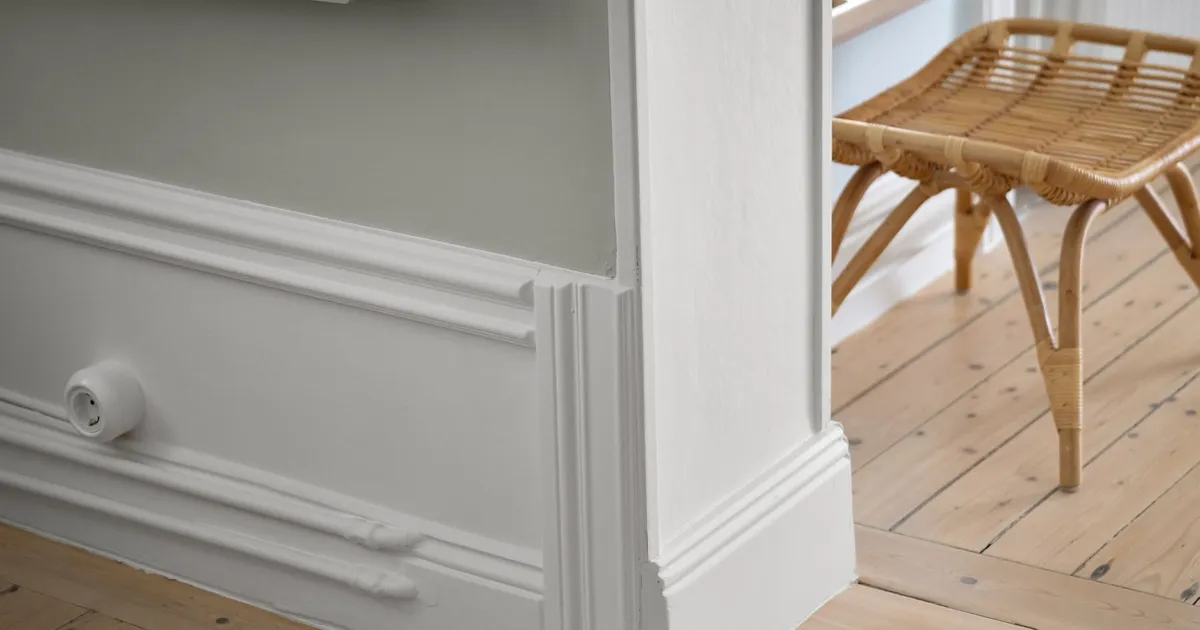
A moulding plant buys hardwood in order to take most of it away. The moulder cuts a profile into a blank, and the rest becomes chips. The lumber must be dry and straight enough to feed through the machine, clear enough that the profile shows no defects, and the right size to leave little waste. Plants that choose their lumber by habit pay for length and width they do not use, or lose yield to defects they could have avoided.
This guide explains how moulding and millwork plants choose grade, blank size, species and moisture, and how to put those choices on an RFQ.
How a moulding plant uses lumber
A typical process looks like this:
- Rip. Boards are straight line ripped and then gang ripped into blanks of the right width, with defects cut out.
- Crosscut. Blanks are cut to length, often with an optimizing saw that removes defects.
- Plane or mould. The moulder cuts the profile in one pass or more.
- Sand and finish. The profile is sanded, then primed, stained or finished.
The plant’s yield depends on how well the board fits the blanks. A plant making 3 in casing needs clear strips about 3 1/2 in wide and 8 to 12 ft long. A plant making small beads and stops needs short narrow strips. The best lumber for one is a poor choice for the other.
Our guide to straight line rip and gang rip explains the ripping step.
Choosing grade by profile
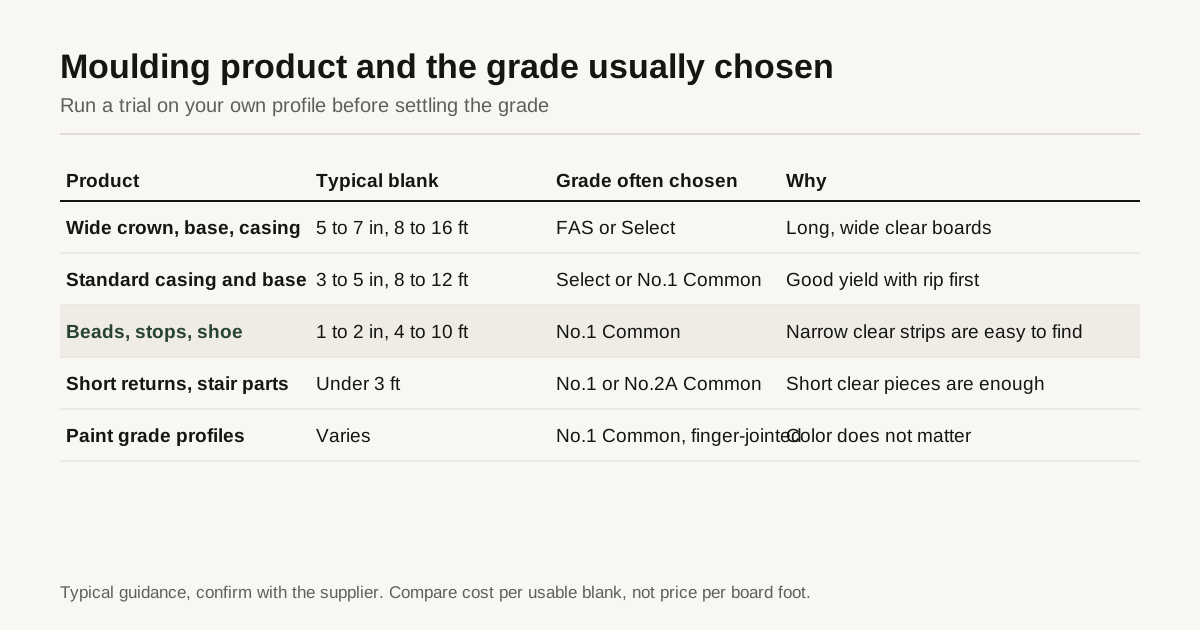
The NHLA grades measure clear cuttings. A profile needs clear cuttings that are as long as the part and as wide as the blank. A rough guide:
| Product | Typical blank | Grade often chosen | Reason |
|---|---|---|---|
| Wide crown, base and casing | 5 to 7 in wide, 8 to 16 ft | FAS or Select | Long, wide, clear boards give long blanks |
| Standard casing and base | 3 to 5 in wide, 8 to 12 ft | Select or No.1 Common | Good yield from rip-first with some cutting |
| Small beads, stops and shoe | 1 to 2 in wide, 4 to 10 ft | No.1 Common | Narrow strips between defects are easy to find |
| Short stair parts and returns | Under 3 ft | No.1 or No.2A Common | Short clear pieces are enough |
| Paint grade profiles | Varies | No.1 Common, finger-jointed blanks | Color does not matter, defects do |
The yields behind each grade are in our guide to NHLA grades. Moulding plants often run a trial: take a sample of each grade, rip and cut blanks as in production, and count the usable blanks per board foot. The grade with the lowest cost per usable blank wins, which is often No.1 Common instead of FAS for narrow work.
Face and back
Profiles have a show face and a back. If the back is hidden, a defect there is not a problem, so plants with this rule can accept lower grades, such as FAS 1-Face or Select, or No.1 Common. If both sides are visible, the lumber needs clear cuttings on both faces.
A simple cost-per-usable-board-foot check
The minimum clear yield of a grade gives a quick way to compare prices. FAS needs at least 83 1/3 percent clear cuttings and No.1 Common at least 66 2/3 percent. If every clear cutting from both grades is usable for your blanks, the break-even is simple:
- Divide 83.3 by 66.7, and you get 1.25.
- If FAS costs more than 25 percent above No.1 Common, No.1 Common gives the lower cost per usable board foot.
- If FAS costs less than 25 percent above, FAS wins.
Real life adds two corrections. First, boards in a grade often yield more than the minimum. Second, some clear cuttings are too short or narrow for your blanks, which favors the grade with longer pieces. That is why a trial with your own profile matters more than the formula. Use the formula to decide which grades deserve a trial, not to skip the trial.
Species
| Species | Typical use in moulding | Notes |
|---|---|---|
| Yellow poplar | Paint grade casing, base and crown | Cheapest, machines cleanly, takes paint |
| Red and white oak | Stained casing and base | Open grain, takes stain, strong profiles |
| Hard and soft maple | Painted or clear profiles | Dense, burns if feed is slow, blotchy stain |
| Cherry and walnut | Premium stained work | Soft to medium, beautiful color |
| Hickory and ash | Rustic and strong profiles | Hard on tools |
| Sapele and African mahogany | Premium profiles, doors and windows | Interlocked grain in sapele tears out |
Our guides to poplar for paint grade, hard maple vs soft maple and sapele, khaya and African mahogany cover several species used in profiles.
Grain and defects that matter at the moulder
A moulder cuts at many angles, so some features that do not matter in other work become serious here:
- Interlocked or wild grain. Fibers change direction, and the cutter lifts them. Expect tear out and rework.
- Tension wood. Fuzzy, woolly grain, common in some poplar and soft species. It sands poorly.
- Knots and pin knots. Knots may fall out of the profile or show as dark spots under finish.
- Mineral streaks. Dark lines are fine under paint, but a problem under clear finish.
- Pitch and gum pockets. In species such as cherry, pockets can spoil the profile or bleed.
- Warp. Boards with bow, crook or twist need more planing and waste thickness.
- Case hardening. Stressed lumber bows after ripping, and thin profiles distort. See the kiln drying guide.
Moisture and acclimation
Mouldings are thin, long pieces that move easily. Wet lumber produces profiles that shrink, gap and crack after installation. Typical practice:
- Buy kiln dried lumber at 6 to 8 percent, with a limit on any single board.
- Let the lumber acclimate in the plant for several days before ripping, if possible.
- Check moisture on arrival, with the method in our moisture meter guide.
- Store profiles and blanks in a dry, controlled area before shipping.
Form: rough, S2S, ripped blanks or finger-jointed
- Rough lumber. Cheapest per board foot, with the most flexibility. The plant surfaces and rips it.
- S2S lumber. Surfaced to a set thickness, which saves a step and lets you see the faces before buying. The thickness allowance for the profile should be clear.
- Ripped blanks. The supplier rips to width. Saves labor, adds cost, and stress relief matters.
- Finger-jointed blanks. Short clear pieces joined into long blanks. Very efficient for paint grade work, since defects are cut out and the joints are hidden under paint. For a clear finish, finger joints show.
Our guide to rough lumber, S4S and dimension parts compares these forms. Choose by how much work you want to do in-house and what your waste costs.
Thickness and width planning
The finished profile thickness drives the stock thickness. A 11/16 in casing profile is normally cut from 4/4 stock, and a thicker crown may need 5/4 or 6/4. If the blank is 3/16 in thicker than needed, the plant is paying for lumber it will plane away. A trial run with the actual profile shows where the extra allowance can be trimmed.
Width planning matters equally. A 5 1/2 in board that yields one 3 1/2 in blank and a thin offcut wastes more than a 7 in board that yields two blanks. Say what blank widths you plan to rip, and let the supplier propose the board widths that fit best.
Common problems and what causes them
| Problem at the moulder | Typical cause in the lumber |
|---|---|
| Tear out on the profile | Interlocked or wild grain, dull knives, wet wood |
| Burn marks | Dense species, slow feed, dull tooling |
| Profile bows after cutting | Drying stress, uneven moisture, unbalanced cut |
| Dark spots after finishing | Mineral streaks, pitch pockets, pin knots |
| Gaps at joints after installation | Wet lumber, or profiles installed before acclimation |
| High scrap from the ripsaw | Boards of the wrong width for the blank, or crook in the lumber |
Most of these can be reduced by tighter specs and by a small trial lot before the full order. A supplier who takes the trial seriously usually delivers a more consistent load.
Questions for the supplier
- Which species and grade rules does this quote use, and what do the sorts mean?
- What is the moisture range, and is the lumber conditioned after drying?
- What is the length mix, and what share of the load is 10 ft and longer?
- Can you rip or surface to my blank size, and at what tolerance?
- Are photos of the actual lot available, with a tape measure in the frame?
- Will you supply a trial lot before the first full order?
What to put on the RFQ
- Species and grade, and the face and back rule
- Form: rough, S2S, ripped or finger-jointed blanks
- Thickness allowance, widths and lengths, with a minimum length and a length mix
- Grain rules: straight grain, no tension wood, limits on knots and mineral streaks
- Moisture: target range, upper limit for any board, and stress relief
- Sort: color, sapwood or paint grade
- Packaging: bundles by length, tally method
- Sample: a test lot for a trial run
Closing checklist
- Run a cut list or a trial, grade by grade, on your own profile
- Choose by cost per usable blank, not price per board foot
- Set grain and defect rules for the profile area
- Specify moisture and stress relief
- Plan thickness and width to match the blank
For the full stack behind a moulding RFQ, see hardwood lumber specifications.
If you want moulding lumber quoted by several suppliers, send your lumber RFQ with the profile, species and grade. We pass it to up to 3 mills or yards that carry the item, and they reply to you directly.
Frequently asked questions
Which NHLA grade is best for hardwood moulding?
It depends on profile width and length. Narrow mouldings are often cut from No.1 Common after a rip-first process, which gives good yield at lower cost. Wide casing, base and crown, or long clear lengths, usually need FAS or Select. Run a cut list through each grade before deciding.
Why does grain matter so much for moulding?
A moulder cuts across the grain at many angles, and a profile exposes fibers that run in different directions. Straight grain gives clean cuts and a smooth surface. Interlocked or wild grain tears out and may require more sanding or scrap.
Should moulding lumber be rough or surfaced?
Many plants buy rough lumber and surface it in-house for better control of thickness. Others buy S2S or ripped blanks to save steps. The right answer depends on your equipment and on how much waste you can tolerate. Write the form and the thickness allowance on the RFQ.
Know what you need? Send the spec.
Tell us the species, grade, thickness and board feet. We pass it to up to 3 mills or yards that carry it and reply within 24 business hours.
Send my lumber RFQ