Guides / Grades and Specs
Hardwood Lumber Defects: Wane, Knots, Heart Center and What Each Grade Allows
February 19, 2027
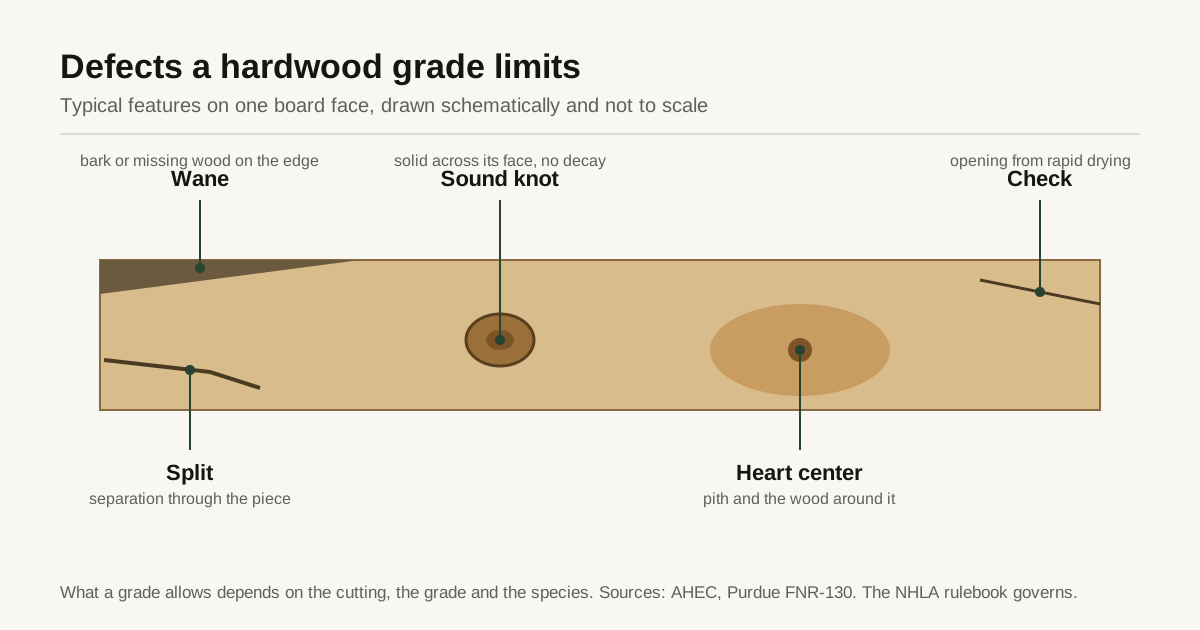
Hardwood lumber defects are the features that stop part of a board counting as clear wood: knots, wane, checks, splits, decay, stain and similar marks. NHLA grades limit them by measuring how much clear face a board can yield, so a defect matters only where it falls inside the cuttings you need. This post is part of our guide to hardwood lumber specifications, and it shows what each defect is, what a grade tolerates and how to write a limit into the order. Grade, thickness and moisture numbers in this guide are typical values, and the NHLA rulebook governs. Its text was not read for this post: the grade figures come from the Wood Handbook and a Purdue summary of the 1998 rules.
Hardwood Vendor is a matching service, not a sawmill. We own no mills, kilns or stock, and the limits below are for you to put in your own contract with a supplier.
The defect table
The table lists the defects a buyer meets most often, what causes them and how a standard grade treats them. Read the last column as a risk map, because the rules decide what is a defect and the contract decides who pays.
| Defect | Likely cause | Treatment in a standard grade | Who usually carries the risk |
|---|---|---|---|
| Wane | Round shape of the log, bark left on the edge | Restricted by grade, with special limits for FAS 1-Face and Selects | Seller, if outside the grade at shipment |
| Sound knot | Branch base, solid across the face | Not allowed in a clear cutting, allowed in a sound cutting | Seller, if the grade is exceeded |
| Unsound knot or decay | Loose knot with a pith center, fungi | Defect, not counted as sound | Seller, if present at shipment |
| Check | Rapid or faulty drying | Defect, unless planing removes it | Drying quality: seller at shipment |
| Split | Separation as the wood dries | Defect | Seller, if outside the grade |
| Shake | Separation between growth rings | Defect | Seller, if outside the grade |
| Warp (bow, crook, cup, twist) | Distortion, usually from drying | Does not affect grade if planing removes it | Depends on storage and contract |
| Sticker stain | Strips between layers during drying | Defect in clear grades, sound in 2B Common | Seller if wet drying, buyer if from storage |
| Bird peck, worm hole | Insect or bird damage in the tree | Counted as sound, allowed in 2B Common cuttings | Seller, if outside the grade |
| Mineral or gum streak | Natural color variation | Characteristic, not a defect | Written sort, if you care |
Caption: AHEC pages on characteristics and defects, Purdue FNR-130 (summary of the 1998 NHLA rules), Wood Handbook chapter 5 and the NELMA-authored grading glossary. Treatment is summarized from those pages; species exceptions are in the rulebook, and the last column is the author’s reading of normal practice, not a rule.
Wane
AHEC defines wane as bark or missing wood caused by the round shape of the tree or log. The NELMA grading glossary words it as missing wood on an edge or corner from bark or any other cause. Wane costs width, and on an edge it can cost the straight reference edge a rip saw needs.
Purdue notes that special wane restrictions apply to FAS 1-Face and Selects. The wane limits themselves are in the rulebook, and I could not open them, so I give no numbers. If wane matters to your parts, such as a nosing edge or a panel that is glued edge to edge, ask for edges that are ripped or trimmed, and write the width you need after trimming. Straight line ripping and gang ripping are the usual ways to get true edges.
Knots and pin knots
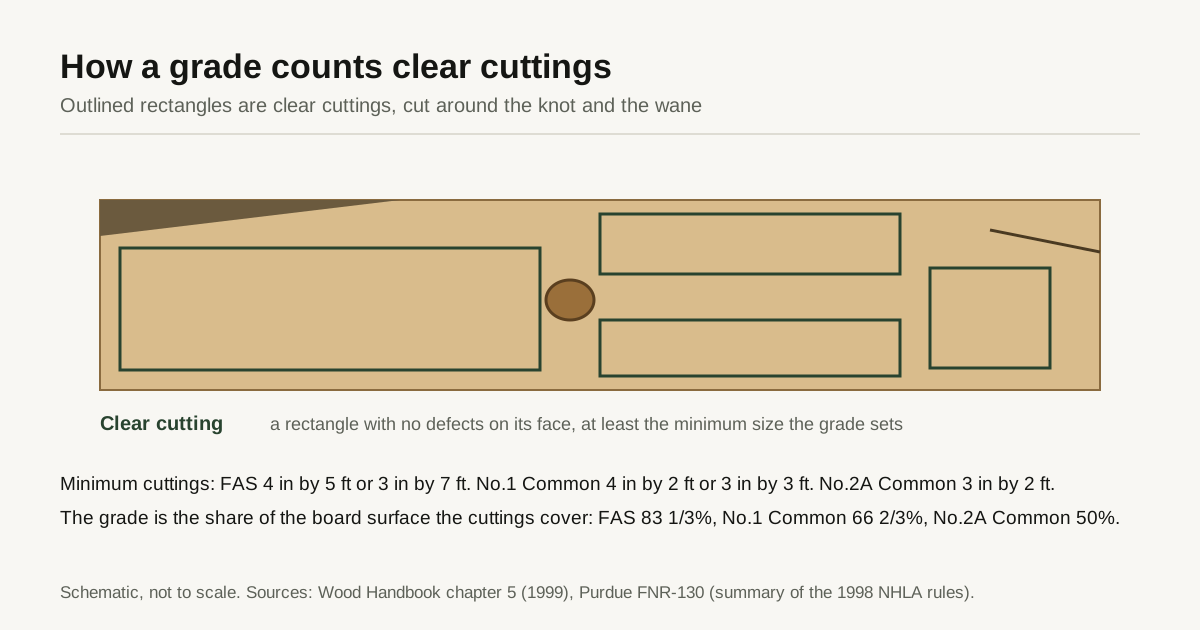
AHEC separates two kinds. A sound knot is solid across its face and shows no decay. An unsound knot is a circular area where a branch joined the trunk, with a pith center and sometimes missing wood. In a clear cutting neither is allowed on the cutting face. Sound cuttings, which the lower common grades use, may carry sound knots, bird pecks, sticker stain and worm holes.
Small knots depend on the species. Purdue gives one example: in cherry, small knots or their equivalent not exceeding 1/8 in in diameter are admitted in the cuttings. Terms such as pin knot are used on mill sheets for small knots, and I found no single public definition that all mills share. For visible parts, write the limit as a size (“no knots over 1/8 in on the face”) or as a rule (“no knots on the show face”), and attach photos of what you accept.
Heart center
Heart center is the wood at and around the pith, the small soft core of the log. AHEC lists pith among defects, and the Wood Handbook abbreviation list includes FOHC, free of heart center, which tells you it is something buyers ask for by name. The NHLA rulebook text on heart center was not read, and I found no limit for it in the sources I could open.
As practical advice, treat it as a sort. Say whether heart center is allowed on the face, on the back or not at all, and say where it is judged: on the board as sawn or on the face after ripping. Without that, a mill sorts to its own habit, and quotes that look the same will not be.
Drying defects: checks, splits, warp and stain
AHEC defines a check as a lengthwise opening on the face caused by rapid or faulty drying. A split is a lengthwise separation that forms as the wood dries, and its glossary defines warp as distortion from the original plane, usually from drying. AHEC’s kiln drying note explains the mechanism: heat is raised gradually while humidity stays high so the outer cells do not dry too fast and trap moisture inside, which can cause irreversible damage. Drying schedules are species specific.
The practical consequence is that a defect can come from the drying, not the log. Stickers cause stain and marks: AHEC calls sticker stain a greyish discoloration and treats a sticker mark that planing removes as a characteristic. Stress from drying shows later, when a board is ripped and the strips bow. See kiln drying hardwood and sticker stain in hardwood lumber for how those are prevented and judged.
What grades do not treat as defects
The grade is about clear area, so several features are outside it. AHEC lists as characteristics, not defects under NHLA rules: heartwood and sapwood, burls, gum streaks (in cherry), mineral streaks, glassworm patches and sticker marks that planing removes. Purdue adds that plain red and white oak are graded to the standard rule apart from a consideration for mineral stain, and that gum streaks and spots are admitted without limit in cherry.
So if your product cannot take sapwood, mineral streak or color change, the grade does not protect you. Write the sort next to the grade, for example “sapwood allowed up to a stated share of the face” or “no mineral streak on the show face”. The NHLA grade guide on this site covers the sorts that sit on top of grade.
Writing the limit into the contract
A limit needs a standard, a place and a time. This wording is an example, not a recommendation, and the values in brackets are for you to set:
- “Grade: FAS, NHLA Rules for the Measurement and Inspection of Hardwood and Cypress, [edition year], graded rough, before kiln drying.”
- “Additional limits: no heart center on the show face; sap stain not accepted; sound knots on the show face not over [size].”
- “End checks and end splits trimmed within [length], measured on [percent] of boards.”
- “Moisture [range], measured with [method] on [number] boards per pack.”
- “Claims: within [days] of receipt, lumber unaltered, rule book and inspector as named in this order.”
The Wood Handbook adds two points that belong in the order. First, the grade stamp shows the quality at the time of grading, and later poor storage, improper drying or careless handling can drop the lumber below its original grade. Second, working or recutting a graded product to a pattern may change or void the grade, so say whether acceptance is on the rough or the worked lumber.
Who inspects and when
Inspection has two moments. Before shipment, a buyer can ask for photos of each pack, a sample board or an independent grader, which is the idea behind pre-shipment grading. On arrival, check a sample of boards from several places in the load before you plane, rip or dry anything.
Purdue’s summary of the 1998 NHLA sales code gives the shape of a claim, and those numbers are from the older edition, so confirm them in the current rules: the sales code binds only when the contract says so, the buyer had 14 days from receipt, and the lumber had to stay unaltered. NHLA says its National Inspectors give on-site rule interpretations and dispute resolution. Photos, the tally and the deadline are covered in lumber quality claim.
Next step
Defects belong on the order as limits and sorts, not as hopes. Start from the full stack in the hardwood lumber specifications guide, then send your lumber RFQ with the limits attached. We pass it to up to 3 mills or yards that say they carry it, and they quote you directly.
Sources
- American Hardwood Export Council, grading sawn lumber: characteristics and defects
- American Hardwood Export Council, glossary of terms
- American Hardwood Export Council, Technical Matters 3: kiln drying
- Purdue Extension, FNR-130 Hardwood lumber grades (summary of the 1998 NHLA rules)
- USDA Forest Products Laboratory, Wood Handbook chapter 5, Commercial Lumber (FPL-GTR-113, 1999)
- Building Products Digest, lumber grading glossary (NELMA)
- National Hardwood Lumber Association, grading rules page
Frequently asked questions
Is a sound knot a defect in hardwood lumber?
It depends on the grade. A clear cutting in FAS, No.1 Common or No.2A Common must be free of defects on its face, so a knot cuts the board there. AHEC says sound knots count as sound and are allowed in the cuttings of No.2B Common, which only need to be sound.
Do defects count if planing removes them?
Not for the grade. AHEC says defects that planing can remove do not affect the grade. That is why a rough board can look better or worse after surfacing, and why the order should say whether grading is on rough or surfaced stock.
Who pays when lumber arrives with defects outside the grade?
The contract decides. Under the older NHLA sales code that Purdue summarizes, the seller paid for a national inspection when more than 20% of the footage was off the order or the value gap was above 4%, and the buyer paid when the gap was 4% or less. Defects that appear after delivery through poor storage are normally the buyer's risk.
What is wane on a hardwood board?
Wane is bark or missing wood on an edge or corner caused by the round shape of the log. Grading rules restrict it by grade, with special wane limits for FAS 1-Face and Selects. Write your own limit if parts need a clean edge, for example for nosing or panel edges.
Know what you need? Send the spec.
Tell us the species, grade, thickness and board feet. We pass it to up to 3 mills or yards that carry it and reply within 24 business hours.
Send my lumber RFQ