Guides / Grades and Specs
Hardwood Lumber Terms: A Buyer Glossary From FAS to Wane, and How to Use Them in an RFQ
February 21, 2027
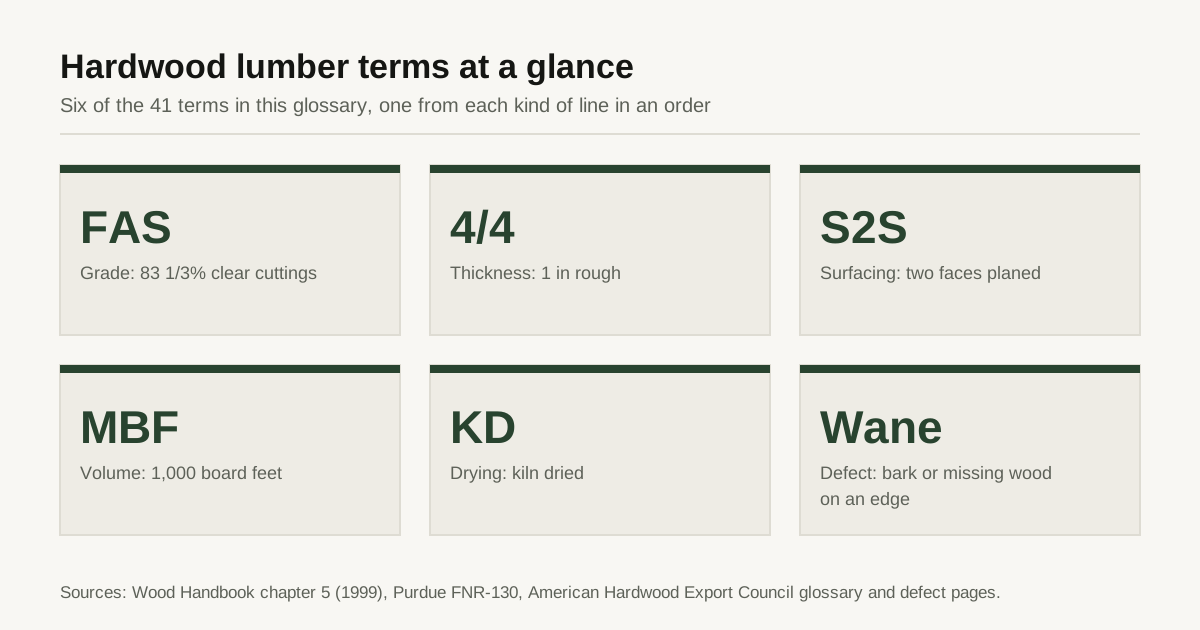
Hardwood lumber has its own shorthand, and the same letters can mean different things on a grading rule, a stock list and a shipping document. This glossary gives about 40 terms in six groups, each defined in plain words with the numbers taken from public sources, and ends with how to use them in an order. It is part of our hardwood lumber specifications guide, which shows where each term goes in a spec. Grade, thickness and moisture values are typical, and the NHLA rulebook governs; its text was not read for this glossary, so grade figures come from the Wood Handbook and a Purdue summary of the 1998 rules.
Hardwood Vendor is a matching service, not a sawmill. We own no mills, kilns or stock, so these definitions describe how the trade writes things, not what any one supplier sells.
Grades and grading terms
Clear face cutting. A rectangle cut from a board face with no defects on that face and at least the minimum size the grade sets. The Wood Handbook says cuttings are generally clear on one side with the reverse face sound. The grade is the share of the board’s surface measure that works into such cuttings (FAS needs 83 1/3%, No.1 Common 66 2/3% and No.2A Common 50%), and it is read from the poorer face, except for FAS 1-Face and Selects.
FAS. Firsts and Seconds, the top grade: boards at least 6 in wide and 8 to 16 ft long, with cuttings at least 4 in by 5 ft or 3 in by 7 ft and an 83 1/3% yield. See NHLA lumber grades explained.
FAS 1-Face (F1F). One face meets FAS and the reverse meets No.1 Common. Purdue says F1F is like Selects but must be 6 in wide, and special wane limits apply to both.
FOHC. Free of heart center, one of the abbreviations in the Wood Handbook list. Treat it as a sort you write on the order, and ask how the seller judges it; the NHLA rulebook text on heart center was not read.
NHLA. The National Hardwood Lumber Association, publisher of the Rules for the Measurement and Inspection of Hardwood and Cypress. Purdue dates the first rules to 1898, and the NHLA page says the rules are reviewed every four years.
No.1 Common. Boards at least 3 in wide and 4 ft long, cuttings at least 4 in by 2 ft or 3 in by 3 ft, and a 66 2/3% yield.
No.2A and No.2B Common. Both need cuttings of 3 in by 2 ft with a 50% yield. In 2A the cuttings are clear, and in 2B they only need to be sound, according to Purdue.
Sales code. The part of the NHLA rules on buying and selling practice and disputes, including reinspection by NHLA National Inspectors. Purdue says it binds buyer and seller only when the contract states that it governs. See lumber quality claim.
Select (Selects). One face FAS and the reverse No.1 Common, on boards at least 4 in wide and 6 ft long, per the Wood Handbook table.
Sound cutting. A cutting that has to be sound rather than clear. Purdue says No.2B Common has the No.2A requirements except that its cuttings need only be sound, and AHEC says bird pecks, sound knots, sticker stain and worm holes count as sound and are allowed in them.
Surface measure (SM). Width in inches times length in feet divided by 12, rounded to the nearest whole number. AHEC says grade percentages use surface measure, so every thickness is graded the same way.
Measure and tally terms
Board foot (bf, BF, BM). A piece 1 ft by 1 ft by 1 in. AHEC gives the formula: width in inches times length in feet times thickness in inches, divided by 12. See board feet and how hardwood is priced.
Gross tally (green tally). Board feet measured before kiln drying. Drying shrinks the boards, so the gross figure is larger than what arrives.
MBF. One thousand board feet, the unit of large orders and market reports. AHEC converts 1 MBF to about 2.36 m³ and 1 m³ to about 424 board feet, so use one conversion in the whole order.
Net tally. Board feet measured after kiln drying. AHEC says buyers can expect about 7% fewer board feet after drying than a green tally shows. See net vs gross tally.
Quarters (4/4, 5/4, 8/4). Rough thickness in quarters of an inch: 4/4 is 1 in, 5/4 is 1 1/4 in, 6/4 is 1 1/2 in and 8/4 is 2 in. The surfaced size is smaller.
Random widths and lengths (RWL). Boards of mixed width and length, within the grade minimums. The Wood Handbook says hardwood is usually made to random width and the grades set only minimums.
Scant. Smaller than nominal by a stated allowance. For example, the Wood Handbook says S1E or S2E lumber is 3/8 in scant of nominal in boards under 8 in wide when the width is set by the purchase agreement.
Tally. The American word for lumber measure, per AHEC, and the list of pieces behind a quantity. A tally sheet shows the counts by thickness, grade, width and length.
Cut, surfacing and size terms
Dimension parts. Stock processed to a specific thickness, width and length, which the Wood Handbook separates from factory lumber, the lumber buyers cut up themselves.
Plain sawn. Lumber that is not quarter or rift sawn, showing arch or cathedral patterns on the face.
Quarter sawn and rift sawn. Lumber cut on or near the radial axis of the log, giving edge, straight or vertical grain patterns, per AHEC. See plain, quarter and rift sawn hardwood.
RGH. Rough: saw-textured and thicker than the surfaced size. The Wood Handbook says grading rough lumber is generally more difficult.
S1S, S2S, S1E, S2E and S4S. Surfaced one side, two sides, one edge, two edges and four sides. The Wood Handbook also lists combinations such as S1S1E, S2S1E and S1S2E. Surfaced two sides at 4/4 is 13/16 in. AHEC adds that PAR, planed all round, is the same as S4S, and that “surfaced” is the American word for planed.
SLR1E. Straight line ripped one edge. Common on stock lists but not in the Wood Handbook list, so write it in words. See straight line rip and gang rip edge options.
Defects and features
Check. A lengthwise opening in the face caused by rapid or faulty drying. Checks that planing removes do not affect the grade. Shake, by contrast, is a separation between annual growth rings.
Heart center. The wood at and around the pith, the small soft core of the log, which AHEC lists among defects. Sorts such as FOHC refer to it, and the NHLA rulebook text on it was not read.
Knot (sound and unsound). A sound knot is solid across its face with no decay. An unsound knot has a pith center and sometimes missing wood, per AHEC.
Mineral streak. An olive to blackish-brown streak that usually follows the grain. AHEC lists it as a characteristic, not a defect. Gum streaks are the cherry equivalent.
Split. A lengthwise separation through the piece from one face to the other, which AHEC says forms as the wood dries. Bird pecks, worm holes (about 1/16 in to over 1/4 in), bark pockets and grub holes (over 1/4 in) are the other defects AHEC lists, and the first two count as sound.
Sticker stain. A greyish discoloration left by the stickers, the spacer strips between layers of boards during drying and storage. See sticker stain in hardwood lumber.
Wane. Bark or missing wood on an edge or corner caused by the round shape of the log. The grading rules restrict it by grade.
Warp. Any distortion from a flat plane: bow along the face, crook along the edge, cup across the face and twist. See hardwood lumber defects and what grades allow.
Drying and moisture terms
Air dried (AD). Dried in the open air without a kiln. AHEC says air drying oak takes roughly a year per inch of thickness.
Equilibrium moisture content. The moisture level wood settles at in its surroundings. AHEC notes timber always tries to reach it, and air-conditioned buildings can dry wood in service below its air dried level.
Kiln dried (KD). Dried in a chamber to a predetermined moisture content. AHEC says American hardwoods are typically kiln dried to 7 to 9%, given as 8% plus or minus 2. See kiln drying hardwood.
Moisture content (MC). The weight of water in wood as a percentage of the oven-dry weight, per AHEC.
Shrinkage. Contraction when wood dries below the fiber saturation point, which AHEC puts at around 25 to 27% moisture, stated as a percentage of the green size.
Trade and paperwork terms
CIF and FOB. Cost, insurance and freight, and free on board at a named point. Both are on the Wood Handbook abbreviation list. One public stock list of April 2026 quotes FOB the mill.
FAS (shipping). The Wood Handbook list also gives FAS as free alongside the vessel, so on an export order write whether FAS is the grade or the delivery term.
Sort. A requirement added on top of a grade, such as color, heart face, minimum width or minimum length.
How to use these terms in an RFQ
Write each term once and in full the first time: “FAS grade, NHLA rules, current edition” instead of “FAS”. Give thickness in quarters with the surfaced size in inches, write the surfacing code in words, name the tally basis and say whether a price is FOB, CIF or another term. If a stock list uses a code you do not know, ask the supplier to define it in the quote. The stock list guide walks through a full line token by token.
For the whole order, follow the hardwood lumber specifications stack, then send your lumber RFQ. We pass it to up to 3 mills or yards that say they carry it, and they quote you directly.
Sources
- USDA Forest Products Laboratory, Wood Handbook chapter 5, Commercial Lumber (FPL-GTR-113, 1999)
- Purdue Extension, FNR-130 Hardwood lumber grades (summary of the 1998 NHLA rules)
- American Hardwood Export Council, glossary of terms
- American Hardwood Export Council, characteristics and defects
- American Hardwood Export Council, measurement
- American Hardwood Export Council, Technical Matters 3: kiln drying
- A sawmill’s public kiln dried stock list, April 2026 (format reference only, no prices used)
- Building Products Digest, lumber grading glossary (NELMA, definitions of warp types and wane)
- National Hardwood Lumber Association, grading rules page
Frequently asked questions
What does FAS mean in hardwood lumber?
FAS is Firsts and Seconds, the top NHLA grade. A board must be at least 6 in wide and 8 ft long and yield 83 1/3% clear face cuttings. The same three letters also mean free alongside vessel in shipping shorthand, so write whether you mean the grade or the delivery term.
What is the difference between S2S and S4S?
S2S means two faces are planed and the edges are left as sawn. S4S means all four sides are surfaced. AHEC says PAR, planed all round, is the same as S4S. Write the code out in words on the RFQ, because mills use edge codes such as SLR1E in different ways.
What is a net tally compared with a gross tally?
A gross or green tally measures board feet before kiln drying and a net tally measures them after. AHEC says buyers can expect about 7% fewer board feet after drying. Two quotes at the same price per board foot are not equal when one is gross and the other net.
What does 4/4 mean on a lumber list?
It is rough thickness in quarters of an inch: 4/4 is 1 in, 5/4 is 1 1/4 in and 8/4 is 2 in. The planed size is smaller. Surfaced on two sides, 4/4 is 13/16 in under the standard thickness table in the Wood Handbook.
Know what you need? Send the spec.
Tell us the species, grade, thickness and board feet. We pass it to up to 3 mills or yards that carry it and reply within 24 business hours.
Send my lumber RFQ