Guides / Choosing a Supplier
Hardwood Lumber Supplier Red Flags to Check Before You Pay a Deposit
March 21, 2027
A supplier red flag is a gap you can test before you pay. The ones that matter in hardwood lumber are a payment request that changes or hurries, species and origin data the seller will not give, a grade, tally and moisture that are not stated, stock you cannot see and claims you cannot check. This guide lists them with what each can mean and the question that settles it. It is general information as of October 2026, not legal advice, and no single flag proves a supplier is dishonest. A small honest mill can be slow and plain. What you want is enough checks that a dishonest one cannot pass them all.
Hardwood Vendor is a matching service, not a sawmill. We do not vouch for any seller named in public sources below, and a match is not an endorsement. Buyer and supplier deal directly, so the checks are yours to make.
Red flags in the payment request
Start with payment, because it is the one step you cannot easily undo.
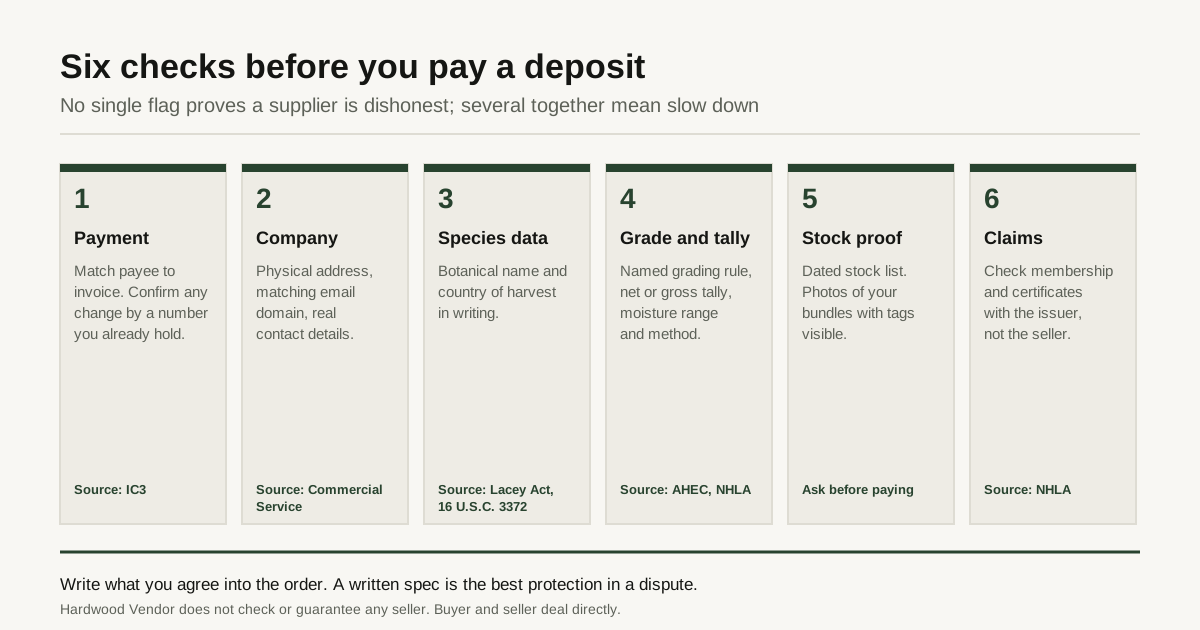
The FBI’s Internet Crime Complaint Center (IC3) lists, among the signs of business email compromise, urgency and last-minute changes in wire instructions or recipient account information, and requests for advance payment of services when it was not previously required. Its advice is to check for late changes in wiring instructions and to verify vendor information through the contact details you already have on file. A separate IC3 notice describes criminals who first get into a company’s email account and then pose as a vendor or customer to ask that pending or future payments be redirected to fraudulent accounts. Its recommendation for businesses is to verify all payment changes in person or by a known telephone number.
For a lumber buyer that means:
- New bank details on an existing order. Phone the seller on a number from your own records, not from the email, before you pay. A real seller’s account can be hacked, so a message from the right address is not proof.
- A deposit demand that is bigger or sooner than agreed. Compare it with the terms in the quote and with the options in our guide to lumber import payment terms.
- Pressure. “The price is only good today” is a sales tactic at best. A seller with stock can wait a day for you to check.
- A payee that does not match the seller. The account name should be the company on the invoice, in the country you expect. Ask why if not.
Red flags in the company itself
The US Commercial Service lists warning signs for screening a business partner. A company with little information across several databases is more likely to be a scam. Other flags are no description of the management on the website, an outdated copyright or an unfinished site, a sender’s email domain that differs from the company’s website and a P.O. box as the main address. It says one flag does not prove a company is false, but more flags make it less likely to be real.
Hardwood adds two checks of its own:
- Is it a mill, a yard or a trader? A seller that calls itself a mill should know the species it saws and the region. Ask where the logs come from and what it dries. A trader is fine too, if it says so. Our guide to sawmill, concentration yard or distributor explains the types.
- Are the stock claims specific? “FAS, 4/4, white oak, kiln dried to 6 to 8 percent” is a statement you can check. “Best quality, any size” is not.
Red flags in the lumber description
These cost you money even when the seller is honest.
| Red flag | What it can mean | What to ask or do |
|---|---|---|
| No grading rule named | “Select quality” can mean anything | Ask for the grade under NHLA rules, and the edition |
| No tally basis | A net and a gross tally differ | Ask net or gross; the American Hardwood Export Council says a gross tally buyer can expect about 7% fewer board feet after kiln drying |
| No moisture range or method | Wet stock moves after you cut it | Ask for the range and the meter type; see moisture meters |
| No botanical name or harvest country | The seller may not know the origin | Ask for genus, species and country of harvest in writing |
| Undated stock list | The lot may be sold | Ask for a list dated this week and the lot you would get |
| Stock photos or photos with no tags | Not your lumber | Ask for photos of your bundles with the tag visible; see lumber photos |
| Price far below other quotes | Different grade, basis or drying | Put every offer on one basis; see landed cost |
Species data deserves its own note for imports to the United States. The Lacey Act import declaration needs the scientific name of the plant, the value and quantity of the shipment and the country where it was harvested, and it is the importer who files it. A seller that cannot or will not tell you the species and harvest country has not given you what you need to file. Our guide to the Lacey Act declaration shows the fields.
Red flags in claims you cannot verify
A claim is only a flag when you cannot check it. Check these at the source.
- Association membership. NHLA groups its members into Active, Associate and Partner categories, so a logo does not say what the company does. Ask the association to confirm the current membership.
- Kiln drying certification. NHLA describes a Kiln Drying Certification program that validates a company’s drying process and documentation against industry standards. Ask for the certificate, its date and what it covers, and confirm it with the issuer. Do not treat a logo as a certificate.
- Grading verification. NHLA’s Facility Grade program, which it describes as voluntary and for members, has independent third parties verify grading. Ask whether the seller takes part and for the latest result, not just the claim.
- Financial guarantee. NHLA’s Strap and Seal program, which repays a buyer the difference in value on a quality problem, is stated to be available for domestic shipments only. If a seller offers it on an export order, ask exactly how it applies.
- Third-party inspection. Our guide to pre-shipment lumber grading and the page on the NHLA inspection certificate explain what an independent inspection covers. A seller who refuses any independent check on a large order has told you something.
Before you pay a deposit: seven checks
- Confirm the company is real. Find a physical address, not a P.O. box, and check that the website, email domain and invoice name match.
- Phone a number you found yourself. Do not use the number in the email.
- Get the spec in writing. Species with botanical name, grade rule, thickness, surfacing, moisture range, tally basis and quantity. Our purchase order clauses guide lists them.
- See the lumber. Ask for a dated stock list and photos of your bundles with tags, or arrange a third-party inspection.
- Verify claims at the source. Ask the association or certifier, not the seller.
- Confirm payment details by a known channel. Match the payee to the invoice and ask your bank what it can do if the money goes wrong.
- Start smaller if you can. A first order that is a fraction of your yearly need costs less to learn from. Our guide to the hardwood lumber minimum order shows how small a mill will ship.
If the lumber arrives and does not match, follow the notice and evidence steps in our guide to a lumber quality claim. A fast, written notice protects your position far more than an angry phone call.
What is not a red flag by itself
A seller who asks you to confirm the grade rule is careful, not difficult. A mill that says “I do not stock that species” is telling you the truth. A plain website with a real address and a dated stock list is a better sign than a polished one with none. A reply that takes a day because the yard was loading trucks is ordinary.
To compare real offers on one basis, write the spec once and send your lumber RFQ. We pass it to up to 3 mills or yards that say they carry your item, they quote you directly and we reply within 24 business hours. We do not check or guarantee any seller, so run the checks above on whoever quotes.
Sources
- IC3, PSA I-040120-PSA, cyber actors and COVID-19 (business email compromise red flags and safeguards)
- IC3, April 2020 public service announcement on business email compromise and redirected vendor payments
- US Commercial Service, background check tips (red flags for screening a business partner)
- 16 U.S.C. 3372, import declaration for plants (subsection f)
- NHLA, certification programs (Kiln Drying, Facility Grade, Strap and Seal)
- NHLA, membership categories
- American Hardwood Export Council, measurement: board feet, tally and kiln dried
Frequently asked questions
What are the biggest red flags with a lumber supplier?
Pressure to pay quickly, bank details that change by email, a request for advance payment that was not agreed before, no botanical name or harvest country for the species, and no stated grading rule, tally basis or moisture. Each one alone can have an innocent cause. Several together mean you should slow down and verify.
How do I verify a lumber supplier before sending a deposit?
Confirm the company exists at a physical address, call a phone number you found yourself and not one in the email, ask for a dated stock list and photos with the tags visible, and check any association or certificate claim with the issuer. Then agree the grade rule, tally basis and moisture range in writing before you pay.
Is it safe to pay a lumber supplier by wire transfer?
A wire is a normal way to pay a supplier, but it is hard to reverse. The FBI advises verifying any change in payment details through contact information you already have on file. Never act on new bank details received only by email, and ask your bank about recall options before you send a large first payment.
What should I do if a supplier stops replying after I paid?
Contact your bank at once to ask about a recall, keep the emails, tally, photos and bank record, and write to the supplier through every channel you have. Report suspected fraud to the FBI's Internet Crime Complaint Center. For a quality dispute rather than non-delivery, follow the notice steps in your purchase order.
Know what you need? Send the spec.
Tell us the species, grade, thickness and board feet. We pass it to up to 3 mills or yards that carry it and reply within 24 business hours.
Send my lumber RFQ