Guides / Cost and Ordering
Hardwood Lumber Minimum Order: Bundles, Lifts, Truckloads and Containers
March 20, 2027
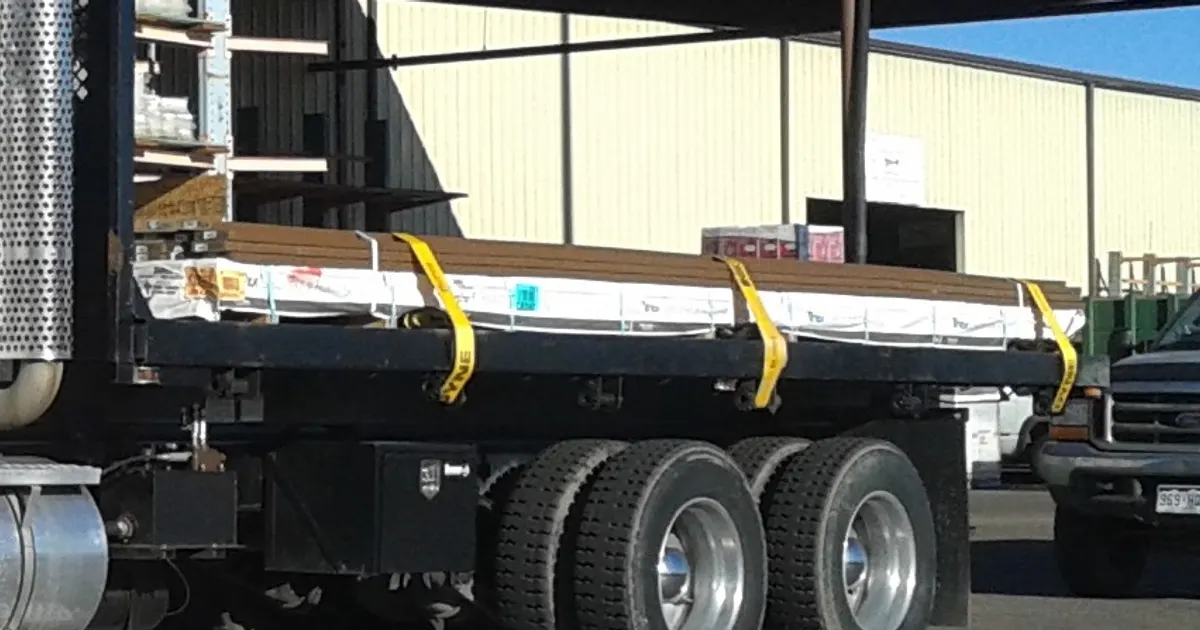
There is no standard minimum order for hardwood lumber. Each seller sets its own, in board feet, bundles, dollars or full loads, and the unit follows how the seller ships: a retail yard cuts to your list, a mill sells packs, a truck carries one load and a container carries another. This guide shows the size of each unit with the arithmetic and sources, what sellers publish about minimums and how to order less than a full load without paying more than you must.
I found no public survey of minimum orders, so every seller figure below is one company’s own statement, labeled as such. Hardwood Vendor is a matching service, not a sawmill. We own no stock and we name no seller.
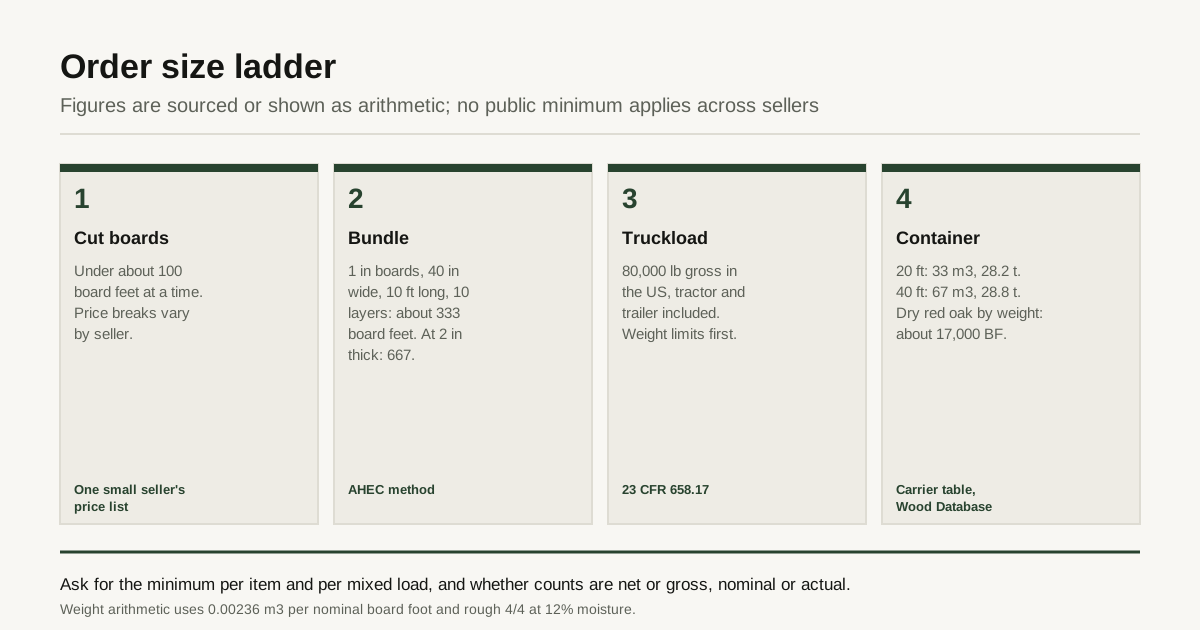
The ladder from boards to containers
| Unit | Typical size | What limits it | Who usually sells it |
|---|---|---|---|
| Boards, cut to your list | Under about 100 board feet at a time | Your list | Local dealer, small seller |
| Bundle | Hundreds of board feet (example below) | Bundle width, length, thickness and layers | Yard, mill |
| Truckload | Thousands of board feet, set by weight | 80,000 pounds gross in the US | Mill, concentration yard |
| 20 foot container | About 14,000 nominal board feet if packed solid, less in practice | Space | Exporter, mill, yard that ships containers |
| 40 foot container | About 17,000 for dry red oak by weight, up to about 28,000 for light wood if packed solid | Weight or space, by species | Exporter, mill, yard that ships containers |
The sections below show where each figure comes from. Our guide to container loading covers bundling and tally sheets for the same loads.
A board foot and a bundle
A board foot is 144 cubic inches of nominal volume, a piece 1 inch thick, 12 inches wide and 1 foot long. In metric that is about 0.00236 cubic meters, which is the figure I use for the weight arithmetic below.
The American Hardwood Export Council (AHEC) shows how a bundle is estimated: take the surface measure of one layer, multiply by thickness and multiply by the number of layers. Its worked example is a bundle 40 inches wide and 10 feet long of 2 inch lumber with 10 layers, which comes to 667 board feet. By the same method, a bundle of the same width and length of 1 inch boards with 10 layers is about 333 board feet, my arithmetic, and one with 20 layers is about 667. A seller who quotes a minimum of “one bundle” can therefore mean a few hundred board feet or more than a thousand, depending on the item. Ask for the board feet per bundle of your thickness and length.
What sellers publish about minimums
Public pages show how widely the unit varies. All of the following are one seller’s own wording, not an industry norm.
- A directory listing for an Ohio yard says no minimum or maximum order, lets you hand select lumber and lists surfacing and straight line ripping.
- A directory listing for a Texas distributor says wholesale sales only and gives a dollar minimum on wholesale orders. A dollar minimum is not a board foot figure, so ask what quantity it buys.
- One small seller’s price list says its prices are retail for quantities under 100 board feet, that orders of 100 board feet or larger are significantly lower and that prices are net tally. Net tally means the board feet are counted after drying shrink, and it is the basis to compare on.
- One industrial lumber supplier says customers can receive up to 7,800 board feet on an actual count or 10,500 on a nominal count before reaching the maximum truckload weight, and offers full and mixed truckloads. Its FAQ tells buyers to ask about minimums.
The pattern is that a ceiling is easy to publish and a floor you have to ask for. Our guide to where to buy hardwood lumber shows which seller types tend to sit on which rung.
A truckload is set by weight
A truck is limited by law before it is limited by space. The federal rule for the Interstate System sets the maximum gross vehicle weight at 80,000 pounds, except where the bridge formula requires a lower figure. That figure includes the tractor and the trailer, so the lumber is only part of it. On a WOODWEB forum thread about how much a truckload holds, posters gave 45,000 to 48,000 pounds for a tractor trailer, one gave a belief of 12,000 board feet if dried, and the forum’s technical advisor said the weight limit is reached before the size limit. The posts are anecdotal and the page shows no weight per board foot, so treat them as direction only.
For your quote, the useful questions are the species, thickness, moisture and whether the seller counts the load on an actual or a nominal basis. The 7,800 and 10,500 figures above differ by about a third for exactly that reason, so a load size with no stated count basis is not comparable.
A container, by space and by weight
The numbers for a dry container come from a carrier equipment table. A 20 foot dry container is listed at about 33 cubic meters with a maximum payload of 28.2 tonnes, and a 40 foot at about 67 cubic meters with 28.8 tonnes. The table says dimensions are a guideline and tells you to confirm exact figures with the carrier.
My arithmetic, at 0.00236 cubic meters per nominal board foot:
| 20 foot | 40 foot | |
|---|---|---|
| Space if packed solid | about 14,000 board feet | about 28,400 board feet |
| Weight limit, dry red oak (700 kg per cubic meter) | about 17,000 board feet | about 17,400 board feet |
| Weight limit, dry white oak (755 kg per cubic meter) | about 15,800 board feet | about 16,200 board feet |
| Weight limit, dry yellow poplar (455 kg per cubic meter) | about 26,300 board feet | about 26,800 board feet |
The densities are the Wood Database averages at 12 percent moisture, and its red oak page notes that density commonly varies about 10 percent either way. They are for rough 4/4 at nominal volume, so surfaced stock weighs less per nominal board foot. Real loads fit less than “packed solid” because bundles need gaps and the door end needs clearance.
Two things follow. A 20 foot container of these three hardwoods is limited by space before weight. A 40 foot container of dense oak reaches its weight limit well before the space is full, while light poplar fills the space first. Road weight limits at origin and destination can cut a payload below the container rating, so ask the seller for the load for your item and the weight it implies. A “minimum of one container” is not one number, and the board feet in it change with species.
How to order less than a full load
- Take a mixed load. A mill or yard that sells by the truckload may mix species, grades or thicknesses on one truck. Ask for the minimum per item as well as for the load, and see which items carry a premium.
- Buy from a distribution yard. Yards are commonly described as serving smaller and mixed orders. The price per board foot is usually higher, so compare it on a landed basis with our landed cost guide.
- Accept random widths and lengths. A narrower spec, such as a stated width and length, can shrink the pool of boards a seller will cut for you. If your cut list allows random widths, say so.
- Consolidate over time. A blanket order with scheduled releases can meet a seller’s volume floor without a pile of stock arriving at once. Our purchase order clauses guide covers release terms.
- Take what is in stock. An item the seller already has dried and sorted can often ship in a smaller lot than one it must saw for you. See hardwood lumber lead time.
- Share an order with another shop. Two buyers of the same item can meet one seller’s minimum. Agree who inspects and who pays freight before you order.
What a small order costs
A smaller order costs more per board foot, and the extra is not only the price. A seller’s volume break is one part. Freight on a part load is another, and handling a small lot can add a minimum charge. The small seller’s list above shows the structure, retail under 100 board feet and lower above, though not what the gap is in your market. I found no public survey of price by order size, so I will not give a percentage. Put each offer on one basis, per usable board foot delivered, and compare.
What to write in the order
State the item, the quantity as a number and a unit, and whether the count is net or gross, nominal or actual. If you are ordering below the seller’s usual minimum, ask for the price and any minimum charge in the quote so it is not a surprise on the invoice. To compare several sellers on one spec and one quantity, send your lumber RFQ. We pass it to up to 3 mills or yards that say they carry your item, they quote you directly and we reply within 24 business hours.
Sources
- American Hardwood Export Council, measurement: board feet, bundles, net and gross tally
- 23 CFR 658.17, maximum gross vehicle weight on the Interstate System
- Blue Water, 20 foot dry container specifications
- Blue Water, 40 foot dry container specifications
- The Wood Database, red oak, white oak and yellow poplar
- WOODWEB, How much weight in a truckload of lumber (2011 forum thread, anecdotal)
- An industrial lumber supplier’s public page, a small seller’s public price page and two directory listings (Ohio yard, Texas distributor), formats only, no prices used
Frequently asked questions
What is the minimum order for hardwood lumber?
There is no industry minimum. I found no public figure that applies across sellers. Retail yards and some small sellers sell by the board, a seller may set a dollar minimum, mills often sell by the bundle or truckload, and exporters sell by the container. Ask each seller for the minimum per item and for a mixed load, in writing.
How many board feet are in a truckload of hardwood lumber?
It depends on species, thickness and moisture, because weight usually limits a truck before space does. One supplier's public page gives up to 7,800 board feet on an actual count or 10,500 on a nominal count. Federal law caps a loaded truck at 80,000 pounds including the tractor and trailer.
How many board feet fit in a 40 foot container?
Space inside a 40 foot dry container is about 67 cubic meters, which is roughly 28,000 nominal board feet if packed solid, and a real load is less. By weight, dry red oak at about 700 kg per cubic meter reaches a 28.8 tonne payload near 17,400 board feet. Ask the seller for the load for your item.
Can I buy less than a full lift of hardwood lumber?
Often yes, from a local dealer or distribution yard, or by taking a mixed load. Expect a higher price per board foot and possibly a dollar minimum. One small seller's price list says orders under 100 board feet are priced as retail and larger orders are significantly lower, so ask where the price breaks sit.
Know what you need? Send the spec.
Tell us the species, grade, thickness and board feet. We pass it to up to 3 mills or yards that carry it and reply within 24 business hours.
Send my lumber RFQ