Guides / Choosing a Supplier
Where to Buy Hardwood Lumber: Sawmill, Concentration Yard or Distribution Yard
March 22, 2027
Choose the seller from your order, not from a search result. Buy a few boards a month and a local hardwood dealer is the usual start. Buy full truckloads of one species and grade and a sawmill or concentration yard fits. Buy mixed lots, surfaced stock or fast delivery and a distribution yard is closer. This guide goes one step before our comparison of seller types: how to find the sellers, how to read what they publish and what to ask so you do not waste a week on a seller that does not sell your size of order.
For the differences between a mill, a concentration yard and a distributor, read sawmill, concentration yard or distributor. Hardwood Vendor is a matching service, not a sawmill. We own no mills, kilns or stock, and we name no seller here. Where a public seller page is quoted below, it is one company’s own description, used as an example of a format.
Start with the size of your order
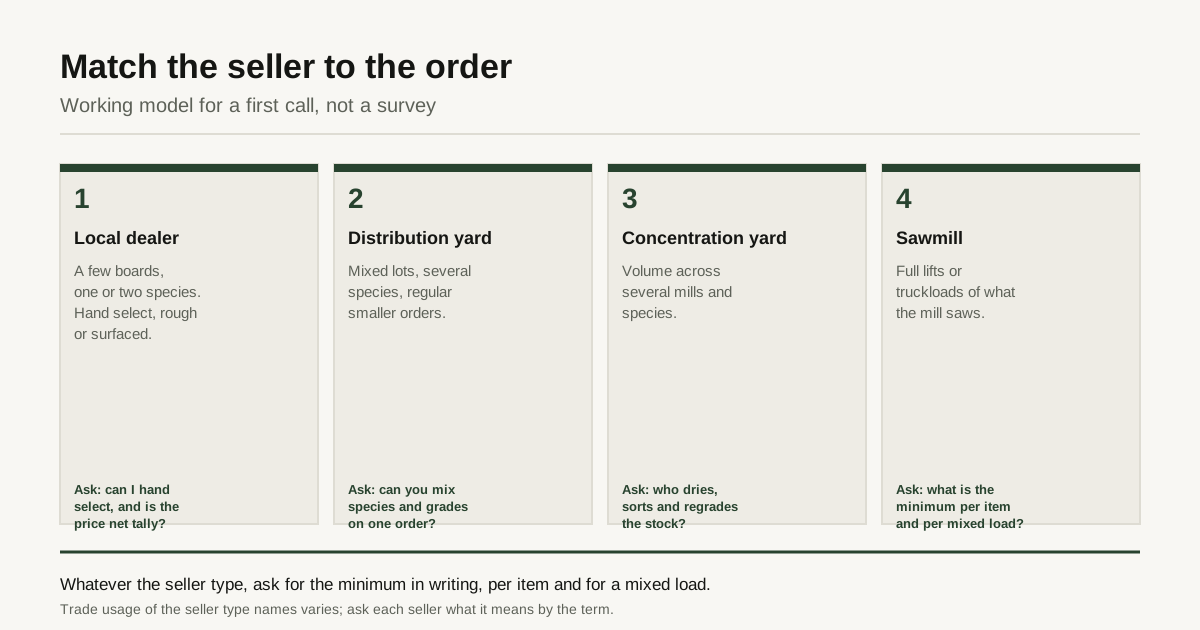
Order size is the first filter because sellers organize their business around it. I found no public standard that says where one seller type stops and the next begins, so the table is a working model for your first call, not a rule.
| Your order | Seller to try first | What to ask in the first message |
|---|---|---|
| A few boards, one or two species, now | Local hardwood dealer with a retail yard | Do you sell rough or surfaced, and can I hand select? |
| Under about 100 board feet at a time | Small seller with a retail price list or a local dealer | Is the price net tally or gross? Is there a price break at 100 board feet? |
| Several species, mixed sizes, regular orders | Distribution yard | Can you mix species and grades on one order? How is it tallied? |
| Full lifts or truckloads of one item | Sawmill or concentration yard | What is the minimum per item and for a mixed load? |
| Containers for export | Exporter, sawmill or concentration yard that ships containers | Which ports do you load from and how is the container tallied? |
The 100 board feet line is one seller’s, not an industry figure. One small seller’s price list says its prices are for retail purchases under 100 board feet and that orders of 100 board feet or larger are priced significantly lower. It also says its prices are net tally, shrink included, and tells buyers to add a waste factor, typically 40 to 60 percent. Use that as a prompt to ask each seller where their price breaks sit, not as a benchmark. Our guide to the hardwood lumber minimum order goes through the ladder from boards to containers.
The local dealer
Most small buyers start here, and the evidence is old but consistent. In a 2008 Fine Woodworking reader poll, nearly 3 out of 4 respondents said they usually buy from a local hardwood dealer, and most bought rough lumber rather than presurfaced stock. The poll had 1,089 responses and the magazine called it unscientific, so read it as a habit, not a market share.
What a local dealer gives you is the chance to look at the board before you pay. One Ohio yard’s public listing, for example, says no minimum or maximum order, lets you hand select your own lumber and lists surfacing and straight line ripping as services. That is the format to look for. What a dealer may not give you is volume pricing, paperwork for an export or a species that is not in stock this month.
The sawmill
A sawmill sells what it cuts. That can be the cheapest route and the most variable one. Stock bought at a mill is often green or air dried, may be sold on the mill’s own grade or ungraded and may need drying before you can use it. Ask four things before you drive out:
- Is the lumber graded under NHLA rules, and by whom?
- Is it green, air dried or kiln dried, and how is moisture measured?
- Is it tallied rough, and is the tally net or gross?
- Can I hand select, and is there a minimum?
One industrial lumber supplier’s public page says its truckloads carry up to 7,800 board feet on an actual count or 10,500 on a nominal count before reaching the maximum truckload weight, and that it ships both full and mixed loads. Its FAQ does not state a minimum order and tells buyers to ask about minimums. That is typical of what you will find: a ceiling is easy to publish and a floor is something you have to ask for.
The concentration yard and the distribution yard
NHLA’s own membership categories show how the trade groups these sellers. Its Active category covers firms that manufacture, custom kiln dry, wholesale or distribute North American hardwood or cypress lumber, which takes in sawmills, kilns, yards, brokers, dimension plants and wholesalers. Its Associate category is for firms that consume lumber, such as cabinet shops and furniture makers, and its Partner category is for firms headquartered outside North America. The categories tell you that yards and wholesalers are part of the same trade as mills. They do not tell you which yard carries your item.
A yard that gathers stock from several mills can usually offer more species and sizes than one mill and can sort and regrade stock. A distribution yard is commonly described as the type that serves smaller and mixed orders. Trade usage varies and I found no public definition, so ask each seller what it means by “yard” and what it dries, sorts and surfaces itself.
Where to find the sellers
No single list covers the trade, so use two or three.
- A lumber directory with a distance filter. Woodfinder describes itself as a place to find sources of lumber, veneer, wood specialties and sawmill services, and lets you filter results to the 10 closest or within 25, 50, 100 or 200 miles. It shows no note on how recently listings were checked, and the text of each listing is the supplier’s own, so treat each as a lead to confirm.
- Trade association lists. NHLA groups its members by the categories above. The American Hardwood Export Council keeps a list of its exporter members and describes its members as companies, many family owned, that include sawmills, veneer, moulding and flooring producers and traders with concentration yards and kilns. A regional group such as Appalachian Hardwood Manufacturers links to a member company page. Membership is a starting point for a search, not a quality guarantee. Confirm a company’s current membership with the association itself.
- Your own spec, sent to several sellers. The cheapest search is to write one clear spec and send it to three sellers of different types. If you would rather send it once, send your lumber RFQ and we pass it to up to 3 mills or yards that carry your item.
What to have ready before you call
Sellers answer quickly when the request is complete. Our guide to hardwood lumber specifications lists the fields. At minimum have:
- Species, and any color or sap rule.
- Grade and the grading rule, usually NHLA.
- Thickness in quarters, and rough or surfaced.
- Drying: kiln dried, air dried or green, and the moisture range you can accept.
- Quantity in board feet, and how often you will order.
- Delivery point and whether you can unload a truck.
- Paperwork you need, such as Lacey Act species data.
The board foot basis matters when you compare offers from different seller types. Our guide to the hardwood lumber tally shows how a net tally and a gross tally can differ by about 7 percent after kiln drying according to the American Hardwood Export Council.
Reading what a seller publishes
Public seller pages and listings are useful for what they say and for what they leave out. Look for four things:
- Species and grade named exactly. “FAS/SEL grade, kiln dried 6 to 8% moisture” is a usable line. “Quality hardwoods” is not.
- A stated tally basis. A price with no tally basis cannot be compared.
- A stated minimum or a way to ask. Sellers that publish no minimum are not saying there is none.
- A date. A stock list or price list with no date may be years old.
A listing that says wholesale sales only, with a dollar minimum on wholesale orders, tells you the seller is not set up for small cash buyers. The listing I read for a Texas distributor says exactly that. It is a different business from the Ohio yard above, and both are legitimate. The skill is matching your order to the right one.
Common mistakes
- Calling a sawmill for a small mixed order and treating the answer as the whole market.
- Comparing a mill’s green price with a yard’s kiln dried price.
- Assuming a distributor’s price is a wholesale price. Ask which tier you fall in.
- Driving to a seller before you have confirmed the item is in stock now.
- Skipping the paperwork question until after the order. For an import, the importer files the Lacey Act declaration, and the declaration needs the scientific name, value, quantity and country of harvest, so the seller has to supply those facts. Our guide to the Lacey Act declaration shows the fields.
Our guide to choosing a hardwood lumber supplier turns these into a nine-point check once you have two or three candidates. For the landed cost of an import, see hardwood lumber landed cost.
Sources
- Fine Woodworking, FWW poll: where you buy wood (2008)
- NHLA, membership categories
- American Hardwood Export Council, our members and exporter list
- American Hardwood Export Council, measurement: board feet, tally and kiln dried
- Woodfinder, lumber source directory
- Appalachian Hardwood Manufacturers, member companies and certification
- 16 U.S.C. 3372, import declaration for plants (subsection f)
- A small seller’s public price page, an industrial lumber supplier’s public page and two directory listings (Ohio yard, Texas distributor), formats only, no prices used
Frequently asked questions
Where is the best place to buy hardwood lumber?
It depends on how much you buy. A shop that needs a few boards a month usually starts with a local hardwood dealer. A plant that buys full truckloads of one species and grade is better served by a sawmill or concentration yard. A buyer who needs mixed lots, surfaced stock or fast delivery looks at distribution yards.
How do I find hardwood lumber suppliers near me?
Use a lumber directory that filters by distance, the member lists of hardwood trade associations and a plain search for your species. A directory listing is the seller's own claim, so phone or email each one with your species, grade, thickness and quantity before you drive anywhere or place an order.
Can I buy hardwood lumber directly from a sawmill?
Yes, but sawmill stock is often sold green or air dried and may not be sorted by grade. Ask whether it is graded under NHLA rules, how it was dried and whether you can hand select. Mills that sell by the truckload may not cut a small order, so ask for the minimum first.
Do I need a business account to buy from a lumber yard?
Not always. Some yards sell to anyone and some sell wholesale only. One public listing from a Texas distributor says wholesale sales only, while an Ohio yard's listing says no minimum or maximum order. Ask each seller whether it sells to your type of business and whether it has a retail price list.
Know what you need? Send the spec.
Tell us the species, grade, thickness and board feet. We pass it to up to 3 mills or yards that carry it and reply within 24 business hours.
Send my lumber RFQ