Guides / Grades and Specs
Iron Stain on Oak Lumber: Where the Blue-Black Comes From and How to Prevent It
April 22, 2027
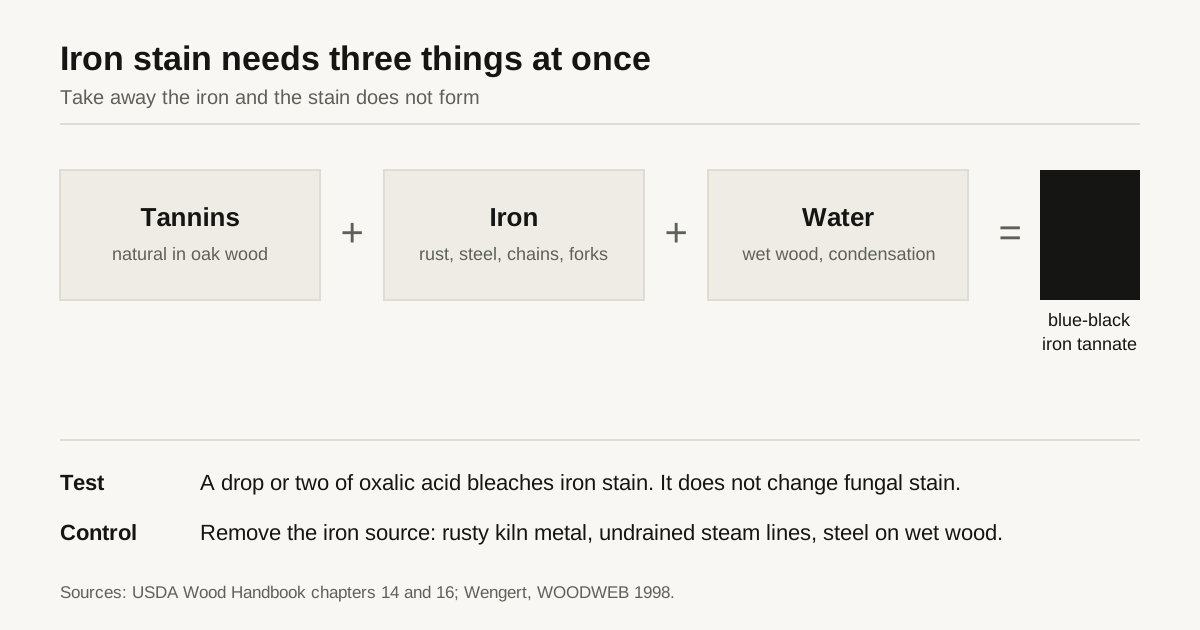
Iron stain is a blue to black discoloration on oak where iron, the wood’s own tannins and water meet. Take away the iron source and it does not form. It is mostly a surface problem, and a drop of oxalic acid on the stain will show whether iron caused it. For a buyer the useful questions are whether the grade and your finish allow it, and what the mill does to keep iron away from wet oak, because the fixes happen at the mill’s kiln and yard, as with the kiln drying schedules that decide how long oak stays wet.
This is general information as of October 2026. The USDA Wood Handbook and extension specialist Gene Wengert are the main sources. I did not find a grading rule for iron stain in the sources I opened, so I do not state one.
What iron stain is
Wengert, then an extension specialist at the University of Wisconsin-Madison, wrote in 1998 that iron tannate stain is dark blue or black, is seen primarily in oak and results from a chemical reaction between wood tannins, water and iron. The Wood Handbook chapter on finishing describes the same reaction: species such as the oaks, cedars and redwood are rich in tannins, and iron reacts with them immediately to give a blue-black discoloration. The handbook’s chapter on decay and stain adds that iron stain is more common in hardwoods such as oak and in many tropical hardwoods, and that control means eliminating the source of iron.
It is a chemical stain, not a fungus. That separates it from sap stain, which is a fungus that grows in sapwood. The Wood Handbook says blue stains range from bluish to bluish black and gray to brown. The two can look alike, which is why the test below matters. Our guide to sticker stain and other lumber stains compares them in a table.
Where the iron comes from
| Source | What it looks like | Control | Opened source |
|---|---|---|---|
| Rusty kiln metal such as roof vents and fan floors | Drips on the lumber below | Fix or replace rusty metal, drain condensate away | Wengert 1998 |
| Rusty steam spray pipes with poor drainage | Stain along spray lines | Drain lines by gravity, add a small pipe at the end to carry water away, point spray holes upward on the top half of the pipe | Wengert 1998 |
| Metal chains or fork tines on wet wood | Marks that seldom go deeper than 1/64 in | Avoid contact with wet oak or use a barrier | Wengert 1998 |
| Steel fasteners, steel wool, wire brushes | Blue-black around the fastener or the cleaned area | Use stainless steel fasteners and no steel wool on tannin-rich wood | Wood Handbook ch. 16 |
| Saw blade running in tannic log moisture | Blue-black on the sawn face, said to plane off in one pass | Saw promptly, keep blades and cooling water clean | WOODWEB 2008, forum contributors |
| Nails or fencing buried in the log | Blue that will not plane away | Metal detector before sawing; reject the log | WOODWEB 2008, forum contributors |
Sources are in the list below. The last two rows rest on contributors to a WOODWEB forum thread, not on a research paper, so treat them as practical experience. The controls for the first, second and fourth rows follow the cited sources. The other controls are my reading of the cause, not a claim from those pages.
Water is the third ingredient. Fresh or wet oak carries tannin-rich moisture, and condensation or drips bring iron into contact with it. The reaction needs water, so the moisture history of a lot matters. See our note on moisture and fiber saturation for how long a board stays above the wet range.
The oxalic acid test
If you are not sure whether a stain is iron or fungal, Wengert’s test is to put a drop or two of concentrated oxalic acid on it. The acid bleaches chemical and iron tannate stains but does not change fungal stains. Wengert also answered a reader in 2000 that a weak oxalic acid solution removes the stain quickly, without giving a concentration.
The Wood Handbook says oxalic acid removes the blue-black discoloration on wood in use: a saturated solution of 0.5 kg per 4 L of hot water, then a thorough rinse with warm water. It warns that if even a trace of iron remains, the discoloration will come back, and that oxalic acid is toxic. This is a finishing procedure for stained parts in use, not a quality-control test for a lumber lot. For a lot, a drop on a scrap board is enough to classify the stain.
Is it a defect on your order?
I could not find a grade rule on iron stain in the sources I opened, and I did not open the NHLA rulebook. So the answer is a contract question. If the stain would show under your finish, write it into the order. Because iron stain is shallow, a planed sample often settles the argument: Wengert says it does not go deep in most cases, but buried metal is the exception that will not plane away.
What to ask the supplier and what to write
- Ask how the kiln and the yard keep iron away from wet oak: rust on vents and fan floors, steam spray lines that drain, how packs are moved while the wood is still wet.
- For a stain-sensitive use such as a clear finish on white oak, ask for a planed sample from the lot before the order, and run the oxalic acid drop on any dark spot.
- Write the face rule on the order: for example, no blue-black stain on the face of visible parts, measured after planing to your thickness.
- Do not use steel wool or wire brushes on tannin-rich wood. The Wood Handbook says trace iron from them can cause iron stain.
When your spec is ready, send one lumber spec and we pass it to up to 3 mills or yards that carry it, with a reply within 24 business hours. For the drying side of the story, the kiln drying schedules guide is the next read.
Sources
- USDA Forest Products Laboratory, Wood Handbook FPL-GTR-190, chapter 14: biodeterioration of wood (chemical stains)
- USDA Forest Products Laboratory, Wood Handbook FPL-GTR-190, chapter 16: finishing of wood (iron stain)
- WoodWeb, Causes and cures for stains in dried lumber (Wengert, 1998)
- WoodWeb, Tannic acid stains in oak (Wengert, 2000)
- WoodWeb, Blue stain in red oak (2008, forum thread with Wengert)
Frequently asked questions
What causes iron stain in oak lumber?
A chemical reaction between the natural tannins in oak, iron and water. The USDA Wood Handbook says oak is rich in tannins and that iron reacts with them immediately to give a blue-black discoloration. At a sawmill the iron comes from places like rusty kiln metal, undrained steam pipes, chains, forks and saw blades.
How can I tell iron stain from other stains?
Put a drop or two of concentrated oxalic acid on the stain. University of Wisconsin extension specialist Gene Wengert wrote that the acid bleaches chemical and iron tannate stains but does not change fungal stains such as sap stain. Oxalic acid is toxic, so handle it with care and test on a scrap board, not on a finished part.
Does iron stain go deep into the board?
Usually not. Wengert noted that marks from chains or forks seldom go more than 1/64 inch below the surface and that iron stain does not go deep in most cases. Metal buried in a log is different: blue from nails or fencing in the log will not plane away. Ask for a planed sample before a large order.
Know what you need? Send the spec.
Tell us the species, grade, thickness and board feet. We pass it to up to 3 mills or yards that carry it and reply within 24 business hours.
Send my lumber RFQ