Guides / Grades and Specs
Fiber Saturation Point in Wood: Why Lumber Shrinks Only Below About 30% Moisture
April 21, 2027
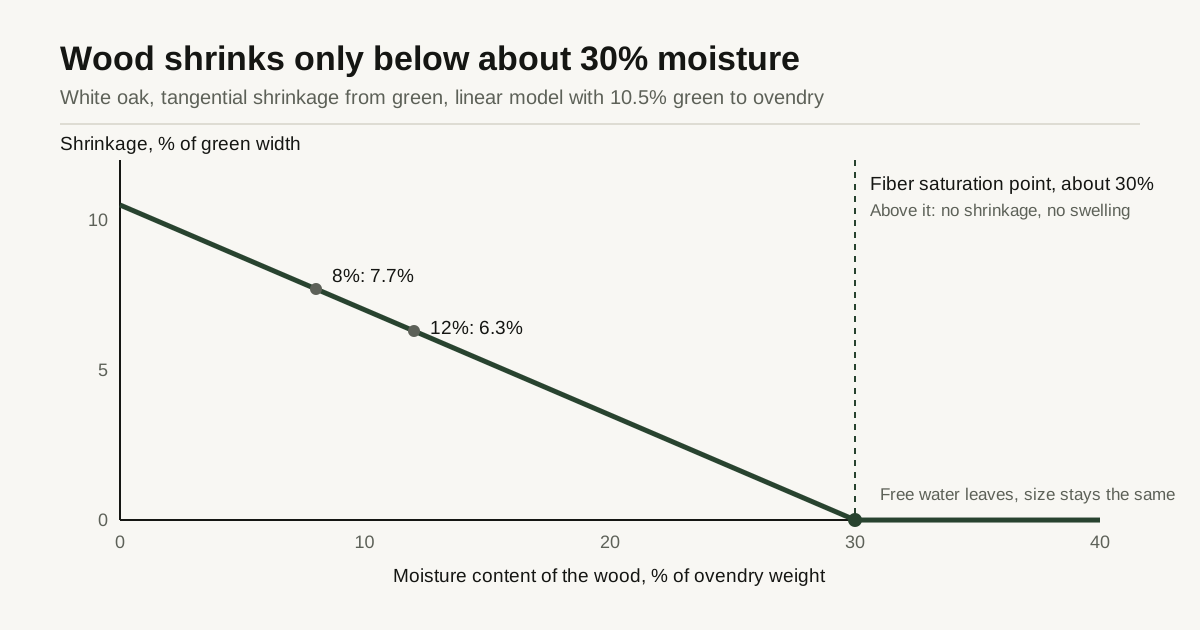
The fiber saturation point is the moisture content, about 30%, at which the cell walls of wood are full of water and the cell cavities are empty. Above it wood does not shrink or swell. Below it every point of moisture lost makes the board smaller, which is why drying from green to 8% costs a plainsawn oak board roughly 7 to 8% of its width. For a buyer it also marks the point where a moisture meter stops giving a trustworthy number.
This is general information as of October 2026, taken from the USDA Forest Products Laboratory Wood Handbook (FPL-GTR-190, 2010) and two university drying studies. Species and pieces differ, so treat the figures as typical. If you check moisture on delivery, our guide to lumber moisture meters covers the tools.
What the fiber saturation point is
Water in wood sits in two places. Free water is liquid water or vapor in the cell cavities. Bound water is held inside the cell walls by molecular attraction. The Wood Handbook defines the fiber saturation point as the moisture content at which only the cell walls are fully saturated and no water remains in the cavities. Operationally it is the moisture content above which the physical and mechanical properties of wood no longer change with moisture.
The handbook says it averages about 30% moisture content, and that for individual species and individual pieces it can vary by several percentage points. It also warns that the real transition is gradual: in one piece of wood some cells can be empty and partly dry while others a few millimeters away are still saturated. Moisture content here is the weight of the water as a percent of the ovendry weight of the wood.
Why lumber shrinks only below it
Free water leaving the cavities does not change the size of the board. Once the cell walls begin to lose bound water they shrink, and so does the piece. The Wood Handbook says wood is dimensionally stable above the fiber saturation point and changes size as it gains or loses moisture below it. That movement is what causes warping, checking and splitting when drying goes badly.
For a small piece with no moisture gradient, shrinkage begins at about the fiber saturation point and then runs in a fairly straight line to ovendry. Real lumber is different. The surface dries first, and when the surface drops below the fiber saturation point it starts to shrink while the interior is still wet. The handbook notes that lumber can therefore shrink even when its average moisture content is still above 30%.
How much a board moves
The handbook gives a simple estimate. Shrinkage at a target moisture content x is the green-to-ovendry shrinkage multiplied by (30 minus x) divided by 30, with 30% used when the fiber saturation point of the species is not known. Tangential values apply to the width of plainsawn boards, radial values to quartersawn. The table applies this to three species from Table 4-3 of the handbook.
| Board moisture (%) | White oak (tangential, 10.5% at ovendry) | Hard maple (tangential, 9.9%) | Black walnut (tangential, 7.8%) | 10 in green white oak, plainsawn (in) |
|---|---|---|---|---|
| 30 | 0.0 | 0.0 | 0.0 | 10.00 |
| 20 | 3.5 | 3.3 | 2.6 | 9.65 |
| 12 | 6.3 | 5.9 | 4.7 | 9.37 |
| 8 | 7.7 | 7.3 | 5.7 | 9.23 |
| 6 | 8.4 | 7.9 | 6.2 | 9.16 |
Columns 2 to 4 are shrinkage in percent of the green width. Source: USDA Wood Handbook FPL-GTR-190, chapter 4, Table 4-3 and the linear shrinkage method. Calculated by Hardwood Vendor; typical values only.
The handbook says the shrinkage of an individual board cannot be predicted closely: variation for a species is about 15% (coefficient of variation) and likely higher in commercial lumber where growth rings are not aligned with the faces. The average of a lot can be predicted much better than any one board.
What a meter reads above it
Moisture meters work on electrical properties. The handbook says these properties change by almost ten orders of magnitude across the possible moisture range, and change a great deal with small moisture differences below the fiber saturation point, which is why electrical measurement predicts moisture well there. It does not offer the same promise above that point.
Research at Virginia Tech (a 1993 master’s thesis by Zhangjing Chen) and a 1994 Forest Products Journal paper tried to measure moisture above 30% with a resistance meter during drying of red oak and yellow-poplar. A two-point technique predicted red oak within 5 moisture points and yellow-poplar within 10, and the thesis found that probe type and insertion depth changed the reading. So a meter showing 35% or 50% on a green or air dried board means “wet”, not a precise figure. Checking a delivery with a meter makes sense below 30%, where the reading is meaningful.
What to write on an order
- Name the moisture content you need at delivery, and how it is measured (see our guide to lumber moisture meters). Wood above about 30% is not dry in any trade sense, and a number from a hand meter up there is not a spec.
- For kiln dried stock ask for the kiln records, since the surface-to-core gradient is what the fiber saturation point explains. See kiln drying schedules for hardwood.
- Expect dimensional change when the moisture changes. Wood bought at 12% and stored in a drier room continues to shrink, and the handbook’s equation gives the direction and size for a typical board.
- Allow for the variation. A plainsawn 10 in oak board dried to 8% is about 9.2 in wide on average, and individual boards differ.
For a lumber spec that includes moisture content, send one spec and we pass it to up to 3 mills or yards that carry it, with a reply within 24 business hours.
Sources
- USDA Forest Products Laboratory, Wood Handbook FPL-GTR-190, chapter 4: moisture relations and physical properties of wood
- Virginia Tech, Zhangjing Chen (1993), Measurement of wood moisture content above fiber saturation point by electrical resistance
- Forest Products Journal 44(9), 1994, A technique to electrically measure the moisture content of wood above fiber saturation
Frequently asked questions
What is the fiber saturation point of wood?
It is the moisture content at which the cell walls hold all the water they can and the cell cavities hold none. The USDA Wood Handbook says it averages about 30% moisture content, but it can differ by several percentage points between species and between pieces of wood.
Does wood shrink above the fiber saturation point?
Not in a piece that is wet all the way through. The Wood Handbook says wood is dimensionally stable above fiber saturation. Boards still start to shrink early, because the surface dries first and drops below 30% while the core is wet, so an average reading above 30% does not mean no movement.
Why do moisture meters read badly above 30%?
Electrical properties of wood change a great deal with small moisture changes below fiber saturation, which is what meters rely on. Above it the signal is weak. Virginia Tech research in 1993 and a 1994 Forest Products Journal paper needed a special two-point method to estimate moisture above 30% in red oak and yellow-poplar.
Know what you need? Send the spec.
Tell us the species, grade, thickness and board feet. We pass it to up to 3 mills or yards that carry it and reply within 24 business hours.
Send my lumber RFQ