Guides / Choosing a Supplier
Lumber Supplier Scorecard: Grade, Moisture, Tally and On-Time Measures for Every Shipment
March 29, 2027
A lumber supplier scorecard is a one-page record that measures the same five things on every shipment from a mill or yard: grade accuracy, moisture within spec, tally accuracy, on-time loading and document completeness. A buyer who sends orders to two or three regular suppliers uses it to compare them from data and to hold a quarterly conversation with facts. Without it, a late load or a wet bundle is argued from memory.
This guide shows what each measure is, how to take it at receiving, how to turn the five into one score and how to review the result with the supplier. A template is at the end. Hardwood Vendor is a matching service, not a sawmill. We own no mills, kilns or stock, and buyer and supplier deal directly. This is general information as of October 2026.
What a lumber scorecard is for (and what it is not)
The ASQ Certified Supplier Quality Professional Handbook describes a scorecard as a common way of combining data so performance can be understood at a glance and compared between suppliers. It adds that a scorecard updated on a regular basis lets you track and trend a supplier’s performance over time, and that warnings of a negative trend can show when to start looking at an alternate supplier. ISO 9001:2015 asks organizations that buy from outside providers for the same discipline: clause 8.4.1 calls for criteria to evaluate, monitor and re-evaluate external providers with records kept, and clause 9.1.3 lists the performance of external providers among the things the analysis of data must evaluate.
A scorecard is not three other things:
- Not a selection tool. Choosing a first supplier is a different job. See our guide to choosing a hardwood lumber supplier.
- Not a claim. A grade or moisture dispute follows the order’s terms and needs notice, photographs and held bundles. The lumber quality claim guide covers it.
- Not proof of a certificate or a system. It measures what arrived, not how the mill is run.
The five measures that matter for hardwood
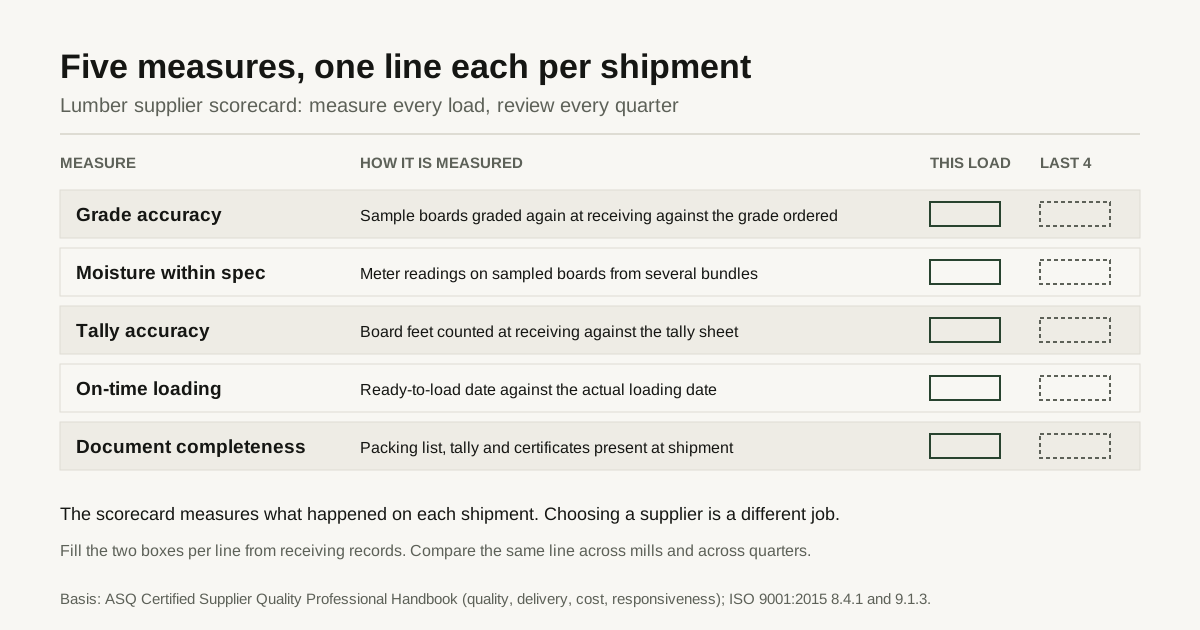
The ASQ handbook sorts supplier metrics into quality, delivery, cost and responsiveness, and its sample metrics include percent on-time delivery and actual against quoted lead time. For hardwood lumber, five measures cover quality, delivery and responsiveness. Cost is left out because the quote and the landed cost already carry it.
| Measure | Group | What it answers |
|---|---|---|
| Grade accuracy | Quality | Did the boards match the grade ordered? |
| Moisture within spec | Quality | Is the lumber in the range the order named? |
| Tally accuracy | Quality | Does the count on the sheet match the board feet received? |
| On-time loading | Delivery | Was it ready to load on the promised date? |
| Document completeness | Responsiveness | Were the packing list, tally and any certificates there when due? |
How to measure each one at receiving
Grade accuracy. Pull sample boards from several bundles, not only the outer ones. Regrade them under the rule named in the order and count the boards below the grade ordered. The score is the share at or above grade. I could not open the NHLA rule book, so I cannot give a published pass mark or reinspection tolerance. Write your own sample size and pass mark into the order. The quality claim guide shows how one published softwood rule sets a pass mark, as an example of the shape of such a clause.
Moisture within spec. Test the same boards or a second sample with a calibrated meter and record every reading. ASTM D7438 says hand-held meter readings are inferential, influenced by moisture content and other wood variables, the environment and the meter design, so calibrate and write the method into the order. ASTM D4442 names the oven-dry method as the primary reference, which is the one to use if a reading is disputed. The Wood Handbook says hardwood lumber for furniture, flooring, cabinets and millwork is usually dried to 6 to 8 percent moisture. Use the range in your own order. The score is the share of sampled boards inside it. Our guides to moisture meters and moisture test methods go further.
Tally accuracy. Recount a sample of bundles and compare with the tally sheet. The score is board feet counted divided by board feet stated, capped at 1. Make sure both sides use the same basis, because a green tally and a dried tally differ. Our tally guide shows the arithmetic.
On-time loading. Compare the ready-to-load date in the order with the date the lumber was ready. If you track milestones as in our guide to following up a sawn-to-order order, the data is already in the tracker.
Document completeness. List the documents the order requires, such as the packing list, the tally and any certificates, and count those present at shipment. The score is documents present divided by documents required.
Weighting and a simple score
Give each measure a weight that adds up to 100, score each measure from 0 to 1 and multiply. I found no industry standard for hardwood weights, so choose them by what hurts your plant. A cabinet shop that cuts to final size may weight grade and moisture highest. A plant on a tight production schedule may weight on-time loading higher.
Worked example. The weights, scores and shipments below are hypothetical and only show the arithmetic. Weights: grade 30, moisture 25, tally 20, on-time 15, documents 10. On-time scores 1 for on time, 0.5 for up to a week late and 0 for later.
| Measure (weight) | Shipment 1 | Shipment 2 | Shipment 3 |
|---|---|---|---|
| Grade accuracy (30) | 0.96 | 0.88 | 0.94 |
| Moisture within spec (25) | 0.90 | 0.70 | 0.95 |
| Tally accuracy (20) | 0.99 | 1.00 | 0.98 |
| On-time loading (15) | 1.0 | 0.5 | 1.0 |
| Documents (10) | 1.0 | 0.75 | 1.0 |
| Score out of 100 | 96.1 | 78.9 | 96.6 |
The average of the three is 90.5, which hides the point. Shipment 2 had two weak lines, moisture and timing, and the review should start there. Always read the lines before the total.
Reviewing the score with the supplier each quarter
Send the table to the supplier before the review, not during it. Ask for a short written answer on any measure below your target: what happened, what changed and when. The ASQ handbook lists corrective action requests among its sample metrics, including how long the supplier takes to respond, so the speed and quality of the answer is itself a measure. Keep the tone factual. Show the shipment dates and the readings. A supplier who sees the data on every load usually fixes the cause faster than one who hears about it once a year.
Agree what a good quarter looks like before the first review, and write the target for each line into your scorecard. If a measure stays below target for several quarters with no change, that is the trend ASQ describes as a reason to look at an alternate supplier. Your RFQ is how you start that search.
Mistakes that make a scorecard useless
- Changing the measures between suppliers. If one mill is scored on moisture and another is not, the comparison means nothing. Use the same five lines for every supplier.
- Sampling only the easy bundles. Boards from the outer bundles are not the lot. Pull from several bundles and write the sample size into the order.
- No written targets. A score without a target is a number nobody can act on. Put the target for each line in the order and in the template.
- Scoring from memory. Record readings and counts at receiving, on the day. A score filled in a month later reflects the last argument, not the load.
- Using it as a stick. Share the table with the supplier before the review and ask for the cause. The aim is a better next load.
Scorecard template to copy
One row per measure. Fill the “this shipment” column at receiving and copy the last four values from earlier shipments.
| Measure | How measured | Target | This shipment | Last 4 shipments |
|---|---|---|---|---|
| Grade accuracy | Share of [number] sampled boards at or above the ordered grade, regraded under [rule] | [percent] | ||
| Moisture within spec | Share of [number] sampled boards within [range] percent by [method] | [percent] | ||
| Tally accuracy | Board feet counted divided by board feet stated, same basis | [percent] | ||
| On-time loading | Ready-to-load date against the date promised in the order | [days late allowed] | ||
| Document completeness | Required documents present at shipment divided by documents required | [percent] |
Fill the brackets from your own order terms. The numbers in this guide are examples, not targets for your mills.
If you want quotes from mills that will agree to measure against a scorecard like this, send your lumber RFQ. We pass it to up to 3 mills or yards that say they carry the spec, they quote you directly and we reply within 24 business hours.
Sources
- ASQ, The Certified Supplier Quality Professional Handbook (publisher sampler, chapter 2: supplier performance categories and scorecards)
- ASTM D7438-20, Standard practice for field calibration and application of hand-held moisture meters
- ASTM D4442-20, Standard test methods for direct moisture content measurement of wood and wood-based materials
- USDA Forest Products Laboratory, Wood Handbook, Chapter 13: Drying and control of moisture content and dimensional changes, FPL-GTR-282 (2021)
- Auditor Training Online, ISO 9001 clause 8.4 summary and The 9000 Store, ISO 9001:2015 evaluating performance (commercial summaries of ISO 9001:2015 clauses 8.4.1 and 9.1.3, not the standard text)
Frequently asked questions
What should a lumber supplier scorecard measure?
For a hardwood buyer, five things per shipment: grade accuracy, moisture within spec, tally accuracy, on-time loading and document completeness. ASQ's supplier quality handbook groups supplier metrics into quality, delivery, cost and responsiveness. The five here cover quality, delivery and responsiveness, and the quote covers cost.
How many shipments do I need before a scorecard means anything?
I found no published minimum. One shipment shows what happened on that load. The scorecard becomes useful when you can read the same line across several loads and quarters, because ASQ says regularly updated scorecards let you track and trend performance over time. Start recording from the first load.
Can I use the scorecard to reject a shipment?
No. A scorecard is a record for comparing mills and for a quarterly conversation. A rejection or a claim follows the terms of the order and needs its own notice, photographs and held bundles. See the lumber quality claim guide for that process.
What weights should I give each measure?
I found no industry standard for hardwood. Choose weights that match what hurts your plant most, write them down and keep them the same across suppliers. The worked example below uses invented weights of 30, 25, 20, 15 and 10, and you should replace them with your own.
Know what you need? Send the spec.
Tell us the species, grade, thickness and board feet. We pass it to up to 3 mills or yards that carry it and reply within 24 business hours.
Send my lumber RFQ