Guides / Cost and Ordering
How to Follow Up a Sawn-to-Order Hardwood Lumber Order: Six Milestones and the Proof to Ask For
March 28, 2027
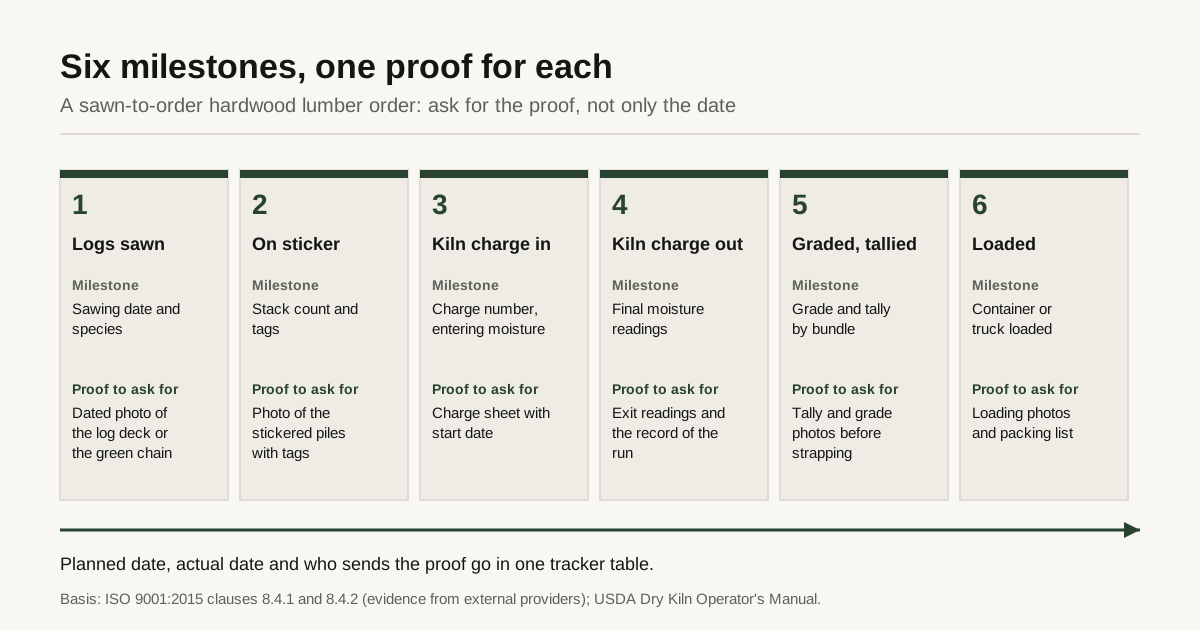
To follow up a sawn-to-order hardwood lumber order, agree six milestones before you pay a deposit: logs sawn, on sticker, kiln charge in, kiln charge out, graded and tallied, and loaded. Ask for one piece of proof at each, and write the planned and actual dates in a tracker both sides can see. A supplier’s loading date is only as good as the milestones before it, because drying is the step that cannot be hurried without risking defects.
This guide is for cabinet, flooring, millwork and furniture plants that order 4/4 to 8/4 lumber sawn for them rather than taken from a yard stock list. Our lead time guide covers how long each step takes. This one covers what to check while the order runs. Hardwood Vendor is a matching service, not a sawmill. We own no mills, kilns or stock, and the buyer and the supplier deal directly. This is general information as of October 2026.
Why sawn-to-order orders slip quietly
A stock order is a line on a dated stock list. A sawn-to-order order is a chain of steps, and the long ones happen where the buyer cannot see them. The date quoted on day one rests on assumptions about which logs are on hand, what season the lumber is stacked in and whether a kiln slot is free. Any of those can change without anyone calling you.
The sources explain why the chain is fragile. The USDA Forest Products Laboratory’s Wood Handbook says air drying time to 20 to 25 percent moisture varies widely with species, thickness, location and the time of year the lumber is stacked, and that drying is very slow in the cold winter months. The USDA Dry Kiln Operator’s Manual calls thickness the most critical dimension: the thicker the lumber, the longer the drying time and the harder it is to dry without defects. It also says kiln drying green 4/4 red oak takes two to three times as long as kiln drying green 4/4 hard maple.
A mill that is behind has choices, and some of them change your lumber. The Wood Handbook notes that, depending on a sawmill’s scheduling, air drying may be cut short at a higher moisture content before the wood goes to the kiln. The manual says mixed charges are not generally recommended because they reduce kiln output and raise the chance of uneven dried lumber, and it adds that some mixing happens to avoid delay for sorts that accumulate slowly. A mill can do these things for good reasons. You still want to know when it happens, which is what milestones are for.
The six milestones from log deck to loaded truck or container
| # | Milestone | What it means | What can go wrong |
|---|---|---|---|
| 1 | Logs sawn | The species and thicknesses on your order have been sawn from logs the mill holds | Logs not yet bought, or sawing queued behind other orders |
| 2 | On sticker | Green lumber is stacked with stickers, for air drying or to wait for a kiln slot | Piles mixed by species or thickness, damp stickers, long waits in warm weather |
| 3 | Kiln charge in | Your lumber has entered a kiln charge with a start date | Charge delayed, or your lumber moved into a different charge |
| 4 | Kiln charge out | The charge has finished and final moisture readings are taken | Readings outside the agreed range, or no readings |
| 5 | Graded and tallied | The lumber is graded, bundled and counted | Grade or thickness different from the order, tally not by bundle |
| 6 | Loaded | The truck or container is loaded with the packing list | Loading date slips, documents incomplete |
Not every mill air dries. Some send lumber from the green chain straight to a kiln queue. In that case milestone 2 becomes “stickered and waiting for a kiln slot”, and you still ask for the same photo.
Two orders on the same board
The table below shows what stretches in two common orders. It is qualitative on purpose. I found no published kiln time I could open for 8/4 hard maple, so I give no day counts.
| Order | What stretches the schedule | What to ask |
|---|---|---|
| 4/4 red oak | Red oak dries slowly and, according to the manual, is subject to bacterial wetwood that dries more slowly and often with more defects than normal wood | Kiln start and finish dates, final readings from sample boards, whether wet boards were sorted out |
| 8/4 hard maple | Thickness: the manual’s red oak example takes about three times as long at 8/4 as at 4/4, and thick stock is harder to dry without defects | Time in the yard before the kiln, the final moisture range, a color specification, since the manual says hard maple sapwood darkens if dried too hot |
What proof to ask for at each milestone
Ask for evidence that a third party could check. This is the same idea that ISO 9001:2015 applies to a company buying from outside providers. Clause 8.4.2 says the organization must decide the controls and the verification that confirm what it receives meets requirements, and clause 8.4.1 says it must set criteria to evaluate and monitor those providers. You are the outside party watching your own supplier, so the logic carries over. You do not need an ISO certificate to ask for proof.
| Milestone | Proof to ask for | Who sends it |
|---|---|---|
| Logs sawn | Sawing date in writing and a dated photo of the green lumber with a tag showing species and thickness | Mill sales contact |
| On sticker | Photo of the stickered piles with tags that match your order reference | Mill sales contact |
| Kiln charge in | The charge number, species, thickness, entering moisture readings and start date, taken from the kiln record | Kiln operator through the sales contact |
| Kiln charge out | Final moisture readings with the method and the number of boards tested, plus the end date of the run | Kiln operator through the sales contact |
| Graded and tallied | Tally by bundle, the grading rule named in the order, photos of sample boards from the top bundles | Grader or shipping office |
| Loaded | Loading photos, packing list that matches the tally, container or truck number | Shipping office |
The kiln records deserve a note. The Dry Kiln Operator’s Manual includes a kiln checklist that asks whether good kiln records are kept, and it describes kiln samples used to monitor moisture during a run. A mill that dries its own lumber should therefore be able to show a charge record. If it cannot, you have learned something at no cost.
Moisture proof needs a method. ASTM D7438 says hand-held meters give inferential readings, compared against a calibration, and that meters of different technologies do not necessarily give equivalent readings. ASTM D4442 sets the oven-dry method as the primary reference. The Wood Handbook says hardwood lumber for furniture, flooring, cabinets and millwork is usually dried to 6 to 8 percent moisture. Write your own target into the order, with the method. Our guide to lumber moisture test methods goes through the options.
Early signs the order is behind
- No sawing date, or “soon”, a week after the deposit.
- Photos without tags or dates, or photos of lumber you cannot match to your order.
- A kiln start date that moves with no new charge sheet.
- Final readings described as “dry” with no numbers, or numbers outside the range you wrote down.
- A proposal to put your lumber in a charge with a different species or thickness. The manual says the slower species sets the schedule, so mixing can lengthen the time in the kiln for the faster one.
- Green lumber waiting in warm weather. The Wood Handbook says slower drying can introduce the risk of stain, and the manual says sticker stain is reduced when stickers are kiln dried and protected from regaining moisture. Our guide to sticker stain covers what the grade allows.
- Silence. A supplier who does not answer a milestone question this week will not answer it at loading time either.
None of these proves a problem. Each is a reason to ask the next question the same day.
Agreeing what happens if the kiln date moves
Dates move even with good suppliers, so settle the rules before the first board is sawn. The clauses to agree are these:
- The supplier tells you in writing within a number of days you set, with the new date and the reason.
- Your lumber stays in its own charge unless you approve a mixed charge in writing.
- You may inspect the lumber before loading, and the readings are taken by the method named in the order.
- A latest ready-to-load date is stated, and the order says what happens if it passes: new date, partial shipment or cancellation of the open part.
Our purchase order guide lists the clauses for packing, marking and remedies. Example wording for the quote: “Seller will notify buyer in writing within [number] days of any change to a milestone date, giving the new date and the reason, and will not combine buyer’s lumber with a charge of a different species or thickness without written approval.” Fill in the number yourself, because no public standard sets it.
Milestone tracker to copy
Paste this into an email or a shared sheet. One row per milestone, one tracker per order.
| Milestone | Planned date | Proof document | Who sends it | Status |
|---|---|---|---|---|
| 1. Logs sawn | [date] | Sawing date in writing, tagged photo | [name] | Not started |
| 2. On sticker | [date] | Photo of stickered piles with order tag | [name] | Not started |
| 3. Kiln charge in | [date] | Charge sheet: species, thickness, entering readings | [name] | Not started |
| 4. Kiln charge out | [date] | Final readings, method, number of boards | [name] | Not started |
| 5. Graded and tallied | [date] | Tally by bundle, grading rule named in order | [name] | Not started |
| 6. Loaded | [date] | Loading photos, packing list | [name] | Not started |
Add a column for the actual date and a line for the reason whenever it differs from the plan. After two or three orders you will have a record of how each mill really performs, which is also the raw material for a lumber supplier scorecard.
If you already know your spec and want quotes that include milestone dates, send your lumber RFQ. We pass it to up to 3 mills or yards that say they carry it, they quote you directly and we reply within 24 business hours.
Sources
- USDA Forest Service, Dry Kiln Operator’s Manual, Agriculture Handbook 188 (revised August 1991)
- USDA Forest Products Laboratory, Wood Handbook, Chapter 13: Drying and control of moisture content and dimensional changes, FPL-GTR-282 (2021)
- ASTM D7438-20, Standard practice for field calibration and application of hand-held moisture meters
- ASTM D4442-20, Standard test methods for direct moisture content measurement of wood and wood-based materials
- Auditor Training Online, ISO 9001 clause 8.4 summary (a commercial summary of ISO 9001:2015 clauses 8.4.1 and 8.4.2, not the standard text)
Frequently asked questions
How often should I ask a sawmill for an update on a sawn-to-order order?
Ask at each milestone rather than on a fixed day: logs sawn, on sticker, kiln charge in, kiln charge out, graded and loaded. Each milestone has its own proof, such as a dated photo or a charge sheet. Agree the milestone list before the deposit so the supplier expects the questions.
What proof shows lumber is really in the kiln?
A kiln charge sheet or record that names the charge, the species, the thickness, the entering moisture readings and the start date. The USDA Dry Kiln Operator's Manual lists good kiln records among the items to check in a kiln operation, so a mill that runs a kiln should have them. Ask for the record, not a promise.
Does a moisture reading from a hand-held meter prove the lumber is dry?
Not by itself. ASTM D7438 describes hand-held meter readings as inferential, meaning they are compared with a calibration to estimate moisture. ASTM D4442 names the oven-dry method as the primary reference. Write the target range, the method and the number of boards to test into the order.
What if the supplier moves the kiln date?
Ask for the new date in writing, the reason and whether your lumber moves alone or into a different charge. The Dry Kiln Operator's Manual says mixed charges are not generally recommended because they cut kiln output and make the dried lumber less even. Agree before the order what the supplier may and may not do when a date moves.
Know what you need? Send the spec.
Tell us the species, grade, thickness and board feet. We pass it to up to 3 mills or yards that carry it and reply within 24 business hours.
Send my lumber RFQ