Guides / Grades and Specs
Kiln Drying Records Importers Ask a Hardwood Mill For
March 30, 2027
An importer cannot walk your kiln. The words “kiln dried” on a tally are a claim, and a drying record is the evidence that stands behind it. Buyers ask for the record for three reasons: they want to know the lumber is dry, they want to know it is dry evenly and they want to know the drying did not leave stress in the boards. This guide is for the owner or export sales engineer of a mill or yard. It sets out which records to keep for each kiln charge, how to tie them to the packs you ship and what an NHLA kiln drying certificate does and does not cover.
It is general information as of October 2026. I found no public figure for how many importers ask for kiln records or how often a missing record costs an order, so none is given. Confirm any certificate rule with the buyer’s authority or your customs broker.
What the buyer is really asking
Behind a request for “your kiln drying records” sit three questions.
| Buyer’s question | What answers it | Where it is measured |
|---|---|---|
| Is the lot on target? | Lot average moisture from final readings | Meter or oven-dry samples across the packs |
| Is the lot even? | Spread between pieces, the highest piece | Same samples, read as a range |
| Is the stress relieved? | Stress test result for the charge | Prong test and a rest period |
EN 14298, the European standard for assessing drying quality, frames it the same way. Its scope is a lot of dried sawn timber, softwood or hardwood, up to 100 mm thick, and it judges quality by the target moisture content, the average moisture content of the lot and the variation between pieces, with an optional way to specify the degree of case hardening. Checks, shakes, warp and stain are outside it and belong to the grade rule or the product spec. The classes and limits sit in the paid standard, so they are not reproduced here. An importer who cites it will usually write the limit into the order, and your record has to show that number.
Our reference page on kiln drying quality checks lists the fields from the buyer’s side. This guide covers the mill’s side: who writes each record, when and how it reaches the buyer.
The record set for one charge
Keep a small file for every charge, built while the charge is in the kiln and closed on the day the lumber leaves.
| Record | What it shows | Written by | When |
|---|---|---|---|
| Charge sheet | Charge number, kiln number, species, thickness, number of packs, dates in and out, schedule or program name | Kiln operator | At loading, closed at unloading |
| Kiln sample log | Initial and later moisture of the sample boards | Kiln operator | During the run |
| Equalizing and conditioning note | Whether equalizing and conditioning were done, and the target they aimed at | Kiln operator | End of the run |
| Final moisture check | Readings from pieces across packs, instrument, species setting, depth, who read them | Quality or shipping lead | After cooling, before packing |
| Stress test result | Prong test sample, whether prongs moved at once and after a rest | Quality lead | Per charge |
| Pack map | Which pack tags came from which charge | Shipping lead | At packing |
| Third-party certificate, if you hold one | Validation by a body such as NHLA | The body | Per program |
Two of these deserve a closer look.
The sample log. Kiln sample boards are how an operator tracks moisture during a run. The Forest Products Laboratory’s Dry Kiln Operator’s Manual, a USDA Agriculture Handbook, has separate chapters on kiln samples and on operating a dry kiln. If your kiln runs on samples, the log of their readings is your best proof that the charge reached the end point by a controlled route. Keep the log with the charge sheet, not in the operator’s notebook.
The stress test. The Forest Service describes casehardening as stress that builds up when the shell dries and shrinks first, and says it can cause warping when the lumber is re-sawn or machined. The prong test uses a 1 inch section cut across the board at least 12 inches from the end. Prongs that pinch together or cross at once show casehardening. If they move again after a 12 hour rest, both casehardening and a moisture gradient are present. Prongs that stay put show the wood is conditioned. The same guidance describes equalizing to 2 percentage points below the target, 6% for an 8% target, then conditioning with steam back to the target. Write the test result on the charge record, with the date.
The final moisture check on loading day
The final check is the number a buyer will compare with its own reading on arrival, so it has to be repeatable.
- Sample across packs and layers. One reading from the top board of one pack says little about a charge and cannot show a spread. Read pieces from several packs and from different heights, and note which.
- Name the method and the instrument. “Pin meter, species setting set for white oak, read at a stated depth” is evidence. “Checked, OK” is not. Our guide to pin and pinless moisture meters explains what each type reads.
- Record the range as well as the average. The buyer’s order may state a lot average and a highest piece. Show the average of your readings and the highest one you found.
- Keep an oven-dry check for the hard cases. EN 13183-1 specifies the oven-dry method and calls it the reference method for the moisture content of a piece of sawn timber. It is slower than a meter, so use it for a disputed lot or to check your own meter now and then, not for every pack.
- Record the time between drying and loading. A charge that read on target at the kiln door can pick up moisture if the packs wait wet in the yard. A reading on loading day shows the lumber’s state when it left you.
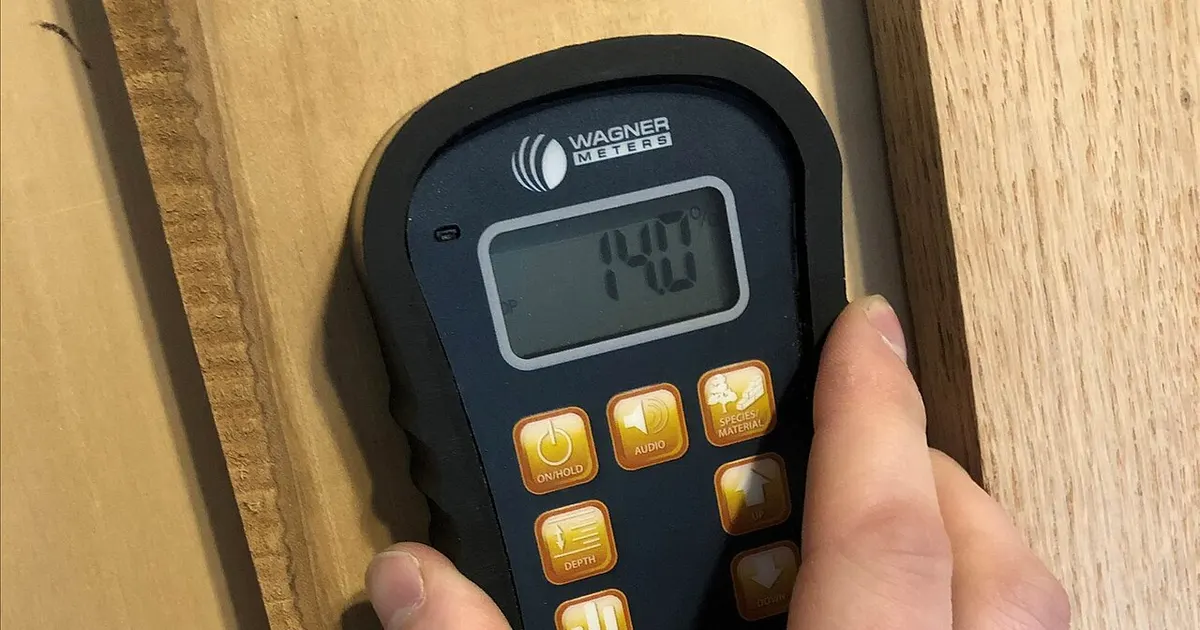
The photo at the top of this page shows a pinless meter reading 14.0% on one board. We do not know the species, the meter setting or where the board came from, so it proves nothing about any mill. It shows why a buyer’s reading and a record that says 6 to 8% cannot both stand. Your loading-day readings should be the ones that hold up.
Tie the record to the pack tags
A record that cannot be matched to the lumber is worth little. The link is the charge number.
- Put the charge number on every pack tag at unloading, next to species, grade and thickness.
- Carry the charge number onto the tally sheet. Our guide to the lumber tally sheet shows the columns; add one for the charge.
- Keep a pack map for mixed containers. If a container holds packs from two charges, the map says which is which, and each charge needs its own record.
- Send the record copy with the shipment documents, not after the buyer asks. A short PDF per charge, with the charge number in the file name, is enough.
A buyer who opens a claim has the pack tag in hand. If the tag leads straight to a charge record with readings and a stress test, the conversation is short. If it does not, the buyer has only its own readings.
What an NHLA kiln drying certificate covers
NHLA runs a Kiln Drying Certification Program. Its own page says the program validates your drying process and documentation against industry standards, saves exporters time and money, and achieves the same goals as the APHIS phytosanitary certificate at lower cost. The page lists no audit checklist or record names, so ask NHLA for the current standard and the application before you rely on it.
The EU decision that recognized the scheme gives more detail, and it shows how narrow the certificate’s job is. Under Commission Implementing Decision 2013/780, Member States could admit wood from the United States without a phytosanitary certificate if it was kiln dried to below 20% moisture content on an appropriate time and temperature schedule, with a standard steel clip stamped “NHLA - KD” and a unique number on each bundle. Each consignment travels with a Certificate of Kiln Drying that an NHLA inspector validates and that lists the bundle count and each clip number. The decision also describes independent third-party monitoring of approved mills and six-monthly APHIS audits of NHLA records and procedures. That is the rule in the decision as published. Rules change, so confirm the current acceptance in your buyer’s market.
Two points follow for a mill.
- A 20% limit is a plant health limit. It says nothing about the 6 to 8% a cabinet shop or flooring plant expects. A certificate of this kind does not answer a buyer’s question about average, spread or stress. Your own charge record does.
- The certificate sits on top of your records. A program that validates documentation needs documentation to validate. A mill with sloppy charge sheets will find the certificate no easier than the buyer’s questions.
Where kiln records go wrong
- A record that says “kiln dried” with no final moisture range, instrument or date.
- Readings written after the container has gone, from memory or from the target.
- No charge number on the packs, so the record cannot be matched.
- Two charges in one container with one record.
- A charge sheet that skips equalizing and conditioning, so the buyer cannot tell whether stress was addressed.
- Air dried stock sold as kiln dried because the drying record does not exist.
Each of these is fixed by writing the same few lines the same way for every charge. Our guide to dry kiln capacity planning shows how a charge-based kiln board can carry the charge numbers you will later need on the records, and the guide on kiln drying schedules explains why a fast schedule leaves the stress the prong test then finds.
What to send with a quote and what to keep back
- With the quote: a blank copy or a redacted sample of your charge record, so the buyer sees what it will receive. Say which moisture check you run and at what depth and species setting.
- With the shipment: the record for each charge in the container, tied to the tally by charge number.
- Kept on file: the full charge sheet, sample log and test sheets. No public rule sets how long. Keep them at least as long as the claim window in your contract and until any open claim is closed.
Talk to us
If you sell kiln dried hardwood lumber and want requests from buyers whose species, grade, thickness and drying requirements fit your stock, see for suppliers. Tell us your species, how you dry, the moisture range you hold and which records you can send with a shipment. Talk to us if you want to go through what a buyer will ask for. We reply within 24 business hours and we make no promise of orders.
Sources
- NHLA, certification programs (Kiln Drying Certification)
- EUR-Lex, Commission Implementing Decision 2013/780, NHLA kiln drying programme for wood from the United States
- EVS, EN 14298:2017 Sawn timber, assessment of drying quality (scope)
- EVS, EN 13183-1:2002 Moisture content of a piece of sawn timber, oven dry method (scope)
- USDA Forest Service, casehardening of lumber, what it is and how to relieve it
- Forest Products Laboratory, Dry Kiln Operator’s Manual (Agriculture Handbook 188), chapter list
Frequently asked questions
What kiln drying records does a hardwood importer ask for?
Usually a record for the charge the lumber came from (charge number, species, thickness, dates in and out, schedule name), the final moisture readings with the instrument used, the stress test result and a way to tie the charge to the pack tags on the tally. Some buyers also ask for a third-party certificate. Ask your buyer which of these it wants before you quote.
Does NHLA kiln drying certification replace my own kiln records?
No. NHLA says the program validates your drying process and documentation against industry standards, so it rests on records you already keep. It also says the program achieves the same goals as the APHIS phytosanitary certificate. It is a plant health document, so a buyer's moisture target and stress limits still have to be met and shown.
How long should a mill keep kiln drying records?
I found no public standard that sets a retention period for kiln records. Your contract with the buyer sets the claim window, so keep each charge record at least until that window and any open claim have closed. If you join the NHLA program, ask NHLA what it requires.
Is a final moisture reading from a meter enough proof?
A meter reading is an estimate. The oven-dry method in EN 13183-1 is the reference method, and it settles a dispute. For routine records, write down the meter, the species setting, the depth, the pieces and packs sampled and the date, so the reading can be repeated.
Know what you need? Send the spec.
Tell us the species, grade, thickness and board feet. We pass it to up to 3 mills or yards that carry it and reply within 24 business hours.
Send my lumber RFQ