Guides / Grades and Specs
Dry Kiln Capacity Planning at a Hardwood Mill: Loading Charges by Species and Thickness
March 27, 2027
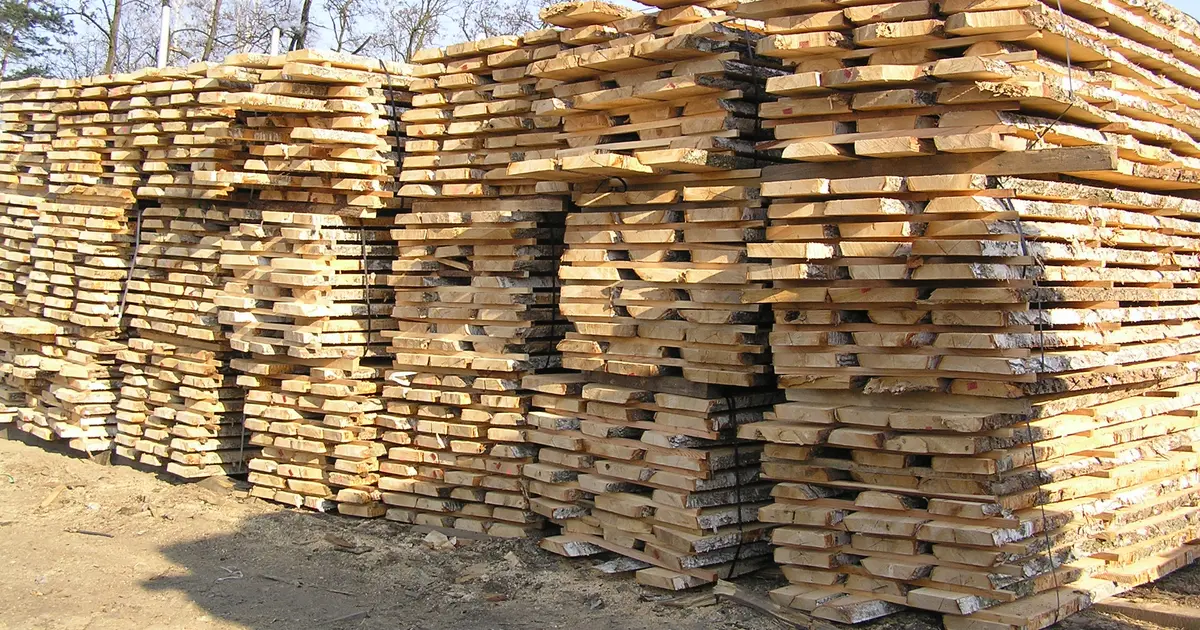
At many hardwood mills the kiln, not the saw, sets the delivery date. Sawing produces lumber every day, but lumber leaves a kiln only in charges, so the real limit is how many charges of a given species and thickness the kiln can finish in a month. Plan the kiln as capacity: board feet per charge, days per charge and the sorts waiting to fill each one. Then promise loading dates from that plan instead of from the saw’s output.
This guide is for owners and production managers of sawmills, concentration yards and exporters who keep missing loading dates. It gives a way to measure capacity, to group lumber into charges and to build a four-week kiln board. A template and a date promise checklist are at the end. It does not repeat temperature and humidity schedules; see our guide to kiln drying schedules for those. This is general information as of October 2026.
Why the kiln, not the saw, sets the delivery date
The USDA Dry Kiln Operator’s Manual gives one example that shows the problem. Kiln drying red oak from green to 7 percent moisture might take 18 days for 4/4 lumber, 32 days for 6/4 and 55 days for 8/4. Thickness alone triples the time a kiln is occupied. It also says the time to kiln dry green 4/4 red oak to 7 percent is two to three times that of 4/4 hard maple. These are the manual’s examples from 1991, not your kiln’s figures, but the pattern holds: each charge occupies a kiln for a time that depends on what is in it.
The manual also names the usual consequence. It says most mixing of charges is caused by lack of enough kilns or improper kiln sizing to accommodate different classes of drying sorts. In other words, mills mix species and thicknesses because their kiln capacity does not fit what the saw produces, and then date promises depend on a charge that is slower and less even than a pure one.
Measuring kiln capacity in charges and board feet
Capacity has two parts. The first is how much a charge holds. The manual gives ranges for lumber-holding capacity, always on a stated thickness basis: track-loaded compartment kilns from around 25,000 board feet on a 4/4 basis up to 220,000 on an 8/4 basis, and package-loaded kilns from around 25,000 to 90,000 board feet on a 4/4 basis. Ask your kiln maker or your own records which basis your figure uses. The manual also says a capacity load assumes the lumber is properly stacked and the packages are of lengths that suit the kiln, and that overloading or underloading changes air circulation and so the drying time and quality.
The second part is how often a charge can turn. Charges per period equal the days available divided by drying days plus turnaround days. The manual says track-loaded kilns have short downtime for loading and unloading, while package kilns have a long one, so count turnaround separately for each kiln.
Hypothetical example, to show the arithmetic only. A kiln holds 40,000 board feet. A 4/4 charge takes 20 days to dry plus 3 days for unloading, cleaning and loading, so 23 days a cycle. In a 91-day quarter it turns three full cycles and part of a fourth, about 120,000 board feet. An 8/4 charge in the same kiln takes 50 days plus 3, so 53 days a cycle and fewer than two charges in the quarter. Those day counts are invented. Replace them with the actual days from your own kiln records, by species, thickness and season. The manual notes that a schedule that works for lumber from one source in one kiln may not suit another source or another kiln, so your own history is the only reliable input.
Grouping lumber into charges by species, thickness and starting moisture
The manual says sorting before drying simplifies stacking and puts material of similar drying behavior in the same charge. Lumber can be sorted by species, moisture content, heartwood and sapwood, wetwood, grain, grade, thickness and length. For thickness it is blunt: sorting for thickness is essential, because uniform thickness simplifies stacking and drying and reduces warp and sticker damage.
Where a mix is unavoidable, the manual gives rules that translate into planning costs:
| Mix | What the manual says | Planning effect |
|---|---|---|
| 4/4 and 8/4 of one species | Follow the schedule for the thickest lumber, with changes based on the samples with the highest moisture, almost surely the thick ones | The charge leaves when the thick boards are ready, so the 4/4 stock waits in the kiln for them (my reading of the rule) |
| Red oak and hard maple, same thickness | The hard maple has to follow the milder oak schedule and stays in the kiln longer than necessary | Kiln days wasted on the faster species |
| Soft maple and red oak | Dried under the milder red oak schedule with oak samples, which doubles the kiln time the maple would normally need | Slot occupied twice as long as the maple needs |
| Hard maple and yellow birch, same thickness and moisture | Drying characteristics do not differ greatly, so they can be dried together economically | A mix that costs little |
| Green and air-dried lumber of the same thickness | The mix needs conditions for the wetter lumber, and the manual gives the green cherry and 25 percent air-dried maple case as an example | Air-dried boards are exposed to the green boards’ schedule |
The manual says some mixing is necessary to avoid undue delay for sorts that accumulate slowly and will degrade or stain if left in green storage too long. A rule that helps is to set a maximum wait for a half-full charge, and to decide in advance which mixes you will accept. That turns a panic decision into a planned one.
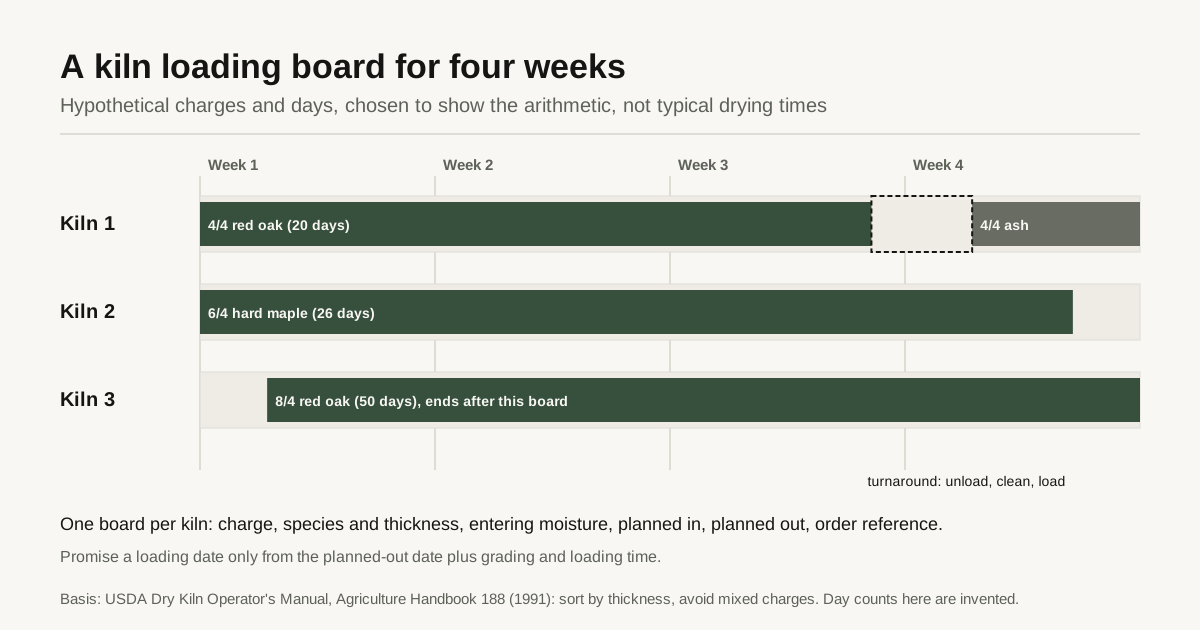
Building a four-week kiln schedule
- List the kilns with the board feet each charge holds and the turnaround days.
- List the sorts on hand and coming: species, thickness, board feet, entering moisture and the order reference each belongs to.
- Fill charges. Combine only sorts that dry alike. Note any charge that will be under capacity, since a part-filled charge is the usual start of an unplanned mix.
- Set the planned in date from the next free kiln date and the planned out date from your recorded drying days for that species, thickness and season.
- Add turnaround and place the next charge after it.
- Review weekly. Change dates when a charge runs late, and tell the sales side the same day.
The manual says kiln operators who dry the same species and thickness regularly can use kiln samples to build time schedules for later charges of the same material. That is the same idea applied to planning: keep a table of actual days per species, thickness and season, and update it after every charge.
Kiln loading board template:
| Kiln | Charge | Species | Thickness | Entering MC | Planned in | Planned out | Order reference |
|---|---|---|---|---|---|---|---|
| 1 | [number] | [species] | [4/4, 6/4, 8/4] | [percent] | [date] | [date] | [order number] |
| 2 | [number] | [species] | [thickness] | [percent] | [date] | [date] | [order number] |
| 3 | [number] | [species] | [thickness] | [percent] | [date] | [date] | [order number] |
Add a status column (planned, loaded, drying, out) and a note column for any mix you approved.
Where air drying and pre-dryers buffer the queue
Air drying and pre-drying take days out of the kiln. The Wood Handbook says air drying down to 20 to 25 percent moisture before kiln drying saves energy and reduces the dry kiln capacity needed. The Dry Kiln Operator’s Manual says 4/4 red oak can be kiln dried from 25 to 7 percent moisture in about a quarter of the time it takes to dry it from green. For a planner that means a yard of stickered stock is a queue that costs little while it waits.
Pre-dryers are the controlled version. The manual describes them as large buildings, typically sized at about four times kiln capacity, with controlled temperature and humidity, and says they dry in about one-third less time than yard air drying and can cut inventory by one-third to one-half. The Wood Handbook gives typical pre-dryer conditions of 27 to 38 degrees C (80 to 100 degrees F) and 65 to 85 percent relative humidity.
There is a cost on the other side. The Wood Handbook says air drying is slow in cold months, can stain in warm humid weather with little air movement and carries the high cost of holding large inventories of high-value lumber. It also notes that air drying may be cut short at a higher moisture content, depending on a sawmill’s scheduling. Record the entering moisture of every charge, because the kiln board only works if the days per charge reflect what actually went in.
Promising a loading date from the schedule
Before you quote a ready-to-load date, check these points:
- The lumber is sawn and sorted by species and thickness, and its entering moisture is known.
- A named kiln and charge will hold it, and the charge is full enough to run without a mix.
- The planned in date comes from the next free kiln date, not from the day the order arrived.
- The drying days come from your own records for that species, thickness and season.
- Time for turnaround, cooling, grading, tally, strapping and booking the load is added.
- The quote states the trigger (deposit or signed order) and that the date depends on the charge holding.
- If the date needs a mixed charge, the buyer has approved it in writing.
- You tell the buyer in writing as soon as a milestone moves.
A buyer reading a date with those conditions can plan. A buyer reading a date with none learns to discount every date. Buyers who follow an order milestone by milestone will ask for your charge records, as our guide to following up a sawn-to-order order explains. The kiln drying quality checks page covers what a kiln record should show after the charge, and our guide on what a sawmill should publish for export buyers covers the other fields buyers look for before they ask.
Next step
If you sell hardwood lumber to buyers who want dated milestones, register your mill or yard. Tell us the species and thicknesses you dry, your drying and tally basis and the paperwork you can issue. We pass a buyer’s spec to you only when it fits. Each request goes to 3 suppliers at most and the buyer deals with you directly. We reply within 24 business hours and we make no promise of orders.
Sources
- USDA Forest Service, Dry Kiln Operator’s Manual, Agriculture Handbook 188 (revised August 1991)
- USDA Forest Products Laboratory, Wood Handbook, Chapter 13: Drying and control of moisture content and dimensional changes, FPL-GTR-282 (2021)
Frequently asked questions
How do you calculate dry kiln capacity?
Capacity is board feet per charge times charges per period. Charges per period is the days available divided by drying days plus turnaround days. The Dry Kiln Operator's Manual rates compartment kilns in board feet on a stated thickness basis, for example 4/4 or 8/4, so note the basis. Use your own recorded drying days, not a table.
Can a mill dry 4/4 and 8/4 lumber in the same kiln charge?
The USDA Dry Kiln Operator's Manual says to sort for thickness, calls mixed charges not generally recommended and says that when thicknesses are mixed the schedule follows the thickest lumber. The mixed charge cuts kiln output and makes the dried lumber less even. Mixing is a last resort, not a plan.
Does air drying reduce the kiln capacity a mill needs?
Yes. The Wood Handbook says air drying to 20 to 25 percent moisture before the kiln reduces the dry kiln capacity required. The Dry Kiln Operator's Manual gives 4/4 red oak as an example: from 25 to 7 percent takes about a quarter of the time from green. The cost is yard time and carrying inventory.
What date should a mill quote a buyer for sawn-to-order lumber?
A planned kiln-out date taken from the kiln board, plus the time for cooling, grading, tally and loading, stated as dependent on the charge holding. Quote the trigger and what happens if the kiln date moves. A date that needs a mixed charge should not be quoted without the buyer's approval.
Know what you need? Send the spec.
Tell us the species, grade, thickness and board feet. We pass it to up to 3 mills or yards that carry it and reply within 24 business hours.
Send my lumber RFQ