Guides / Cost and Ordering
Industrial Hardwood Lumber for Pallets, Crating and Blocking: Grades, Sizes and Moisture
November 7, 2026
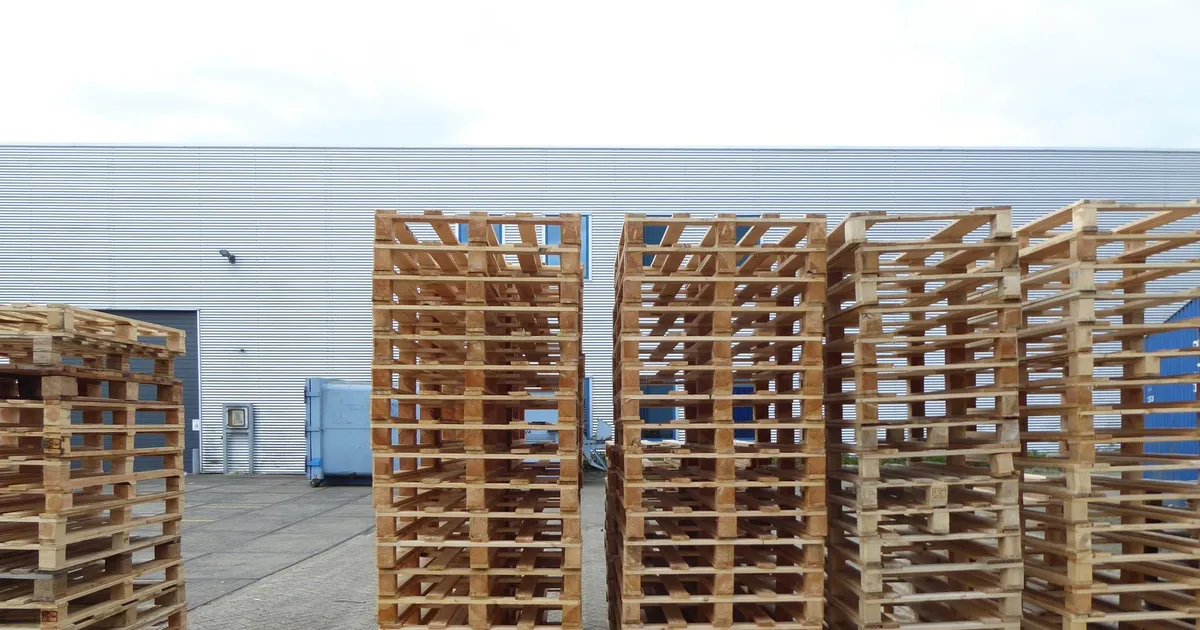
Most people picture hardwood as furniture and floors, but a large share of the hardwood cut in North America never becomes either. It becomes pallets, crates, dunnage, crane mats, railroad ties and blocking. This is industrial lumber. The buyers are not looking for clear faces or fine color. They want strong, sound pieces in the right size, at the lowest cost per piece and in steady volume.
This guide explains the grades and products used for industrial hardwood, how sizes and moisture are specified, what treatment is needed for export, and what to write on an RFQ.
What counts as industrial hardwood
Industrial hardwood lumber covers several products:
- Pallet parts. Deck boards, stringers, runners and blocks, cut to the sizes of the pallet design.
- Pallet cants. Squared timbers sawn from lower-grade logs and cut further into pallet parts, normally by the pallet maker.
- Crating and boxing timber. Boards and timbers for crates, skids and heavy-duty containers.
- Blocking and dunnage. Boards and squares to brace loads inside trucks, containers and ships.
- Mats and crane mats. Heavy timbers bolted or pinned together to form ground protection.
- Railroad ties and switch ties. Large sections sold under railroad specifications, a separate market from this guide.
The common feature is that the buyer cares about strength, size and cost. Appearance does not matter.
Species and grades
Pallet and industrial lumber is a mixed-species product. Oak is the most common species, followed by mixed hardwoods, with yellow poplar, ash, gum and others also used. Many mills sell “mixed hardwood” and do not sort by species.
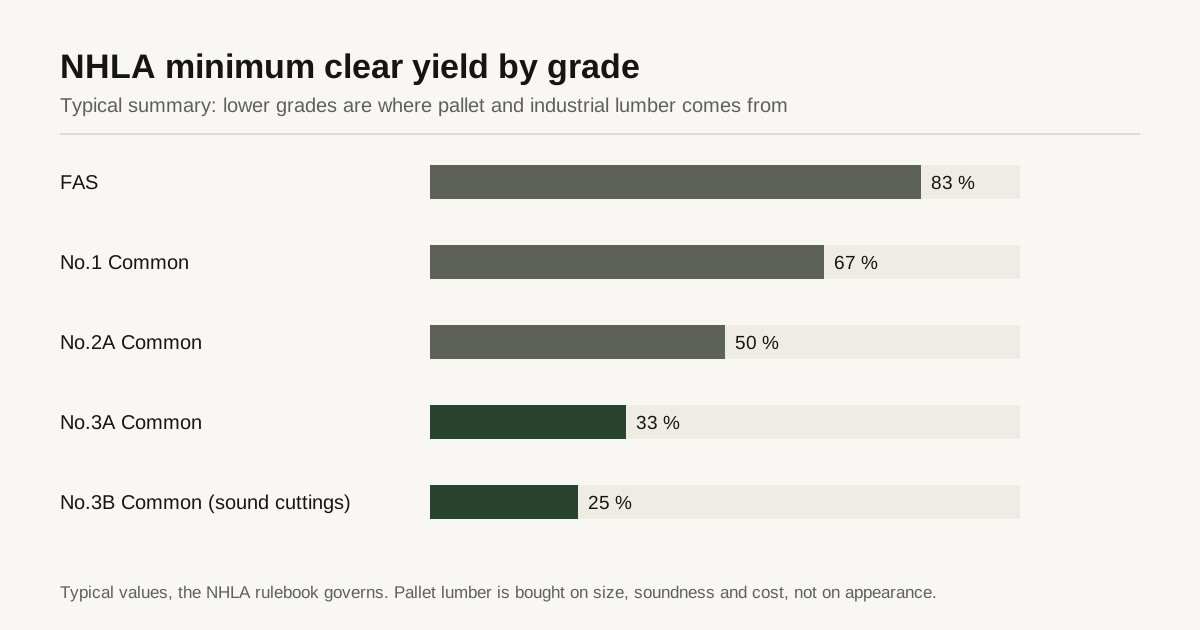
NHLA grades at the low end are the usual way to describe the lumber:
| Grade | Minimum yield (NHLA, typical) | Typical industrial use |
|---|---|---|
| No.2A Common | 50% clear cuttings | Heavy pallet parts, better crating |
| No.3A Common | 33 1/3% clear cuttings | Pallet deck boards and stringers |
| No.3B Common | 25% sound cuttings | Blocking, dunnage, lower-grade pallet parts |
| Below grade | Sound but not meeting No.3B | Mat timber, fuel and fiber |
The rulebook governs, and the figures above are summaries. Our guide to NHLA grades explains the grading logic for the upper grades.
Industrial buyers often skip grades altogether and buy by specification:
- Sound wood. No rot, no large cracks, no wane beyond a stated limit.
- Knot rules. Knots no larger than a set fraction of the width, and not on the edges of load-bearing pieces.
- Size rules. Minimum and maximum thickness and width, and exact cut lengths.
A written spec with sketches or photographs gives better results than a grade name alone.
Sizes and tolerances
Pallet parts are cut to the actual size, not nominal sizes. Typical pallet industry sizes, though designs vary:
| Part | Typical thickness | Typical width | Typical length |
|---|---|---|---|
| Deck board | about 5/8 to 3/4 in | about 3 1/2 to 5 1/2 in | 40 or 48 in, for common designs |
| Stringer | about 1 1/2 in | about 3 1/2 in | 40 or 48 in |
| Block | about 3 1/2 in square | about 3 1/2 in | about 3 1/2 to 5 1/2 in |
| Blocking timber | 2 to 6 in | 4 to 6 in | Random or cut to length |
The common North American grocery pallet is 48 by 40 in, and the common European pallet is 1,200 by 800 mm. Pallet makers cut from their own design drawings, so the numbers vary. Ask for dimensions and tolerances, for example plus or minus 1/8 in on thickness, and a limit on taper and bow.
If you buy rough-sawn pieces, sawn thickness varies by a small amount along the board, and a wide tolerance reduces cost. If you need accurate dimensions for automatic nailing, say so.
Moisture and drying
Moisture matters less than for furniture but still matters:
- Green lumber. Fresh from the saw, at 40 percent moisture or more. It is cheap and heavy, and it dries and shrinks on the pallet. Green lumber can mold in a sealed container.
- Air dried lumber. Dried in stacks outdoors for a few weeks or months, usually reaching 20 to 25 percent. A common middle option.
- Kiln dried or heat treated. Dried to lower moisture, often as part of heat treatment. Lighter, less prone to mold, higher cost.
Weight is another consideration. Green oak is much heavier than dry oak, which affects freight, and a pallet that dries and shrinks can loosen at the nails. If your pallets carry sensitive goods in closed containers, ask for a moisture limit. See our moisture meter guide for how to check it.
Export, ISPM 15 and heat treatment
Pallets, crates and dunnage used in international trade are wood packaging material under ISPM 15. They must be heat treated or fumigated and carry the ISPM 15 mark. Heat treatment normally requires the wood core to reach 56 C for 30 minutes. The treatment and the marking are done by registered firms, often the pallet maker, under official supervision.
Ask the pallet supplier:
- Is the pallet ISPM 15 compliant, and who marks it?
- Is the treatment heat or fumigation?
- Is bark limited as the standard requires?
Our guide to phytosanitary and fumigation rules explains the system, and the container loading guide shows where dunnage fits in the load.
Quality problems that cost money
Because the price per piece is low, small problems add up across thousands of pieces. The usual ones:
- Off-size pieces. Boards thinner than the spec fail on automatic nailers or leave loose pallets. A thickness check on a sample of each bundle catches this early.
- Rot and punk. Soft, decayed wood in stringers and blocks reduces load capacity. Reject bundles with more than a few pieces showing decay.
- Large cracks and splits. A split running through a block or a deck board end opens under nails. Set a limit on end splits.
- Excess wane. Wane on the edge of a stringer cuts the nailing area. Set a maximum wane in inches.
- Mold and stain on green stock. Cosmetic in most cases, but a problem for pallets that go to food or clean-goods customers. Ask for a limit if it matters.
- Mixed species and weights. Heavy oak mixed with light poplar changes the weight of each pallet. Say whether weight matters for freight or handling.
A sample bundle before the first full load is cheap protection. Count off-size pieces, check moisture and look for decay. If the results are inside your limits, write them into the order as the acceptance rule.
Mats, heavy timbers and special items
Large timbers, such as crane mats and heavy blocking, are sold by size and species in a market that works differently from pallet parts. Oak and mixed hardwood in sections of 6 by 8 in or larger, often in lengths of 8 to 16 ft, are typical. Buyers care about sound wood, straightness and the ability to take bolts or pins. Because heavy timbers are slow to dry, they are normally sold green or air dried. Loads are limited by weight and not by volume, so ask for the weight per piece and per load.
Another special item is switch or bridge timber, sold under railroad and construction specifications. These are separate products with their own grading rules, and the supplier should supply the specification they follow.
Planning volume and seasons
Industrial lumber is a volume business, and consistency matters. Plan with the supplier:
- A weekly or monthly volume, so the mill can set aside logs and sawing time
- A lead time for each size, since odd sizes need a separate sawing setup
- A seasonal adjustment, since green lumber properties change with weather, and winter and summer drying times differ
- A backup source for peak periods
Mills supply industrial lumber as one product among several, and a small buyer with a steady order is often better served by a distribution yard than by a large mill.
How industrial lumber is sold
- By the board foot or MBF. Common for sawn boards.
- By the piece. Typical for cut-to-size parts, for example a price per deck board or per stringer.
- By the ton. Used for some low-grade or cant loads.
- By the truckload. A “load” of pallet lumber is typically a flatbed or closed trailer of bundles of a specified part.
Compare prices on a piece or usable-volume basis. A cheaper board foot with more waste costs more per finished pallet. Our guide to board feet and pricing explains tally methods.
Freight is a large share of the cost for heavy lumber, and often the deciding factor, so quote delivered where possible.
Packaging and handling
Cut-to-size parts are normally bundled by size and strapped on skids or loaded loose in trailers. Ask how pieces are sorted, whether the lots are mixed in size, and what the tally shows. A mixed bundle with off-size pieces adds sorting labor at the pallet plant.
What to put on the RFQ
- Product: deck boards, stringers, blocks, cants, crating timber or dunnage
- Species: oak, mixed hardwood, or other
- Dimensions and tolerances, with a drawing if possible
- Quality rule: grade name, or a spec on knots, wane, rot and cracks
- Moisture: green, air dried or kiln dried, with a limit
- Treatment: heat treatment under ISPM 15 if needed, and who marks
- Volume: pieces, board feet or loads per week or month
- Delivery: location, truck or container, delivered price
- Tally method and unit
Closing checklist
- Write the dimensions and tolerances, not just a grade name
- Decide how dry the lumber needs to be
- Check ISPM 15 needs for export pallets
- Compare price per piece or per usable board foot, with freight
- Ask for a sample bundle before a large order
If you want pallet and industrial lumber quoted by several suppliers, send your lumber RFQ with the part sizes, species and volume. We pass it to up to 3 mills or yards that supply it, and they reply to you directly.
Frequently asked questions
What grade of hardwood is used for pallets?
Most pallet lumber comes from the lowest NHLA grades, No.3A and No.3B Common, and from cants or logs sawn to pallet part sizes. Buyers care about size, strength and sound wood more than about appearance. Specify the dimensions, allowed knots and wane, and whether the wood is green or dried.
Does pallet lumber need heat treatment?
Pallets used in international shipping need to meet ISPM 15, which usually means heat treatment and a mark on the pallet. The treatment is normally done by the pallet maker or a treatment plant after assembly. Ask your pallet supplier which route they use, and see the guide to phytosanitary rules for the details.
Should pallet lumber be kiln dried?
Not always. Many domestic pallets use green or air dried lumber to save cost. Export pallets that go through heat treatment dry in the process. If the pallet will sit in a sealed container with sensitive goods, a drier pallet reduces the risk of mold and moisture.
Know what you need? Send the spec.
Tell us the species, grade, thickness and board feet. We pass it to up to 3 mills or yards that carry it and reply within 24 business hours.
Send my lumber RFQ