Home / Lumber grades and size rules / Lumber Thickness in Quarters and Surfacing Codes: Rough, S2S, S4S and Edge Options
Lumber Thickness in Quarters and Surfacing Codes: Rough, S2S, S4S and Edge Options
Reference page · Last reviewed 9 April 2027
Hardwood lumber thickness is named in quarters of an inch of the rough sawn board: 4/4 is 1 in, 5/4 is 1 1/4 in, 8/4 is 2 in, up to 16/4 at 4 in. Surfacing codes say which faces and edges were planed: RGH (rough), S1S, S2S, S1E, S2E and S4S. A board surfaced two sides loses about 3/16 in up to 6/4 and 1/4 in from 7/4 up, but it is normally still tallied on its rough nominal thickness.
| Quarters | Rough nominal | Metric (rough) | Surfaced two sides (S2S) |
|---|---|---|---|
| 3/8 in (not quartered) | 3/8 in | 10 mm | 3/16 in (5 mm) |
| 1/2 in | 1/2 in | 13 mm | 5/16 in (8 mm) |
| 5/8 in | 5/8 in | 16 mm | 7/16 in (9 mm) |
| 3/4 in | 3/4 in | 19 mm | 9/16 in (14 mm) |
| 4/4 | 1 in | 25.4 mm | 13/16 in (21 mm) |
| 5/4 | 1 1/4 in | 31.8 mm | 1 1/16 in (27 mm) |
| 6/4 | 1 1/2 in | 38.1 mm | 1 5/16 in (33 mm) |
| 7/4 | 1 3/4 in | 44 mm | 1 1/2 in (38 mm) |
| 8/4 | 2 in | 50.8 mm | 1 3/4 in (44 mm) |
| 10/4 | 2 1/2 in | 63.5 mm | 2 1/4 in (57 mm) |
| 12/4 | 3 in | 76.2 mm | 2 3/4 in (70 mm) |
| 14/4 | 3 1/2 in | 89 mm | 3 1/4 in (83 mm) |
| 16/4 | 4 in | 101.6 mm | 3 3/4 in (95 mm) |
| 18/4 to 24/4 | 4 1/2 to 6 in | 114 to 152 mm | By contract |
Standard thickness values from the Wood Handbook Table 6-4, with the metric rough sizes from the American Hardwood Export Council. Typical values: the NHLA rulebook and your contract govern.
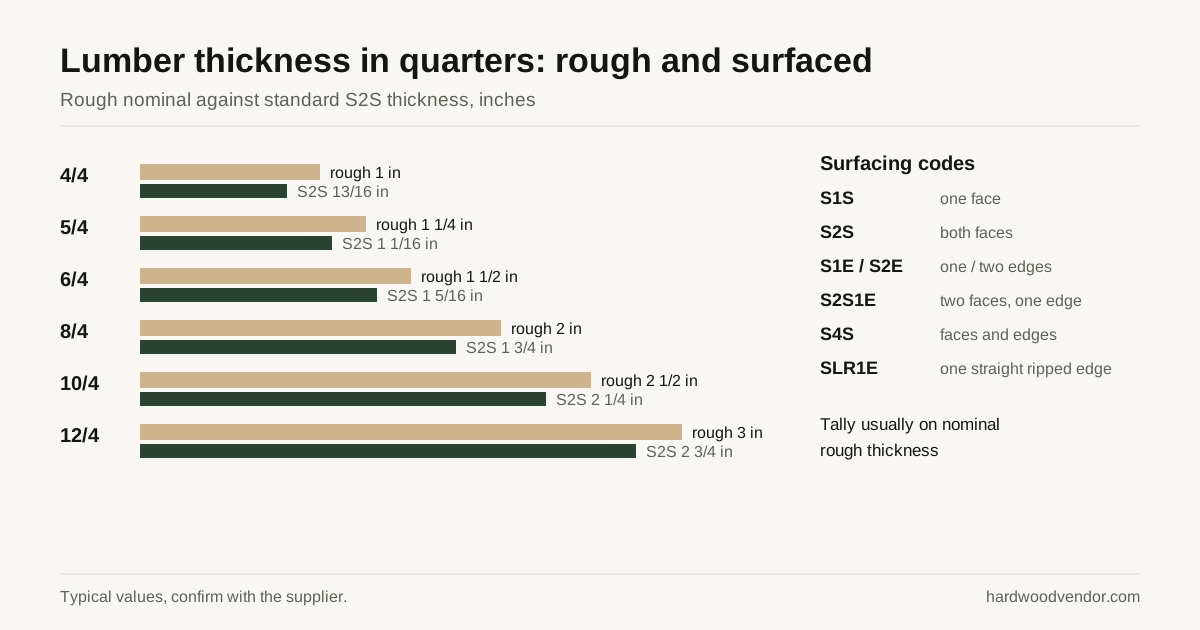
How the quarter system works
The quarter number is the rough thickness in quarter inches over four. It is a sawing target, not a finished size. American Hardwood Export Council material notes that most US hardwood lumber is sawn between 1 in and 2 in, so 4/4 to 8/4 is where the volume and the choice of grades are.
| Thickness | Typical availability | Typical uses |
|---|---|---|
| 4/4 | Every species and grade, the bulk of production | Cabinet doors, face frames, drawer parts, flooring, mouldings |
| 5/4 | Common | Stair risers, table aprons, parts that finish at a full 1 in |
| 6/4 | Common in the main species | Frames, thicker rails, some treads |
| 8/4 | Common in the main species, smaller grade choice | Legs, treads, thick tops, turning squares |
| 10/4 to 16/4 | Fewer suppliers, longer drying | Butcher block, newel posts, thick legs |
Thick stock takes much longer to dry, so mills saw it in smaller volumes. The NHLA species guides note, for example, that not every white oak supplier offers 10/4 and 12/4.
Rough, surfaced and the scant allowance
Rough lumber comes off the saw and the kiln. The Wood Handbook notes that it can run over target size by variable amounts, depending on the mill’s equipment. Kiln drying also shrinks it. AHEC gives a scant allowance for rough kiln dried lumber: boards specified 3/8 to 1 3/4 in may be 1/16 in scant of nominal, and 2 in and thicker may be 1/8 in scant.
Surfaced lumber has been planed. For S2S the standard table above applies. The S1S thickness is subject to contract agreement. When the width is specified, edged lumber (S1E or S2E) is typically 3/8 in scant of nominal width under 8 in wide and 1/2 in scant at 8 in and wider, according to the Wood Handbook.
That leads to a practical rule: order the thickness that leaves room for your own planing. A part that must finish at a full 1 in comes from 5/4, not 4/4. A 3/4 in part comes comfortably from 4/4 rough. If you buy S2S, check that the table size suits your part before you order.
Surfacing and edge codes
| Code | Meaning | Faces planed | Edges |
|---|---|---|---|
| RGH | Rough | None | Sawn or wane |
| S1S | Surfaced one side | One | Sawn or wane |
| S2S | Surfaced two sides | Both | Sawn or wane |
| S1E | Surfaced one edge | None | One planed |
| S2E | Surfaced two edges | None | Both planed |
| S1S1E | Surfaced one side, one edge | One | One planed |
| S2S1E | Surfaced two sides, one edge | Both | One planed |
| S1S2E | Surfaced one side, two edges | One | Both planed |
| S4S | Surfaced four sides | Both | Both planed |
| SLR1E | Straight line ripped one edge | As stated | One sawn straight |
| SLR2E | Straight line ripped two edges | As stated | Both sawn straight, parallel |
| SL2E (trade use) | Straight line two edges | As stated | Both sawn straight |
| GR (gang ripped) | Ripped to fixed widths | As stated | Both, to width |
The surfaced codes are listed in the Wood Handbook. Straight line rip and gang rip codes are trade usage and vary by mill, so define them on the order. Our guide to straight line rip and gang rip edge options covers when an edge is worth paying for.
Tally: nominal or surfaced
Board feet are normally counted on the nominal rough thickness, even when the lumber ships surfaced. AHEC describes the tally: widths rounded to the nearest whole inch (exact halves alternately up and down), lengths rounded down to the whole foot, thickness on the nominal basis. A 4/4 board planed to 13/16 in is still counted as 1 in thick.
Two quotes on the same 4/4 lumber can therefore differ by nearly 19% (13/16 against 1) if one counts surfaced size and the other nominal. Ask every supplier to state the basis. The NHLA measurement rules page explains surface measure and rounding, and board feet and hardwood pricing shows the effect on price.
Metric orders
Buyers who order in millimeters should name both the quarter and the metric size, and say whether the metric figure is rough or finished, and at what moisture. A European contract may set thickness at a reference moisture and allow for shrinkage. Our page on EN 1313-2 permitted deviations covers the European size rules.
| Metric order wording | What it can mean |
|---|---|
| 26 mm | 4/4 rough, slightly over 25.4 mm at the saw |
| 21 mm planed | 4/4 S2S at 13/16 in |
| 52 mm | 8/4 rough |
| 45 mm planed | 8/4 S2S, close to 1 3/4 in |
What to write on the RFQ
State the quarter, rough or surfaced code, the finished size if surfaced, the minimum thickness you can accept, the tally basis and the moisture. Then send your lumber RFQ and we pass it to up to 3 mills or yards that carry the thickness. The lumber grades hub links the grade rules that go with it, and the hardwood lumber terms glossary defines the other trade abbreviations.
RFQ line: Hard maple, FAS, 5/4 S2S to 1 1/16 in, SLR1E, KD 6-8%, tally on nominal 5/4, minimum net 1 1/32 in accepted, 2,000 BF.
Frequently asked questions
What does 4/4 mean in lumber?
It is the rough thickness in quarters of an inch: 4/4 is 1 inch, 5/4 is 1 1/4 inch, 8/4 is 2 inches. It is a rough sawn size. After planing on two sides a 4/4 board is typically 13/16 inch.
How much thickness do I lose when lumber is surfaced?
For hardwood surfaced two sides the usual rule is 3/16 inch off the nominal for lumber 1 1/2 inch and thinner, and 1/4 inch off for 1 3/4 inch and thicker. The Wood Handbook's standard table gives 13/16 inch for 4/4 and 1 3/4 inch for 8/4. Above 4 inches the finished size is set by contract.
Is surfaced lumber tallied on its surfaced size?
Usually not. In normal trade practice hardwood is tallied on the nominal rough thickness, so a 4/4 board planed to 13/16 inch is still counted as 1 inch thick. Say on the quote which basis applies.
What is the difference between S2S and S4S?
S2S is planed on both faces, with rough or sawn edges. S4S is planed on both faces and both edges, so it is ready to use at a fixed width. S4S costs more and loses width at the planer.
Sources
- USDA Forest Products Laboratory: Wood Handbook, FPL-GTR-190 (2010), Table 6-4 standard thickness of rough and surfaced (S2S) hardwood lumber, surfacing terms and abbreviations
- American Hardwood Export Council: how sawn hardwood lumber is measured (quarters, metric equivalents, surfaced thickness, scant allowance, tally)
- NHLA: grading rules and the four-year review cycle
Standards and rules are cited as references, not as claims about Hardwood Vendor or any mill. Editions and status change: confirm with the issuing body, your customs broker or the regulator.
Know what you need? Send the spec.
Tell us the species, grade, thickness and board feet. We pass it to up to 3 mills or yards that carry it and reply within 24 business hours.
Send my lumber RFQMore in lumber grades and size rules
- FAS Lumber: What the Firsts and Seconds Grade Allows
- NHLA Measurement Rules: Surface Measure, Board Feet and Tally Rounding
- Selects and F1F Hardwood Lumber: When One Clear Face Is Enough
- EN 1313-2: Permitted Deviations and Preferred Sizes for Hardwood Sawn Timber
- EN 13556 Timber Names: How to Read Trade Names and Codes on a European Quote
- Hardwood Flooring Stock Grades: NWFA and NOFMA Names, Lengths and the EN 14342 Note