Guides / Choosing a Supplier
Sending Hardwood Lumber Samples to Overseas Buyers: What, How Much, Who Pays
April 2, 2027
A buyer abroad cannot walk your yard, so a sample is the one thing in the process that is physically yours. It is also easy to get wrong in ways that cost you the order: a perfect board that does not match the lot, a box that sits in customs for weeks or a quote that nobody wrote down about who pays the courier. This guide is for the owner or export sales engineer of a sawmill, yard or dimension plant that sells hardwood lumber and is asked for samples by an overseas buyer. It covers what a sample has to prove, what to send, how to tag and pack it, which paperwork questions to ask and how to settle who pays.
It is general information as of October 2026, not legal or shipping advice. I found no public standard for sample size or sample charges in hardwood lumber, and no survey of who pays freight, so none is given. The sizes and sets below are suggestions, and your buyer’s own test decides what it needs.
What a sample has to prove
A buyer asks for a sample to settle one of three questions. Knowing which one tells you what to send.
| Buyer’s question | What it needs | What to send |
|---|---|---|
| Is this the species, color and figure I want? | Faces it can look at and compare against its own standard | Short pieces of the species and sort, rough or surfaced as the lot will be, both faces visible |
| Will it mill, glue and finish as I need? | A piece large enough to run through its machines and finish | Pieces cut from the lot at the thickness you sell, long enough to run through a planer and a rip saw |
| Is your stock as good as your quote says? | Evidence that the lot matches the grade, drying and tally in the offer | A sample set drawn from the actual lot, plus tally sample, moisture readings and photos |
Be honest with yourself about the third one. A sample is a few boards, and a grade is a property of each board. Our guide to NHLA lumber grades explains that the grade measures how much clear wood a board yields, so a handful of pieces shows what those pieces are, not what the next bundle holds. Tell the buyer how the pieces were chosen. A box of selected best boards sold as “typical” is the sample that comes back as a claim. For how to build evidence that supports a lot, see pre-shipment lumber grading.
How much to send
No published standard sets a sample size for hardwood lumber, so size it to the test. A practical way to decide:
- Ask first. One line to the buyer: what will you do with the sample and what size do you need? A cabinet shop testing a stain wants different pieces from a stair plant testing a rip yield.
- Send a set, not one board. Two or three pieces from different bundles of the lot show the range better than one. If the species is sorted by color, such as white maple against sap free walnut, include a piece at each end of the sort you offer.
- Cut to what the courier takes. Ask the courier for its length and weight limits before you saw anything. A long board that cannot travel helps nobody.
- Keep a twin set. Pack a second, identical set and keep it, labeled with the same numbers. When the buyer says piece 2 looks darker than the one it was shown, you can hold up the same piece. This is a suggestion, not a trade rule, but it removes the argument about what was sent.
If the buyer needs a quantity larger than a sample set to run a real trial, that is a trial order, not a sample. Say so and quote it as an order. Our guide to a mill’s first export order covers how to quote it.
Tag every piece and include a sample sheet
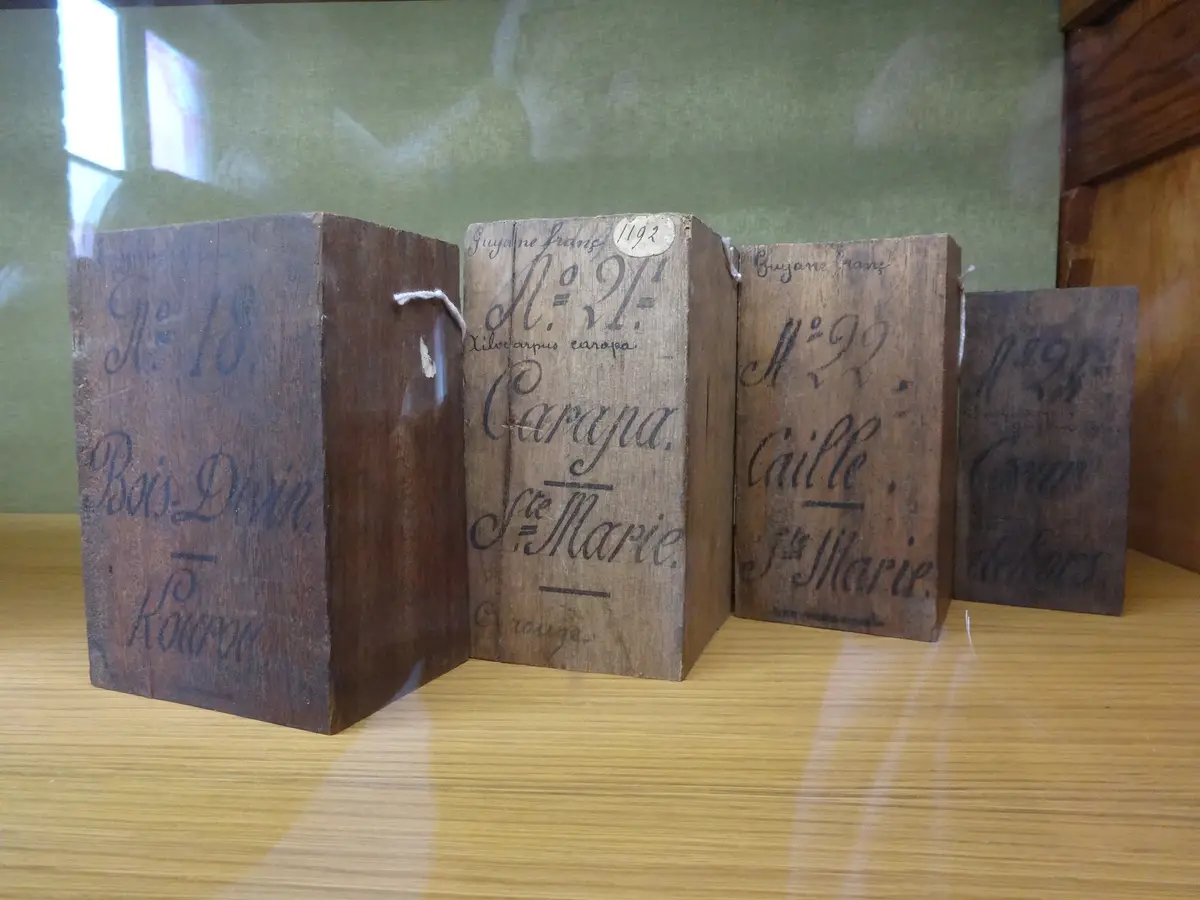
The wood in the photo above is a museum specimen, and it shows the principle: the identity is written on the piece. Do the same. Mark each piece with a number that matches a sheet inside the box.
| On the piece | On the sheet |
|---|---|
| Sample number matching the sheet | Species by botanical name |
| Species (short form) | Grade rule and grade, and the thickness in quarters |
| Which face is the better face | Surfacing: rough or the surfaced code |
| Lot or bundle number | Drying method and the moisture reading, with the meter, the species setting and the date |
| How the pieces were chosen: selected, typical or worst typical | |
| Country and region of harvest |
On thickness, the American Hardwood Export Council notes that the NHLA kiln dried rule allows rough kiln dried lumber to be scant of nominal thickness, by 1/16 in for 3/8 in to 1 3/4 in stock and by 1/8 in for 2 in and thicker. A sample cut from a bundle that follows that rule can measure a hair under the nominal thickness. Write the nominal and the measured thickness so the buyer does not take it for a short board. Add photos of the bundles the pieces came from, as described in our guide to lumber photos for buyers. If you hold drying charts, send a sample of the record as in kiln drying records hardwood buyers ask for.
Moisture will change in the box
Wood trades moisture with the air around it. A sample that read on target in your yard can gain or lose moisture over days in a box and a customs shed, and a buyer who measures it on arrival may see a different number. You cannot stop that, but you can control what the buyer is told:
- Measure and write the moisture reading on the day you pack, with the meter type and setting. See pin versus pinless lumber moisture meters for what that reading means.
- Wrap each piece, or the set, in plastic film inside the carton so the exchange with the air is slower.
- Tell the buyer to measure on opening and to compare with your sheet, and tell it the sample is not conditioned for a test that needs a stable moisture.
Packing, paperwork and customs
Check these three points before you choose the box.
Packing. A solid wood crate counts as wood packaging. APHIS says regulated wood packaging material entering the United States must be treated and certified under ISPM 15 and bear a compliant stamp. It lists some materials as not regulated, such as plywood, oriented strand board and laminated veneer lumber. It does not list corrugated cardboard, so I cannot tell you from that page whether it is exempt. Ask your courier or forwarder which packing the destination accepts. A cardboard carton avoids the wood packaging question where it is accepted.
Plant health. Rules differ by country and by wood. The Swedish Board of Agriculture says a phytosanitary certificate is nearly always required for timber from coniferous trees, and that rules for deciduous trees apply only to certain tree types from certain origin countries. I found no sample exemption for commercial lumber in the sources I opened. Ask the buyer to check with its plant health authority or broker, and see our page on the phytosanitary certificate for lumber exporters and the guide to phytosanitary and fumigation rules for the typical rules.
Legality data. For the United States, APHIS says the importer of record or its agent files the Lacey Act declaration, which carries the scientific name of the plant material and where it was harvested. Its “not regulated” disclaimer covers scientific specimens. A sample you send for a buyer to evaluate is a commercial item, and I found nothing that says it falls under that exemption, so do not assume it. Put the botanical name and the country and region of harvest on the sample sheet, so the buyer’s broker can answer whatever the entry needs. For EU buyers, ask what harvest data it wants for a sample. This is typical information, not legal advice.
Who pays: settle it before the box leaves
There is no public norm. What goes wrong is that nobody says anything, and the courier invoice arrives to a buyer who thought the sample was a courtesy. Agree three things in writing, even in two lines of email:
- Is the sample charged? Say yes or no. Do not leave it open.
- Who pays the courier? Common structures are the buyer’s own courier account, so you pay nothing for freight, or you ship and the buyer pays the invoice.
- Is the cost credited against a first order? If so, say what counts and for how long.
If you ship on your own account, think about the delivery term. The International Chamber of Commerce says under DAP the buyer handles and pays for import clearance, and under DDP the seller handles and pays for all customs formalities including import. It cautions that if the seller cannot or will not clear imports, or local rules prevent it, DAP is more suitable, and that if import authorities require a local importer to clear the goods DDP cannot be used. For a sample, the simplest route is usually the buyer’s courier account or a clear DAP, with the buyer clearing the import. Our guide to quoting hardwood lumber for export shows how the same rules apply to a container.
After the box leaves
- Send the tracking number and a photo of the packed box and the twin set the same day.
- Write down the date, what went in, the numbers and who received it, in the same place you keep RFQ replies. See why sawmills lose hardwood RFQs for what to log.
- Ask for the buyer’s result by a date and for what would count as a pass. A sample that gets no feedback is a sign to ask which row of the comparison sheet decided it.
- Treat the buyer’s measurements as data. If its moisture reading differs from yours, ask how it measured before you answer.
Talk to us
If you sell hardwood lumber and want buyer requests that name species, grade, thickness, drying and paperwork, so you know what a sample must prove before you cut one, see for suppliers. Tell us your species, grades, drying, tally basis and minimum order. Talk to us if you want to go through what a sample set should hold for your stock. We reply within 24 business hours and we make no promise of orders.
Sources
- American Hardwood Export Council, measurement: board feet, tally and the NHLA kiln dried rule
- USDA APHIS, Lacey Act declaration requirements for plant imports
- USDA APHIS, wood packaging material (ISPM 15)
- Swedish Board of Agriculture, trade with wood and wood products
- ICC Academy, Incoterms 2020: DAP or DDP
Frequently asked questions
What should a sawmill send as a hardwood lumber sample?
Send pieces cut from the lot you are offering, not from your best board, tagged with species, grade rule and grade, thickness, surfacing, drying and the moisture reading. Match the sample to what the buyer will test: a color and figure check needs a face, a machining or finishing test needs a piece big enough to mill. Ask the buyer which test it will run.
Does a lumber sample need a phytosanitary certificate?
It depends on the importing country and the wood. The Swedish Board of Agriculture says a certificate is nearly always required for timber from coniferous trees, while rules for hardwood apply only to certain tree types from certain origins. I found no general sample exemption for commercial lumber, so ask the buyer to check with its plant health authority before you ship.
Who pays for hardwood lumber samples?
I found no public survey of what mills charge or who pays freight, so there is no norm to quote. Settle three things in writing before you send: whether the sample is charged, who pays the courier and whether the cost is credited against a first order. Agree this before the box leaves the yard so nobody argues over it later.
Can I ship a lumber sample in a wooden crate?
A solid wood crate counts as wood packaging. The US Department of Agriculture's APHIS says regulated wood packaging entering the United States must be treated and certified under ISPM 15 and carry a compliant stamp. Other countries apply the same standard. Ask your courier or forwarder which packing the destination accepts before you choose a crate.
Know what you need? Send the spec.
Tell us the species, grade, thickness and board feet. We pass it to up to 3 mills or yards that carry it and reply within 24 business hours.
Send my lumber RFQ