Guides / Species
Choosing a Teak Lumber Supplier: Plantation vs Old Growth, Grades and Papers
January 22, 2027
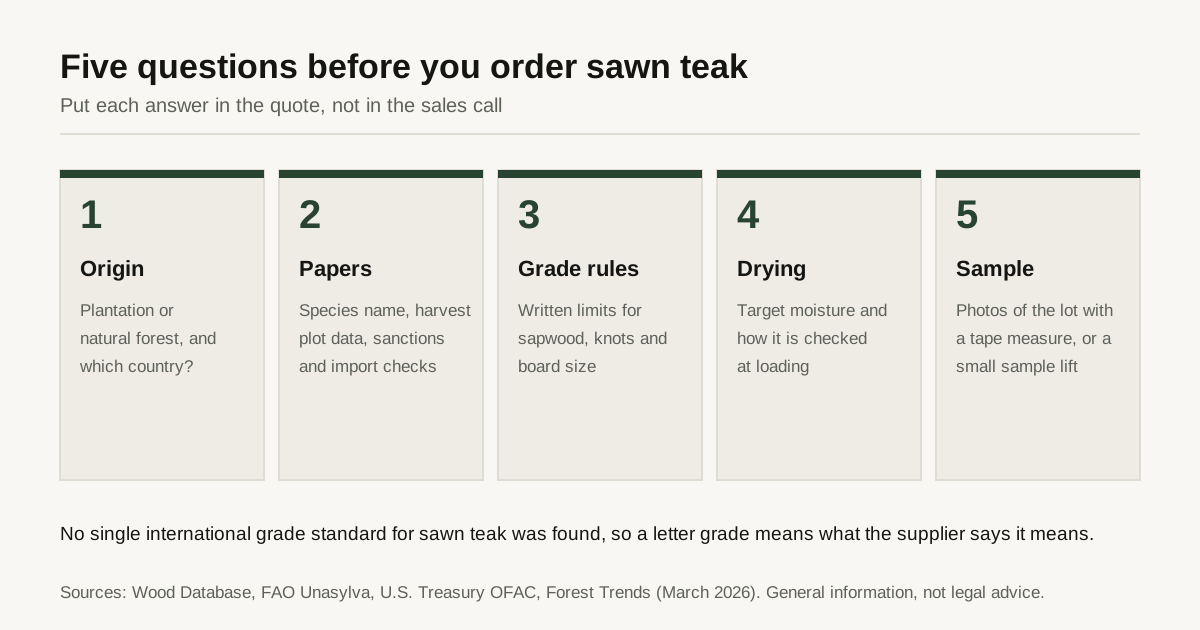
Teak lumber is sold under at least four different claims: plantation, natural forest, old growth and reclaimed. Each carries different legal and quality risks, and the grade letters on the quote do not settle them. To choose a supplier, ask where the logs grew, which papers travel with the lumber, what the grade limits are in writing and how the boards were dried. This guide sets out what the published sources say about plantation against natural teak, why Myanmar origin needs a sanctions check and what to put on the order.
This is general information as of October 2026, not legal advice. Sanctions, customs and timber rules change, so confirm them with a customs broker or counsel for your shipment.
What teak is and what it costs
The Wood Database describes teak (Tectona grandis) as golden to medium brown heartwood that darkens with age. It gives an average dried weight of 655 kg/m³ and a Janka hardness of 1,070 lbf, which is softer than the 1,350 lbf the Wood Database gives for white oak. Shrinkage is low: 2.6% radial, 5.3% tangential and 7.2% volumetric, green to oven dry. The heartwood is rated very durable and termite resistant, and the page calls it the gold standard for decay resistance. It also lists the working traits that matter on a shop floor. Silica up to 1.4% dulls cutting edges, and the natural oils leave surfaces greasy, so glued joints may need a solvent wipe first.
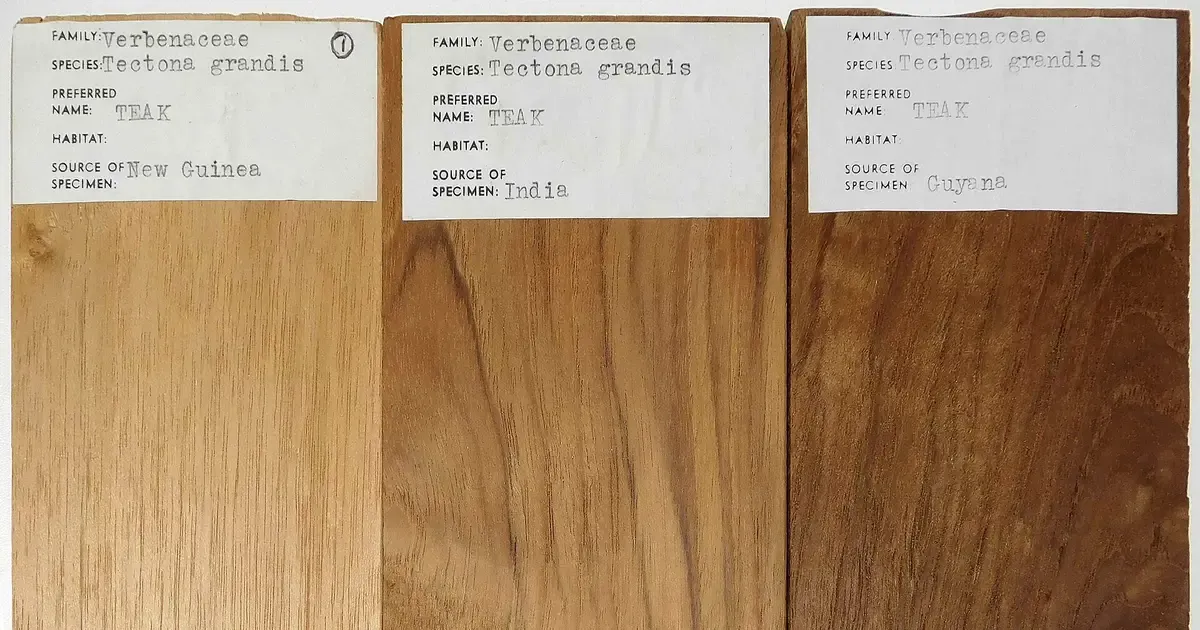
On price, the Wood Database calls teak one of the most expensive lumbers for large, plain boards. I found no current public price index for sawn teak, and the unit values in older FAO material are from the 1990s and are not a guide. Compare quotes on the same grade, thickness and delivery term. The photo above shows why a sample matters: three boards labelled as Tectona grandis from New Guinea, India and Guyana are visibly different in color.
Plantation against natural forest teak
The Wood Database says teak is widely grown on plantations across tropical Africa, Asia and Latin America, and that “Burmese teak” means naturally grown trees, typically from Myanmar. It adds that faster grown plantation wood tends to be more semi-ring-porous, while slower grown wild trees tend to be more distinctly ring-porous.
An older FAO review of teak trade and marketing, using data from the 1990s, gives a fuller picture of how buyers saw the two:
- Studies it cited found no significant overall strength difference between plantation and natural teak.
- Plantation teak is lighter in color and lower in hardness, especially in juvenile wood.
- Traders preferred natural teak for hardness, stability, an oilier texture and more uniform color.
- Plantation teak was priced lower, and some poor quality shipments from new African mills hurt the reputation of fast grown wood.
The FAO overview in Unasylva gives rotation lengths that explain the gap: natural forest selection systems run about 120 years, plantations inside the natural range 50 to 90 years and plantations outside it 40 to 60 years. It also says more research is needed on differences in timber properties between short rotation plantation teak and natural or long rotation stands. These are older sources. They tell you what to test, not what your supplier’s lot will be.
What to take from this: plantation teak is a normal, legal source for most buyers, and the quality range inside “plantation” is wide. Age at felling, thinning, the share of juvenile wood and sapwood and the sorting at the mill matter more than the word plantation. Ask for the felling age range, the plantation country and the sorting rules, and look at boards from the offered lot.
Myanmar origin and sanctions
Natural teak is tied to Myanmar in most trade talk, and that is where the legal risk sits. On 21 April 2021 the US Treasury’s Office of Foreign Assets Control designated Myanma Timber Enterprise (MTE), a state-owned enterprise under the Ministry of Natural Resources and Environmental Conservation, under Executive Order 14014. Property of designated persons in US hands is blocked, entities owned 50% or more by blocked persons are blocked too, and US persons’ transactions involving blocked property are prohibited unless authorized by license or exempt. The Wood Database notes that sanctions followed the February 2021 military takeover.
A Forest Trends briefing of March 2026 reports that importing countries had recorded over US$1.45 billion in forest product imports from Myanmar since the coup, up by more than US$185 million since mid-2024. It says sanctioning countries report minimal direct imports, that trade increasingly passes through China and that buying from third countries such as China, India and Thailand exposes importers and financial institutions to legal, financial and reputational risk.
For a buyer, that means a few rules:
- Treat “old growth” and “Burmese” offers as a document question first and a price question second.
- Ask for the chain of custody back to the felling, and who sold the logs.
- Do not accept a letter that only says the wood is not from Myanmar. Ask for plot or concession information.
- Let a sanctions-aware broker or counsel review any offer that touches Myanmar origin, directly or through a third country.
Other papers to expect
- EUDR. Sawn wood under heading 4407 is in scope, and the operator needs species, quantity, country of production and plot geolocation. Plantation teak can usually give plot data. See our guide to EUDR for hardwood lumber.
- Lacey Act. US imports of wood products can need a plant declaration naming species and country of harvest. See Lacey Act, FSC and legal timber papers.
- CITES. The Wood Database lists teak as not in the CITES Appendices. Check the botanical name against the current lists anyway, using our CITES timber guide.
- Tariffs. Per our Section 232 lumber guide, the tropical sawn wood subheadings that include teak are not on the CBP list of the 10% duty. Rates change, so ask your broker.
- Phytosanitary. See phytosanitary and fumigation rules.
Grades: there is no common ladder
I found no published international grading standard for sawn teak. Suppliers use their own names, such as premium, select, A, B and C, and each defines its limits in its own sheet. A letter on a quote tells you the seller’s order of quality, not a measured spec. Convert the letter to numbers before you buy:
| Item to specify | Why it matters |
|---|---|
| Sapwood allowance | Sapwood is paler than heartwood, and the durability rating applies to heartwood |
| Knots and pin holes | Size, number and whether they are sound |
| Minimum board width and length | Drives yield for your parts |
| Color sorting | Teak color varies by source and by board |
| Thickness, surfacing and tolerance | Rough, planed or sanded, and the allowance |
| Moisture and drying | Kiln dried to a stated target, checked on arrival |
| Defects | Shake, checks, end splits and end sealing |
| Tally and unit | Board feet or cubic meters, net or gross |
Our guides to kiln drying schedules, moisture meters and inspecting a delivery show how to check the last three rows.
Checks before you pick a supplier
- Where did the logs grow, and is it a plantation, with the country and felling age range?
- Which papers go with each shipment, and can they be shown before the deposit?
- Are the grade limits written, with photos of a typical lift and a tape measure in the frame?
- What is the moisture target and how is it measured at loading?
- Can you test a small sample lift against your own finish and glue?
Suppliers that answer these in writing are easier to compare. For the wider checklist, see how to choose a hardwood lumber supplier and the RFQ checklist. To put teak specifications in front of mills and yards that say they carry it, send your lumber RFQ with the origin claim, grade limits and papers you need. We pass it to up to 3 mills or yards that say they can supply it, and they reply to you directly.
Sources
- Wood Database, teak (Tectona grandis)
- Wood Database, white oak (Quercus alba), hardness comparison
- FAO Unasylva 201, Teak: a global overview
- FAO, trade and marketing of teak wood and products (older data, directional)
- U.S. Treasury, Treasury Sanctions Key Timber and Pearl Enterprises in Burma, 21 April 2021
- Forest Trends, update on international sanctions and Myanmar’s forest sector, March 2026
Frequently asked questions
Is plantation teak as good as old growth teak?
For many uses, yes, but it is not identical. An older FAO review found no significant overall strength difference, but plantation teak is lighter in color and lower in hardness, especially in juvenile wood, and traders prefer natural teak for stability and color. Match the grade and sapwood limits to the job.
Is teak a CITES listed species?
The Wood Database lists teak (Tectona grandis) as not in the CITES Appendices and not on the IUCN Red List. That does not remove other papers. Sanctions on Myanmar timber, EUDR data for the EU and Lacey Act declarations for the US can still apply, depending on origin and destination.
Can I still buy Burmese teak?
It is risky. The US Treasury designated Myanma Timber Enterprise in April 2021, which prohibits dealings by US persons unless licensed. Forest Trends reported in March 2026 that trade continues, increasingly through third countries. Ask a sanctions-aware broker or counsel before accepting any Burmese or old growth claim.
What grade names are used for sawn teak?
There is no single international grade standard for sawn teak that I could find. Suppliers use their own labels such as premium, select or A, B and C, each with its own limits. Ask for written limits on sapwood, knots, board size and color sorting, with photos of a typical lift.
Know what you need? Send the spec.
Tell us the species, grade, thickness and board feet. We pass it to up to 3 mills or yards that carry it and reply within 24 business hours.
Send my lumber RFQ